Arsenal Defeats Atletico Madrid 1-0 in UEFA Champions League Semi-Final
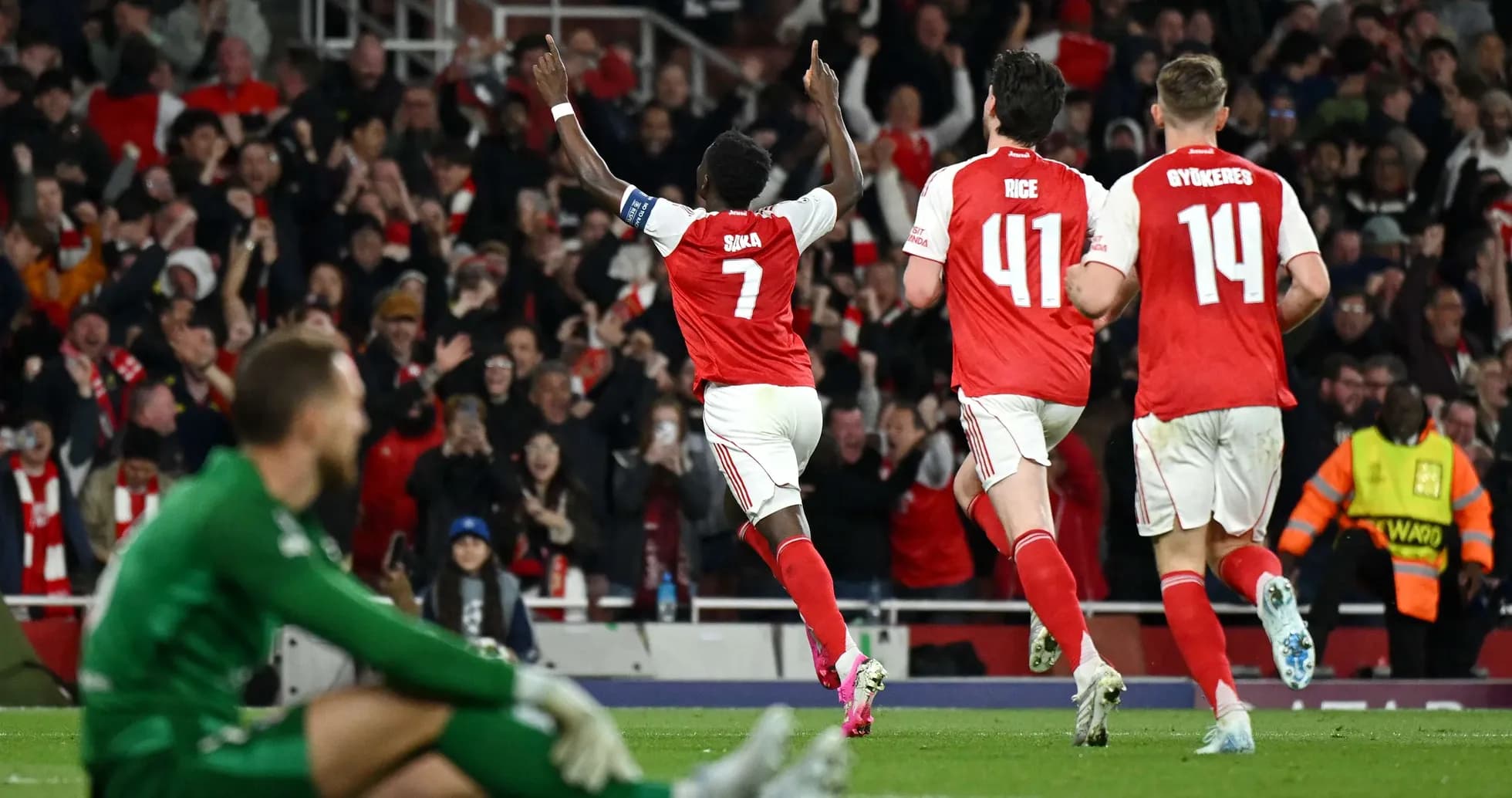
Arsenal edged a narrow 1–0 win over Atletico Madrid at Emirates Stadium in this UEFA Champions League semi-final, built on territorial control and one decisive first-half action. Mikel Arteta’s 4-2-3-1 out-possessed Diego Simeone’s 4-4-2 (54% to 46%), generated the higher xG (1.58 to 0.53) and managed the game state maturely after Bukayo Saka’s 44' winner. Atletico’s reshaped front line after the hour pushed the hosts deeper, but Arsenal’s defensive structure, anchored by William Saliba and Gabriel, limited clear chances, with David Raya required for only two saves against Jan Oblak’s one at the other end.
The disciplinary and scoring narrative began unusually before kick-off. At -5', Kepa Arrizabalaga, unused Arsenal substitute goalkeeper, received a yellow card for time wasting, a rare pre-match sanction that nonetheless framed the referee Daniel Siebert’s low tolerance for game-management tricks. The only goal arrived at 44', when B. Saka struck for Arsenal. With no VAR intervention listed, the goal stood immediately and defined both the halftime and full-time scorelines: 1–0 to Arsenal at the break and at the final whistle.
Second Half
The second half was dominated by substitution-driven tactical adjustments. At 57', Atletico executed a triple attacking reshuffle: A. Sorloth (IN) came on for R. Le Normand (OUT), N. Molina (IN) came on for A. Lookman (OUT), and J. Cardoso (IN) came on for G. Simeone (OUT). Simeone effectively moved from a back four towards a more aggressive, hybrid back three / wing-back structure, sacrificing a centre-back and a wide midfielder to add a striker and an attacking full-back, while Cardoso provided fresh legs in midfield.
Arteta responded almost immediately. At 58', N. Madueke (IN) came on for B. Saka (OUT), and P. Hincapie (IN) came on for R. Calafiori (OUT), refreshing the right wing and left-back positions. One minute later, at 59', M. Odegaard (IN) came on for E. Eze (OUT), shifting Arsenal’s No.10 role from a more dribble-oriented profile to a controller capable of longer possession spells under pressure.
At 66', Atletico’s second wave of changes further increased their attacking threat: A. Baena (IN) came on for A. Griezmann (OUT) and T. Almada (IN) came on for J. Alvarez (OUT). Griezmann and Alvarez were replaced by two creative, mobile attacking midfielders, suggesting a tilt towards combination play between the lines rather than classic strike-pair movements.
Arsenal’s next adjustment came at 74', when M. Zubimendi (IN) came on for M. Lewis-Skelly (OUT), adding positional discipline in the double pivot alongside D. Rice to protect the central lane as Atletico pushed numbers forward. The final Arsenal change arrived at 83', with G. Martinelli (IN) coming on for L. Trossard (OUT), injecting direct counter-attacking pace on the left to exploit Atletico’s advanced full-backs.
Atletico’s increasing frustration surfaced in the late disciplinary incidents. At 81', Marc Pubill received a yellow card for a foul, reflecting the risk in his aggressive overlapping and counter-pressing role after the system change. Deep into stoppage time, at 90+5', Koke was also booked for a foul, underlining Atletico’s late-game urgency and tactical fouling to stop transitions. Across the match, Arsenal collected one yellow (Kepa Arrizabalaga, time wasting) and Atletico two (Marc Pubill, Koke, both for fouls).
Tactical Analysis
Tactically, Arsenal’s 4-2-3-1 was about controlled aggression in possession and compactness without the ball. With 444 passes at 85% accuracy, they used D. Rice and M. Lewis-Skelly initially, then Zubimendi, to create a secure double pivot. Rice often dropped between Saliba and Gabriel in the first phase, allowing full-backs B. White and R. Calafiori to push higher. This created a 2-3-5 in attack, with Saka and Trossard wide, Eze between the lines, and V. Gyökeres as the focal point.
The shot profile (13 total shots, 6 inside the box, 7 from range) shows a balanced approach: Arsenal were able to enter the area but were also forced to take several efforts from distance against Atletico’s typically deep block. Their xG of 1.58 indicates that Saka’s goal was supported by a handful of other decent-quality openings, even if Oblak was called into only one official save. Atletico’s defensive line, with R. Le Normand and D. Hancko centrally and M. Ruggeri and Pubill wide, generally protected the most dangerous zones but struggled to fully suppress Arsenal’s right-sided combinations before the interval.
After Saka’s withdrawal, Madueke’s entrance preserved the one-v-one threat on the right but with fresher legs, while Odegaard’s arrival shifted the focus to tempo control rather than direct penetration. Zubimendi’s later inclusion tightened Arsenal’s Defensive Index: they reduced central spaces, dropped the block a few metres deeper, and accepted longer Atletico possession phases in exchange for protecting the area in front of Raya. The goalkeeper’s two saves, combined with a goals-prevented figure of 0.02, underline that Arsenal’s defensive work was more about shot suppression than spectacular last-ditch interventions.
Atletico’s 4-4-2 morphing into a more attacking structure after 57' aimed to tilt the game’s Overall Form in their favour. With Sorloth joining the front line and later Baena and Almada operating between the lines, they improved their territorial presence and ended with 9 total shots (7 inside the box). However, the quality of those chances, reflected in an xG of just 0.53, shows that Arsenal largely forced them into crowded or suboptimal shooting positions. Raya’s modest goals-prevented value (0.02) and Oblak’s identical figure emphasize that this semi-final was decided more by structural control and a single moment of first-half precision than by goalkeeping heroics.
Statistically, Arsenal’s 54% possession, superior pass volume (444 vs 384) and marginally better pass accuracy (85% vs 83%) aligned with the eye-test of a side comfortable managing a one-goal lead. Atletico committed more fouls (13 to 10) and received more yellows (2 to 1), reflecting their increasing desperation and higher defensive risk as they chased the tie. Both goalkeepers finished with low save counts (Raya 2, Oblak 1), consistent with the xG profile: Arsenal created the better chances but not in overwhelming volume, while Atletico’s late pressure never truly translated into clear-cut opportunities.
In synthesis, Arsenal’s Overall Form on the night was defined by controlled possession, a well-timed first-half breakthrough, and intelligent game-state management via substitutions. Their Defensive Index was strong: a compact block, effective central protection from Rice and his partners, and limited reliance on Raya. Atletico’s structural changes and aggressive second-half approach shifted the rhythm but not the underlying shot quality, leaving them short of the incision needed to overturn Saka’s decisive 44' strike.