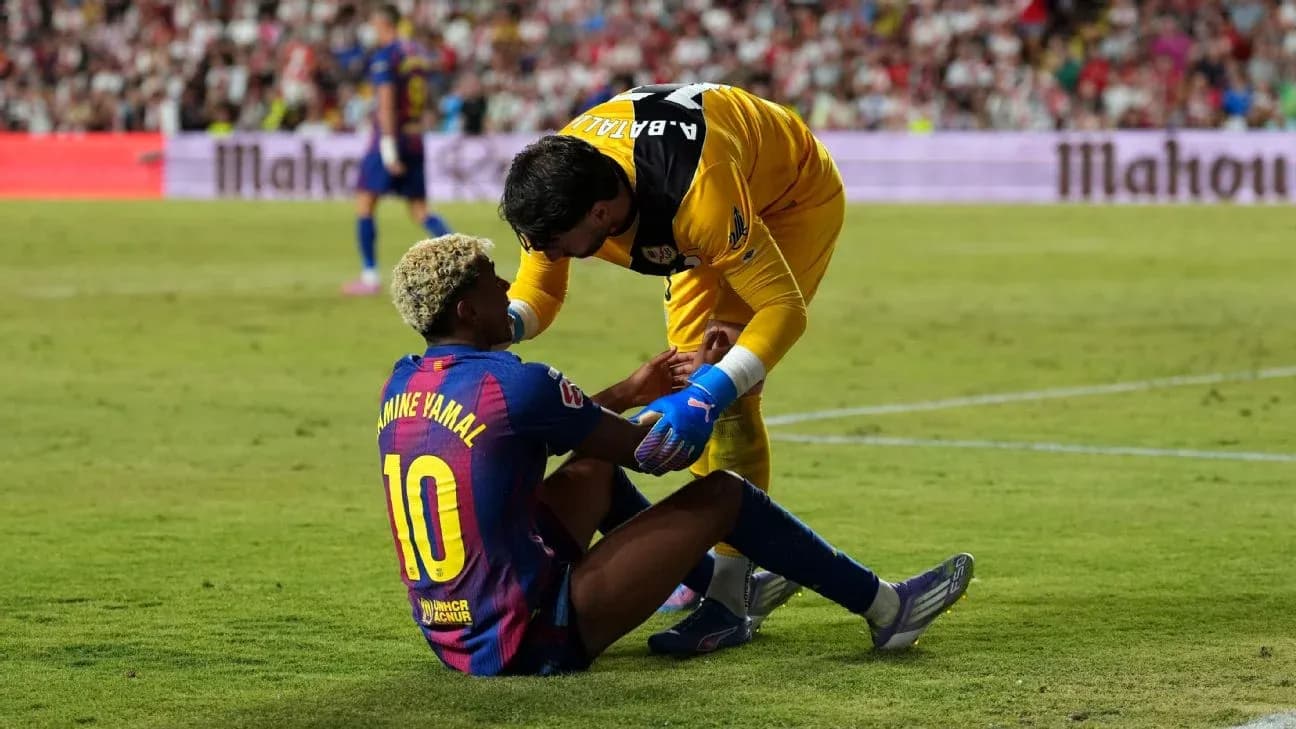
Barcelona Edges Rayo Vallecano 1–0 in Tightly Contested Match
At Camp Nou, Barcelona edged Rayo Vallecano 1–0 in a tightly contested La Liga regular-season match (Round 29), decided by Ronald Araujo’s 24' header. The game was defined by Barcelona’s territorial control and structured 4-2-3-1 possession against Rayo’s disciplined 4-2-3-1 mid-to-low block and strong set-piece threat. Despite Barcelona having 61% possession and more overall shots (15 to 8), the xG balance (1.39 vs 1.56) underlined how Rayo carved out chances of similar, if not slightly better, quality. Ultimately, Barcelona’s early set-piece efficiency and stable defensive structure in open play outweighed Rayo’s late pressure and volume of corners.
Scoring Sequence & Disciplinary Log
The decisive moment arrived in the 24th minute. From a right-sided delivery, J. Cancelo’s service found R. Araujo, who attacked the ball aggressively to score the only goal of the match for Barcelona. The sequence encapsulated Barcelona’s early superiority in territory and their ability to exploit Rayo’s zonal structure on dead balls.
The card sequence began very early. At 8', Raphinha received a yellow card for a foul, an early warning that Barcelona’s counter-pressing aggression carried disciplinary risk. At 26', Lamine Yamal was also shown a yellow card for a foul, reflecting the intensity of Barcelona’s attempts to immediately regain possession after turnovers.
Rayo’s first booking came at 34', when Óscar Valentín received a yellow card for a foul, signaling the cost of repeatedly stepping out from the double pivot to disrupt Barcelona between the lines. In the second half, Fran Pérez was cautioned at 65' for a foul, followed by Pathé Ismaël Ciss at 67', again for a foul, as Rayo’s back line and pivots increasingly resorted to contact to stop transitions.
Barcelona’s final booking came at 72', when Pau Cubarsí was shown a yellow card for a foul, underlining the growing pressure Rayo exerted as they pushed higher. At 88', Isi Palazón received Rayo’s fourth yellow card for a foul, capping a match where both sides’ intensity without the ball translated directly into disciplinary action. No red cards were issued, and there were no VAR interventions recorded in the event log.
Tactical Breakdown & Personnel
Both teams lined up in a 4-2-3-1, but the match evolved as a contrast between Barcelona’s structured possession and Rayo’s direct, vertical interpretation of the same base shape.
For Barcelona, J. Garcia in goal had 4 saves, indicating that while Rayo created chances, Barcelona’s defensive line limited clear-cut central looks. The back four of J. Cancelo, R. Araujo, P. Cubarsi and G. Martin had distinct roles: Cancelo advanced aggressively on the right, often forming a three-plus-one structure in buildup with Araujo and Cubarsi, while Martin balanced on the left, providing width but with more positional restraint. Araujo, beyond scoring, anchored the back line against I. Palazón’s movements and Rayo’s crosses, while Cubarsi’s yellow card at 72' reflected his involvement in duels as Rayo pushed late.
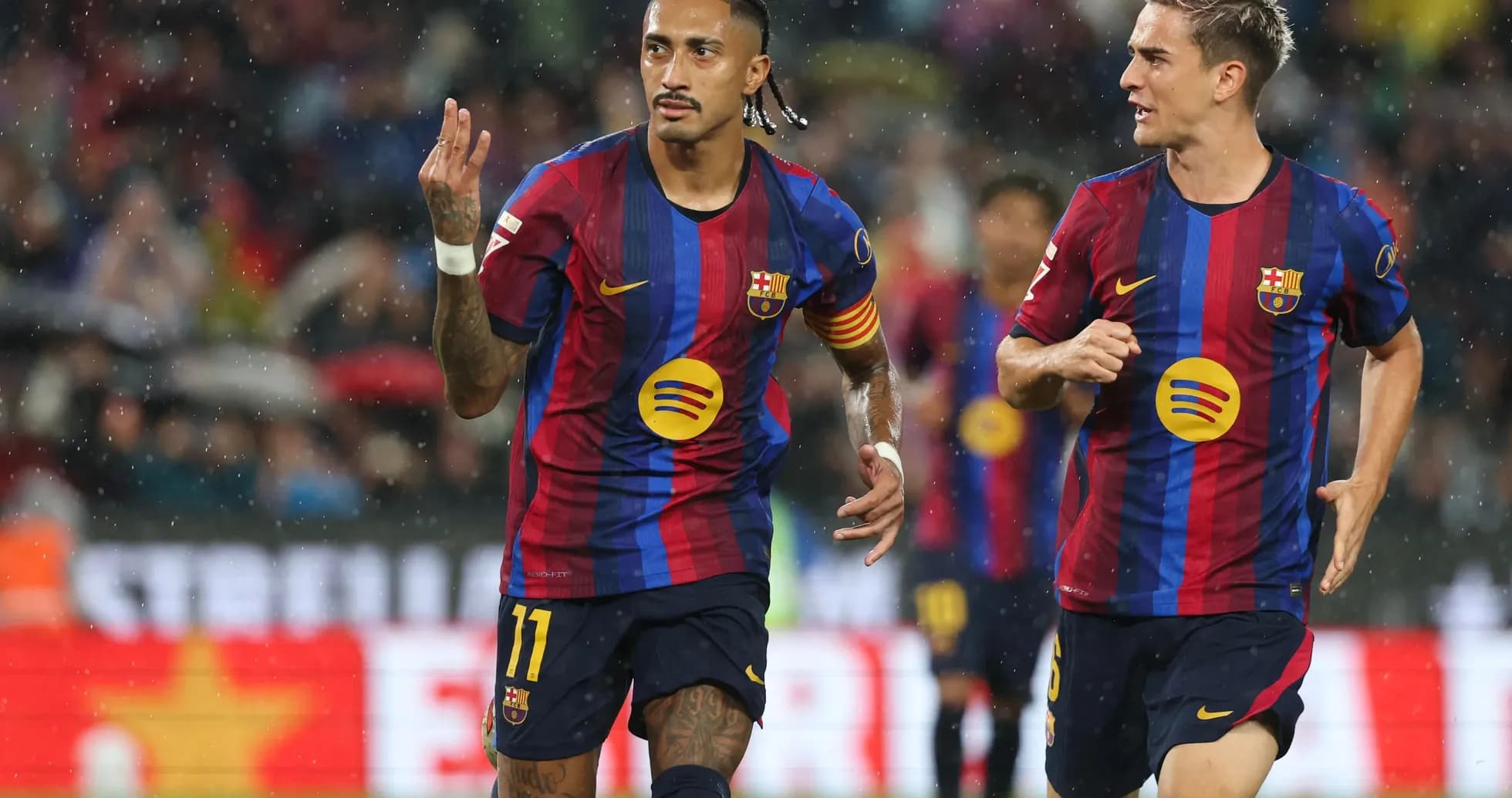
In midfield, M. Bernal and Pedri operated as the double pivot. Bernal provided the deeper stabilizing presence, often dropping between or beside the centre-backs to facilitate progression, while Pedri connected to the advanced trio, receiving between Rayo’s lines. Ahead of them, the line of three – Lamine Yamal on the right, Fermín centrally, Raphinha left – constantly rotated positions. Lamine Yamal’s early booking did not blunt his willingness to receive wide and drive inside, while Raphinha’s yellow at 8' showed how early he was involved in counter-pressing. Fermín worked as the connector, attacking the half-spaces and making third-man runs beyond R. Lewandowski.
Lewandowski, as the lone striker, occupied the centre-backs, dropping off to link play and open channels for wide runners. At 46', F. Torres (IN) came on for R. Lewandowski (OUT), slightly changing the profile of the front line towards more mobility and depth runs rather than pure reference play. Later, at 61', D. Olmo (IN) came on for Fermín (OUT), adding a more creative, associative presence in the central pocket, while at the same minute M. Casado (IN) replaced M. Bernal (OUT), refreshing the pivot with fresh legs for the final half-hour. At 82', M. Rashford (IN) replaced Lamine Yamal (OUT), adding vertical threat in transition. Finally, at 90', X. Espart (IN) came on for J. Cancelo (OUT), a clear late-game adjustment to secure the right flank defensively.
Rayo Vallecano’s 4-2-3-1 under Inigo Perez was more reactive but dangerous in moments. A. Batalla in goal faced 4 shots on target and made 3 saves; with Rayo registering 0 goals prevented as a team, the decisive Araujo header was more about defensive organization than goalkeeping error. The back four of A. Ratiu, F. Lejeune, Pathé Ismaël Ciss and P. Chavarría had to manage large horizontal distances due to Barcelona’s width. Ciss, nominally a defender, picked up a yellow at 67', reflecting his dual role as both stopper and first distributor from the back.
In midfield, P. Diaz and Óscar Valentín formed the double pivot, tasked with screening the central lane and tracking Fermín and Pedri. Valentín’s yellow at 34' came from one of several interventions stepping into Barcelona’s half. Ahead, C. Martin, G. Gumbau and Fran Pérez supported Isi Palazón. Their structure shifted between a compact 4-4-2 without the ball and a more fluid 4-2-3-1 in possession, with Palazón drifting wide or dropping to receive.
Rayo’s substitutions significantly altered the attacking dynamic. At 46', A. Garcia (IN) came on for C. Martin (OUT), and Pacha (IN) replaced O. Valentin (OUT), giving more thrust on the left flank and fresh legs in midfield. At 59', U. Lopez (IN) replaced G. Gumbau (OUT) and J. de Frutos (IN) came on for P. Diaz (OUT), injecting creativity and wide 1v1 ability. At 82', S. Camello (IN) replaced F. Perez (OUT), adding a true penalty-box presence alongside or around Palazón. These changes coincided with Rayo’s late territorial push, reflected in their 9 corner kicks and 7 shots inside the box.
Defensive resilience was high on both sides: Barcelona saw 5 of their shots blocked, while Rayo Vallecano had 1 attempt stifled by the opposition. Barcelona’s back line, especially Araujo and Cubarsi, managed Rayo’s aerial and cutback threats well despite the volume of set plays.
The Statistical Verdict
The statistical profile underlines a narrow, finely balanced contest. Barcelona’s 61% possession and 483 total passes at 86% accuracy show a controlled, possession-oriented approach. Rayo’s 39% possession and 296 passes at 76% accuracy reflect a more direct, opportunistic style that nevertheless produced slightly higher xG (1.56 to Barcelona’s 1.39).
Both sides recorded 4 shots on target, but Barcelona generated more total volume (15 shots to 8), while Rayo concentrated their attempts in more central, box-oriented locations (7 shots inside the box). The fact that both teams finished with 0 goals prevented highlights that the 1–0 scoreline was more about finishing and set-piece execution than extraordinary goalkeeping overperformance.
Barcelona’s 12 fouls and 3 yellow cards versus Rayo’s 11 fouls and 4 yellows illustrate a match of high intensity but controlled aggression. Ultimately, Barcelona’s early set-piece goal, stable defensive structure, and ability to manage Rayo’s late surge, especially across 9 opposition corners, justified the narrow home win despite the xG suggesting a result that could easily have been different.