Barcelona’s New Front Three Outperform Guardiola’s Record
Hansi Flick has not just tuned up Barcelona’s attack. He has detonated it.
Sixteen games into the 2026/27 campaign, Barça have already rattled in 62 goals across all competitions. Forty-eight of those have come in LaLiga, another 14 in the Champions League. That’s an attack running at almost four goals a game, a tempo that feels closer to a basketball scoreline than a football tally.
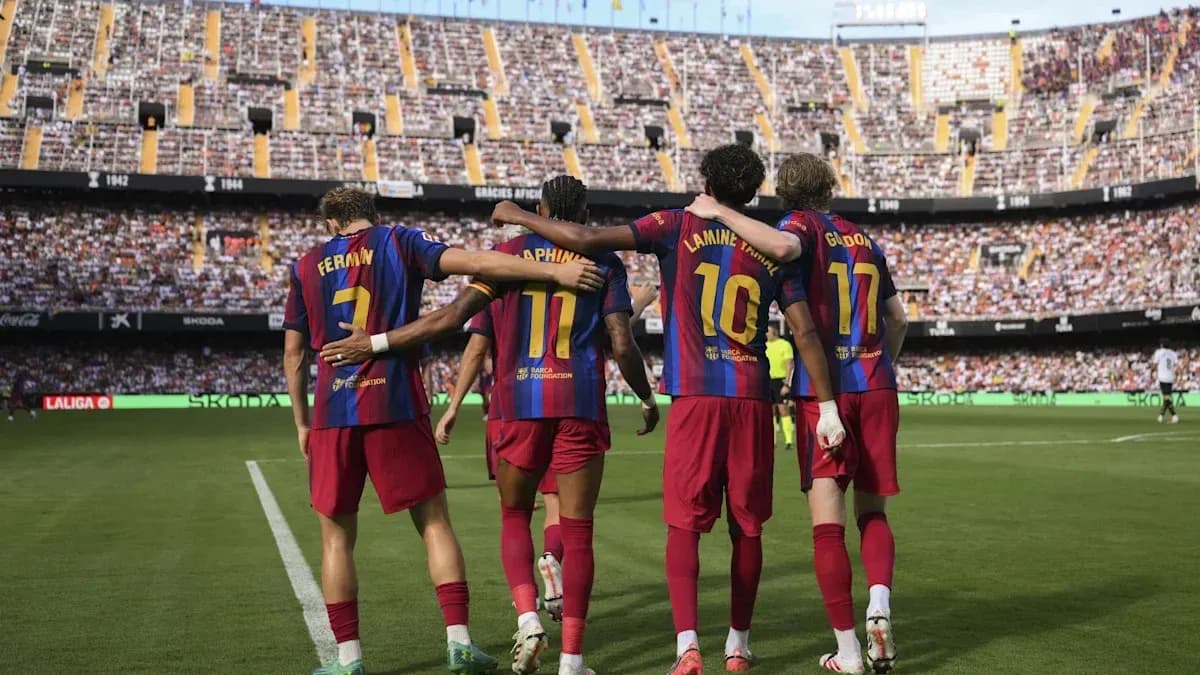
And at the heart of it all, a trio that nobody would have picked as the club’s new superstructure a couple of years ago: Raphinha, Lamine Yamal and Fermin Lopez.
A start that outstrips Guardiola’s record-breakers
To understand how wild this pace is, you have to drag out the heaviest comparison possible in Barcelona terms: Pep Guardiola’s 2011/12 side.
That team, with Lionel Messi at his most ruthless, set a historic club record of 190 goals in 64 matches. Yet after 16 games of that season, they still sat 14 goals behind where Flick’s side are now. This Barça are not just echoing a golden era; they are sprinting ahead of its early markers.
The difference lies in the spread of responsibility. There is no single Messi figure. Instead, three players have taken on the burden and turned it into a shared weapon.
Between them, Raphinha, Yamal and Fermin have had a hand in 50 of Barcelona’s 62 goals so far, either scoring or assisting. That is not a supporting cast. That is the show.
Their combined scoring alone is staggering: 32 goals in LaLiga, 40 in all competitions. Those are the numbers of an entire frontline, but they belong to three specific names who are defining the way Flick’s team attacks.
Raphinha leads the charge with 19 goals across all competitions. Yamal, still a teenager but already playing with a veteran’s calm, has 13. Fermin, the late-blooming midfielder forcing his way into the conversation, has eight. In league play, the breakdown is just as sharp: 15 for Raphinha, 10 for Yamal, seven for Fermin.
The output is not padded. It is relentless.
Outgunning Europe’s elite
The raw numbers are impressive on their own. They become something else entirely when you line them up against Europe’s biggest clubs.
In LaLiga, Barcelona’s trio have 32 league goals between them. Real Madrid’s main attacking contributors cannot live with that pace. Kylian Mbappe sits on 13, Jude Bellingham on four, Yan Diomande on three. Add them together and they still fall well short of what Raphinha, Yamal and Fermin have produced.
Look to Germany and the picture is similar. Bayern Munich’s attacking options – Michael Olise, Harry Kane, Luis Diaz – bring heavyweight reputations and serious scoring power. Yet as a collective, they still trail the combined output of Barcelona’s three across all competitions at this stage.
This is no local purple patch. On current form, Flick’s front combination is one of the most productive in Europe.
Flick’s blueprint: clarity and risk
The structure around them matters. Flick has not stumbled onto this; he has committed to it.
Yamal owns the right flank, stretching defences, attacking full-backs, and opening lanes inside. Raphinha, once seen primarily as a winger, has been repurposed as a false nine, constantly dropping, dragging centre-backs into uncomfortable zones, then arriving in the box at the right moments to finish moves. Fermin pushes on from midfield, timing his runs, attacking the half-spaces, and arriving as the extra man that opponents fail to track.
It is a front three by function, not by traditional positioning, and it has given Barcelona a clear attacking identity. Quick combinations, vertical movements, and a constant stream of runners into the box. When it clicks, it overwhelms teams.
Fermin’s rise has been one of the most striking elements of this evolution. At the start of the season, Dani Olmo looked like the natural lock for that advanced midfield role. His injury, though, opened a door. Fermin did not just walk through it; he tore it off the hinges.
His performances have turned what could have been a short-term patch into a genuine selection battle. Every goal, every late run, every sharp touch in the final third has strengthened his claim to start on merit, not just necessity.
Olmo’s absence could have disrupted Barcelona’s rhythm. Instead, it has helped sharpen the edge of Flick’s attack.
A machine that doesn’t feel mechanical
The most striking aspect of this Barcelona side is that, for all the staggering numbers, they do not feel like a sterile, system-first machine. There is structure, yes, but there is also chaos in the right areas of the pitch.
Yamal’s daring on the ball, Raphinha’s aggression between the lines, Fermin’s surges from deep – these are not pre-programmed patterns so much as instincts given a clear framework. Flick has given his key attackers zones, roles and reference points, then trusted their decisions.
Right now, the evidence is brutal for opponents: 62 goals, three main protagonists, and very few signs that defences have worked out how to slow them down.
Defensive questions will come later in the season. They always do. For the moment, Barcelona’s attack is not a problem to solve. It is the answer.