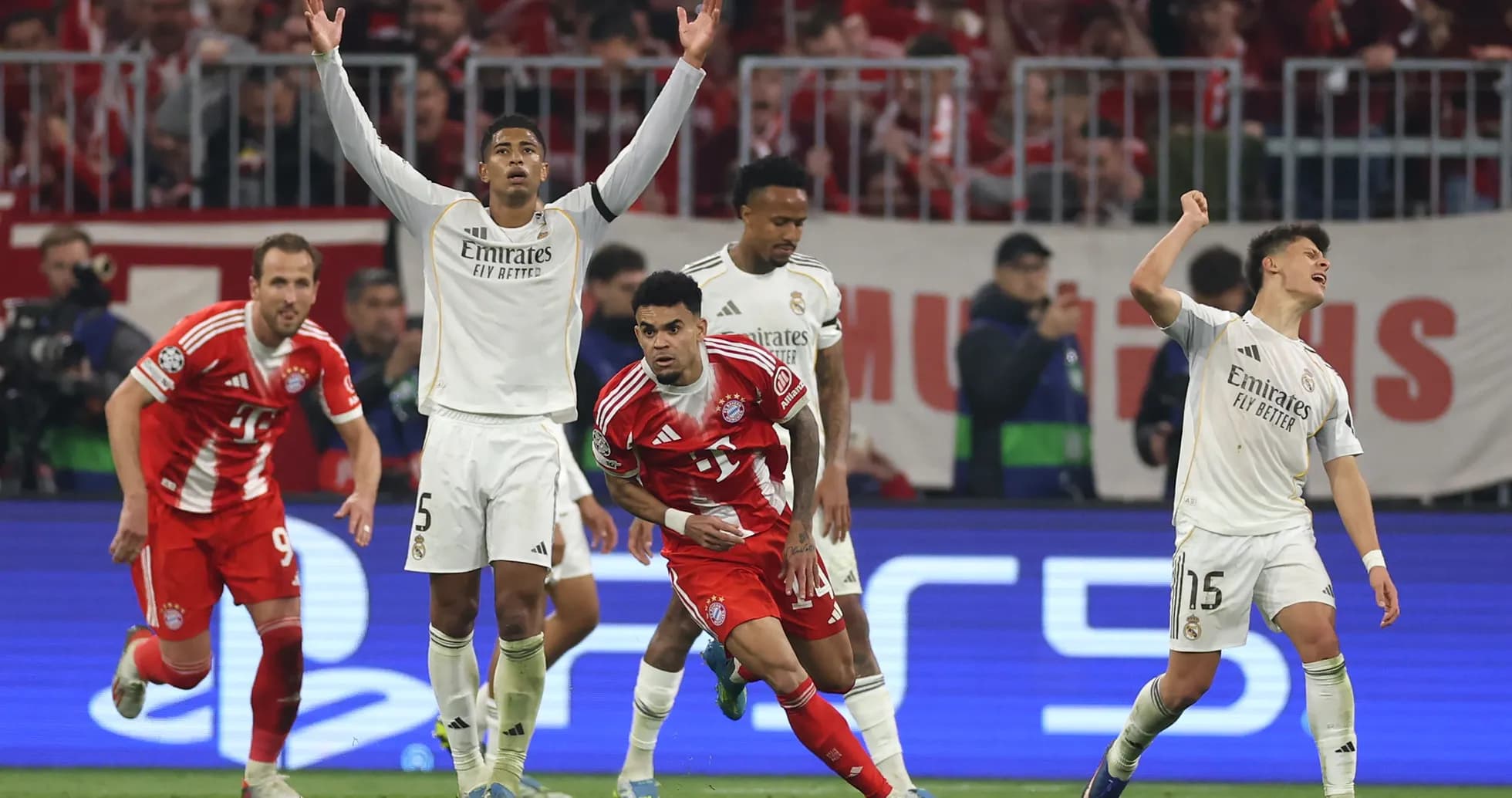
Bayern München's Tactical Mastery in 4-3 Win Over Real Madrid
Bayern München’s 4-3 comeback over Real Madrid at the Allianz Arena in this UEFA Champions League quarter-final first leg was defined by structural control versus transition threat. Bayern’s 4-2-3-1, built on territorial dominance and high possession, eventually overwhelmed a Real side that began in a 4-4-2 and lived off early vertical punches and individual brilliance, before discipline and fatigue eroded their defensive platform. The late surge, catalysed by Jamal Musiala and Alphonso Davies, turned a high-level tactical duel into a statement of Bayern’s collective resilience and Real’s fragility once reduced to ten men.
The scoring opened instantly: at 1', Arda Güler drifted into a pocket from Real’s right-sided midfield lane and finished a “Normal Goal” to punish Bayern before their structure had settled. Bayern’s response was textbook: at 6', Aleksandar Pavlović arrived from the double pivot, fed by Joshua Kimmich, to level with a composed strike. The pattern of the half became clear—Bayern circulating and pinning, Real waiting to spring.
Discipline first surfaced at 29', when Josip Stanišić received a yellow card for “Argument”, a sign of Bayern’s frustration with Real’s disruptive tactics and the referee’s management of contact. Seconds later at 29', Güler struck again with another “Normal Goal”, exploiting Bayern’s high line and the space between the centre-backs and Kimmich–Pavlović shield. Bayern stayed on script: at 38', Harry Kane equalised, assisted by Dayot Upamecano, attacking the box as Bayern loaded the central lane with numbers.
Real’s edge in transition reappeared at 42', when Kylian Mbappé, assisted by Vinicius Junior, finished a rapid move for 3-2, again a “Normal Goal” born from Bayern’s advanced full-backs and the vulnerability of their rest defence. At 40', Éder Militão’s yellow card for a “Foul” underlined Real’s willingness to accept bookings to slow Bayern’s rhythm. Half-time arrived with Real 3-2 up, despite Bayern’s territorial superiority.
Second Half
The second half’s tactical turning point came immediately. At 46', Bayern adjusted their left flank: Josip Stanišić (OUT) left, Alphonso Davies (IN) came on. This shifted Konrad Laimer’s responsibilities and gave Bayern a true overlapping threat on the left, pushing Real’s wide block deeper and stretching their 4-4-2 horizontally.
On 61', Bayern injected creativity between the lines: Serge Gnabry (OUT) departed, Jamal Musiala (IN) entered. Musiala’s role as a high “10” and half-space dribbler increased Bayern’s ability to break Real’s second line and commit centre-backs. Real responded at 62' with a more conservative, ball-retentive midfield: Brahim Díaz (OUT), Eduardo Camavinga (IN). The idea was to stabilise possession and help protect the back four under growing pressure.
Discipline then began to unravel for Real. At 70', Antonio Rüdiger was booked with a yellow card for “Argument”, reflecting rising emotional tension as Bayern’s waves of attack intensified. Camavinga, asked to cover huge distances, lost composure: at 78' he received a yellow card for a “Foul” as he tried to break up another Bayern progression. The decisive collapse came at 86', when Camavinga was booked again for “Time wasting” and immediately shown a red card for the same “Time wasting” incident. Real were reduced to ten, forced into a deep, emergency block without the legs in midfield to counter-press.
Bayern’s structural superiority, already visible in the numbers—69% possession, 640 passes at 88% accuracy, and 21 total shots (15 inside the box)—now had numerical superiority to match. Real, with only 31% possession and 294 passes at 78% accuracy, could no longer relieve pressure effectively.
The bench then decided the tie’s narrative. At 89', Luis Díaz scored a “Normal Goal”, assisted by Jamal Musiala, making Bayern’s left side the decisive zone. Davies’ width and Musiala’s inside drifts forced Real’s right flank to collapse inward, freeing Díaz to attack the half-space and box. Real tried late fresh legs: at 90', Arda Guler (OUT) made way for Franco Mastantuono (IN), and Trent Alexander-Arnold (OUT) was replaced by Thiago Pitarch (IN), but these were damage-limitation moves rather than proactive tactical shifts.
The final blow came at 90', when Michael Olise converted a “Normal Goal” assisted by Harry Kane. This action encapsulated Bayern’s attacking structure: Kane dropping to link, Olise attacking the space created as Real’s back line, exhausted and undermanned, failed to track runners from the right half-space.
In goal, Manuel Neuer registered 2 saves, reflecting how Real’s 12 shots (5 on target) were more about efficiency and moments than sustained pressure. Andriy Lunin, with 4 saves against 9 shots on target, was exposed by volume and quality of chances; Bayern’s 2.14 xG against Real’s 2.25 xG shows that while Real’s chances were slightly higher in expected value per shot, Bayern’s repeated entries and box occupation eventually broke resistance. Importantly, the goals prevented metric at 0 for both keepers underlines that this was not a goalkeeping clinic but a battle of structures and finishing.
The disciplinary ledger is stark: Bayern finished with 1 yellow card (Stanišić for Argument) and no reds. Real accumulated 5 yellow cards—Éder Militão (Foul), Antonio Rudiger (Argument), Eduardo Camavinga twice (Foul, Time wasting)—and 1 red card (Camavinga, Time wasting). The official match statistics list 6 yellows and 2 reds for Real, but within the provided event log, only these specific bookings and the single dismissal are recorded; tactically, the key inflection is still Camavinga’s sending-off, which tipped control decisively.
Overall, Bayern’s performance index on the night was driven by sustained possession, aggressive full-back positioning, and bench impact from Musiala and Davies. Real’s defensive index was strong in the first hour—compact 4-4-2, disciplined back line—but deteriorated as bookings mounted and the midfield screen lost both energy and personnel. Bayern aligned their statistical dominance with the final scoreline late; Real, despite slightly higher xG and an early 3-2 advantage at half-time, could not withstand the structural and emotional pressure of ninety minutes in Munich.