Bayern München vs Real Madrid: Champions League Epic
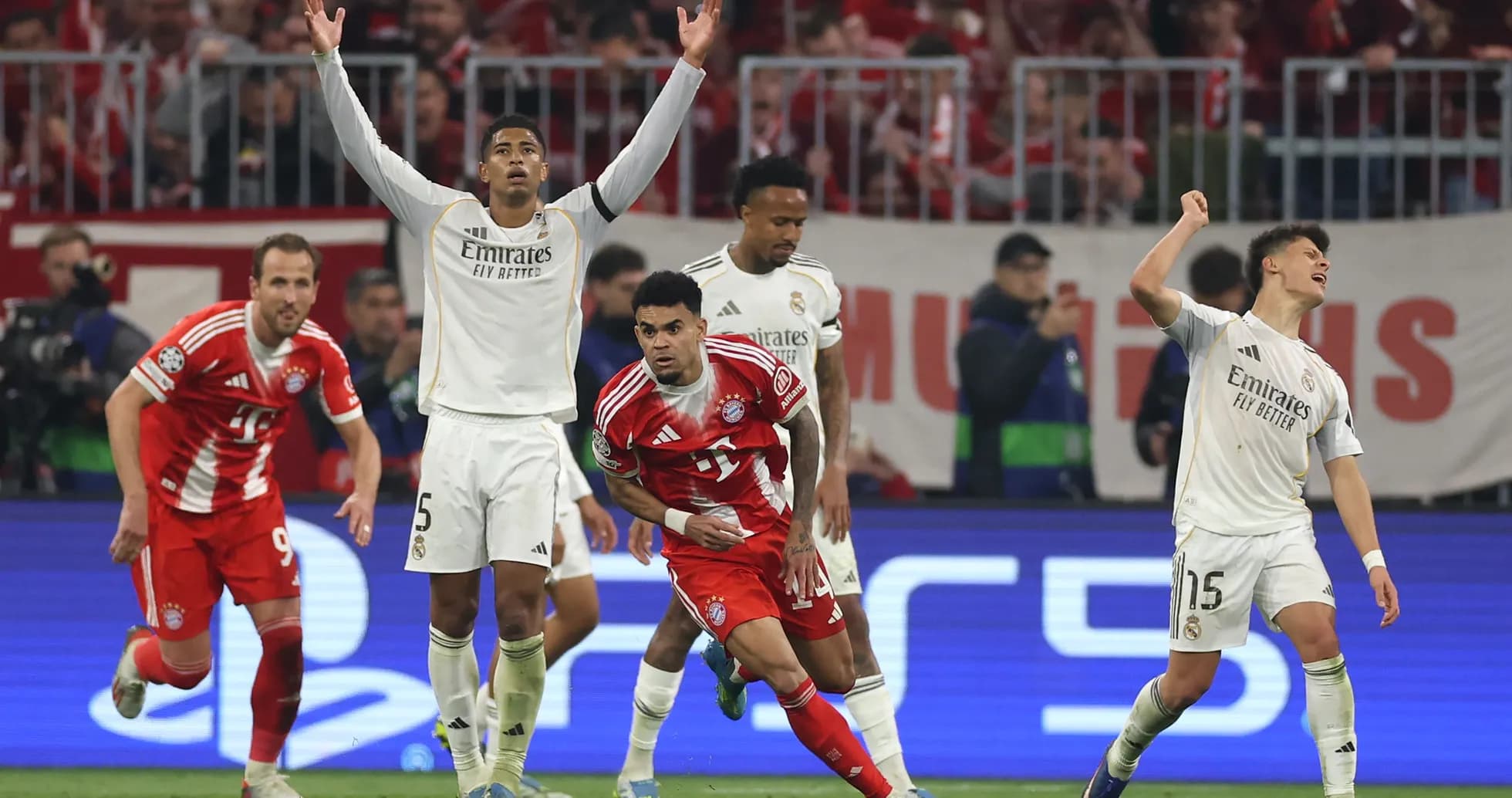
Under the lights of the Allianz Arena, this quarter-final first leg became a modern Champions League epic. Bayern München, ruthless at home all season, edged Real Madrid 4-3 after a breathless 90 minutes that felt like three different matches stitched into one.
Heading into this game, the numbers had already hinted at a storm. Bayern arrived as one of the competition’s most complete machines: 12 matches, 11 wins, no draws, and only 1 defeat overall. At home they had been flawless, with 6 wins from 6, scoring 20 and conceding just 6, an average of 3.3 goals for and 1.0 against at the Allianz Arena. Real Madrid, ranked lower in the overall table but forged in chaos, brought their own brand of volatility: 14 matches, 9 wins and 5 losses, no draws, with an away profile of 4 wins and 3 defeats, 17 scored and 13 conceded on their travels. Two sides that do not negotiate; they impose.
I. The Big Picture: Structures and Season DNA
Vincent Kompany stayed loyal to Bayern’s season-long blueprint: a 4-2-3-1 that has started all 12 Champions League fixtures. Manuel Neuer anchored a back four of Josip Stanisic, Dayot Upamecano, Jonathan Tah and Konrad Laimer, with Joshua Kimmich and Aleksandar Pavlovic as the double pivot. Ahead of them, a fluid trio of Michael Olise, Serge Gnabry and Luis Díaz buzzed around Harry Kane, the competition’s second-top scorer with 12 goals.
Across the halfway line, Alvaro Arbeloa leaned into Real Madrid’s flexibility but chose the 4-4-2 that has underpinned 7 of their European outings. Andriy Lunin started behind a back line of Trent Alexander-Arnold, Éder Militão, Antonio Rüdiger and Ferland Mendy. The midfield four of Brahim Díaz, Jude Bellingham, Federico Valverde and Arda Güler supported a devastating front two: Kylian Mbappé, the tournament’s leading scorer with 15 goals, and Vinícius Júnior, sitting among the top assist providers with 5.
The match’s 2-3 half-time scoreline to Real Madrid told its own story: Bayern’s home attacking average of 3.3 goals per game met Madrid’s away average of 2.4, and neither blinked. Yet Bayern’s overall defensive record of 1.2 goals conceded per game was shredded by Madrid’s front line before the break, forcing a tactical recalibration from Kompany.
II. Tactical Voids: Absences and Discipline
Both squads were subtly reshaped by who was missing. Bayern’s absentee list was long but largely peripheral in terms of established hierarchy: M. Cardozo, L. Karl, C. Kiala, W. Mike, B. Ndiaye and Sven Ulreich were all unavailable. The real consequence lay in the goalkeeping department: with Ulreich out, Neuer’s presence became non-negotiable, removing any possibility of rotation and sharpening the focus on his distribution under Madrid’s press.
Real Madrid’s absences cut closer to the core of their identity. Thibaut Courtois’ thigh injury meant Lunin again had to carry the burden in goal, while Rodrygo’s knee injury stripped Arbeloa of a direct, line-breaking wide option from the bench. Most tellingly, Aurélien Tchouaméni was suspended through yellow-card accumulation, depriving Madrid of their primary screening midfielder. That absence reshaped the entire defensive structure: Bellingham and Valverde had to split their attention between creation and protection, and Güler’s inclusion as a starter tilted the balance further towards guile over steel.
Disciplinary trends framed the risk. Bayern’s yellow-card distribution this campaign shows a pronounced late-game spike: 37.50% of their cautions arrive between 76-90 minutes, a sign of a side that finishes aggressively and occasionally on the edge. Their red cards have been concentrated between 46-75 minutes, with one dismissal in each of the 46-60 and 61-75 ranges. Real Madrid, meanwhile, spread their yellow cards more evenly but with notable clusters between 46-60 and 76-90 (both at 20.59%), and a remarkable 17.65% in added time (91-105). Their red cards skew very late: 40.00% between 91-105 minutes, another 20.00% in both the 61-75 and 76-90 windows. This is a team that lives on the disciplinary edge as matches stretch.
III. Key Matchups: Hunter vs Shield, Engine Room Battles
The headline duel was always going to be Hunter vs Shield: Harry Kane against Real Madrid’s defensive unit. Kane’s Champions League body of work this season is elite: 12 goals and 1 assist, with 32 shots and 21 on target. His penalty record is nuanced rather than flawless—3 scored, 1 missed—meaning Madrid could not simply assume perfection from the spot. Up against him, Rüdiger and Militão faced not just a finisher but a complete forward who drops into pockets, links play and even defends his box, having blocked 4 shots and made 5 interceptions in Europe.
Without Tchouaméni, Madrid’s shield in front of that back line was thinner. Valverde, usually Madrid’s all-terrain midfielder, had to expand his role. His season stats—21 tackles, 6 blocks, 12 interceptions—underline how much of Madrid’s defensive scaffolding runs through him. But he was simultaneously tasked with driving transitions and connecting with Mbappé and Vinícius. That dual mandate stretched him, especially as Bayern’s structure repeatedly created 3v2 overloads in the half-spaces around him and Bellingham.
On the other side, Bayern’s back line had to cope with the purest form of the Hunter in this competition: Mbappé. With 15 goals from 43 shots (30 on target), 3 penalties scored and none missed, he arrived as the most ruthless forward in Europe. Bayern’s overall defensive average of 1.2 goals conceded per game met Madrid’s 2.4 goals scored per game overall, and the first half showed exactly how thin that margin was. Laimer, nominally at right-back, had to balance his natural instinct to step into midfield—22 tackles and 3 blocks this campaign—with the need to track Vinícius’ diagonal runs and Mbappé’s bursts into the right half-space. Every time he stepped in, Madrid looked to spin in behind him.
In the Engine Room, Kimmich and Pavlovic faced Bellingham and Valverde in a contest that defined the rhythm. Kimmich’s role as Bayern’s metronome allowed Olise and Díaz to receive higher and wider, isolating Alexander-Arnold and Mendy. Olise, the competition’s leading assist provider with 6, repeatedly dragged Madrid’s midfield line out of shape, his 31 key passes and 56 dribble attempts a constant invitation to chaos. Each time Bayern found him between the lines, Madrid’s lack of a natural holding midfielder was exposed.
IV. Statistical Prognosis: xG, Momentum and the Second Leg
Following this result, the tie’s narrative bends towards Bayern’s attacking inevitability at home and Madrid’s capacity to score anywhere. Bayern’s season-long goal difference in the Champions League is emphatic: 38 goals for and 14 against overall, a GD of 24. Real Madrid’s is more modest but still dangerous: 33 scored and 20 conceded overall, a GD of 13, with their away profile (17 for, 13 against) underlining both threat and vulnerability.
In xG terms, this first leg would almost certainly show Bayern edging the quality of chances, especially in the second half as they tilted the field and forced Madrid deeper. Their relentless shot volume and box occupation, combined with Kane’s high-efficiency finishing profile and Olise’s creative gravity, suggest a side that routinely outperforms average attacking metrics. Madrid, by contrast, are a classic high-talent, medium-control side: Mbappé and Vinícius can generate high xG moments from relatively low-possession spells, but the structural cracks without Tchouaméni invite sustained pressure.
The disciplinary curves add another layer to the second leg prognosis. Bayern’s late yellow-card surge (37.50% between 76-90 minutes) mirrors Madrid’s own tendency to collect cards and even reds in the closing and added minutes. In a finely poised aggregate scenario, those patterns hint at a second leg defined by late chaos: tired legs, stretched distances between lines, and refereeing decisions under maximum pressure.
Tactically, Bayern will travel knowing that even in a wild, end-to-end contest, their season-long averages favour them: 3.2 goals scored and 1.2 conceded overall, compared to Madrid’s 2.4 scored and 1.4 conceded. Real Madrid, however, will cling to the knowledge that they put three past the competition’s most complete defence in 45 minutes and that their front line remains the most explosive in Europe.
The first act at the Allianz Arena confirmed what the data had promised: this is not a tie to be controlled, but one to be survived. Bayern’s structure and depth give them a slight statistical edge; Madrid’s individual brilliance and late-game volatility keep the door wide open. Over 180 minutes, the side that best manages its own chaos—discipline, transitions, and penalty-box composure—will write the final chapter.