Brazil's Historic Olympic Gold: A Night to Remember
On a warm August night in 2016, Brazilian football finally filled in the one empty space on its honours board.
At the Maracanã, under the weight of a nation’s obsession and a stadium packed with more than 63,000 tense, restless fans, the Seleção chased the medal that had always slipped away. Germany stood in the way. The ghosts of 2014 lurked in the background. The script demanded a response.
Brazil delivered it from the penalty spot.
Neymar’s Free-Kick, Germany’s Reply, and a Nerve-Shredding Wait
The final itself never turned into a rout or a spectacle. It became something else: a contest of nerve and detail.
Midway through the first half, Neymar bent the game to his will. In the 26th minute, he stood over a free kick and whipped it past the German wall and into the net, a strike as precise as it was symbolic. The Maracanã erupted. Brazil led. The dream edged closer.
Germany refused to play the supporting role. They grew into the match, and the tension grew with them. Fifteen minutes into the second half, Maximilian Meyer struck the equaliser, silencing the stadium and dragging the final back into a grinding, anxious stalemate.
At 1-1, the clock crawled. Extra time came and went without a winner. Every tackle, every misplaced pass, every clearance felt like it carried history on its back. The gold medal would be decided by penalties.
Weverton’s Save, Neymar’s Kick, and a Nation Released
From the spot, both sides walked the tightrope with remarkable composure.
Renato Augusto, Marquinhos, Rafinha and Luan all converted for Brazil. Ginter, Gnabry, Brandt and Süle matched them for Germany. Four kicks each, no errors, no cracks.
Then came Nils Petersen, one of the tournament’s top scorers. He stepped up for Germany’s fifth penalty.
Weverton guessed right.
The Brazilian goalkeeper plunged and pushed away Petersen’s effort, a single save that flipped the pressure, the story, and the stadium in an instant. The Maracanã roared again, this time with disbelief and hope colliding.
Neymar walked forward with the gold medal at his feet. One kick to end decades of frustration. He struck his penalty cleanly, sending it home and sending Brazil to its first Olympic football title. The captain tore away in celebration, collapsing to the turf as teammates Walace, Gabriel Jesus, Gabriel Barbosa and Rafael Alcântara sprinted to join him.
Brazil had finally turned silver and bronze into gold.
A Stuttering Start, Then Lift-Off
The path to that night had not been smooth.
Brazil opened the Rio 2016 campaign in Brasília, and the first two matches at the National Stadium brought only frustration: 0-0 against South Africa, 0-0 against Iraq. The football felt heavy, the anxiety obvious. A home Olympics was drifting towards disappointment.
Qualification, and calm, arrived in Salvador.
At Arena Fonte Nova, with top spot in Group A on the line, Brazil dismantled Denmark 4-0. Gabriel Barbosa struck twice, Gabriel Jesus added another, and Luan completed the rout. The attack finally clicked, and the tournament shifted. Brazil topped the group and marched into the knockouts with momentum restored.
Colombia, Honduras and a Statement at the Maracanã
The quarterfinal brought Colombia, runners-up in Group B after draws with Sweden and Japan and a win over Nigeria. At Arena Corinthians in São Paulo, Brazil showed control and purpose. Neymar opened the scoring, Luan added the second, and a 2-0 victory secured at least a shot at the podium.
With a medal guaranteed, the semifinal offered something more: a chance to make a statement.
Honduras, who had advanced from a group with Argentina, Algeria and Portugal and then stunned South Korea 1-0 in the quarters, arrived at the Maracanã with belief. They left on the wrong end of a demolition.
Brazil tore through them 6-0. Neymar hit two, Gabriel Jesus matched him with a brace, Marquinhos scored, and Luan found the net again. The performance felt like a release of all the early tension, all the doubts. It set up the final everyone had circled: Brazil vs Germany, for gold, in Rio.
The 18 Names Etched in History
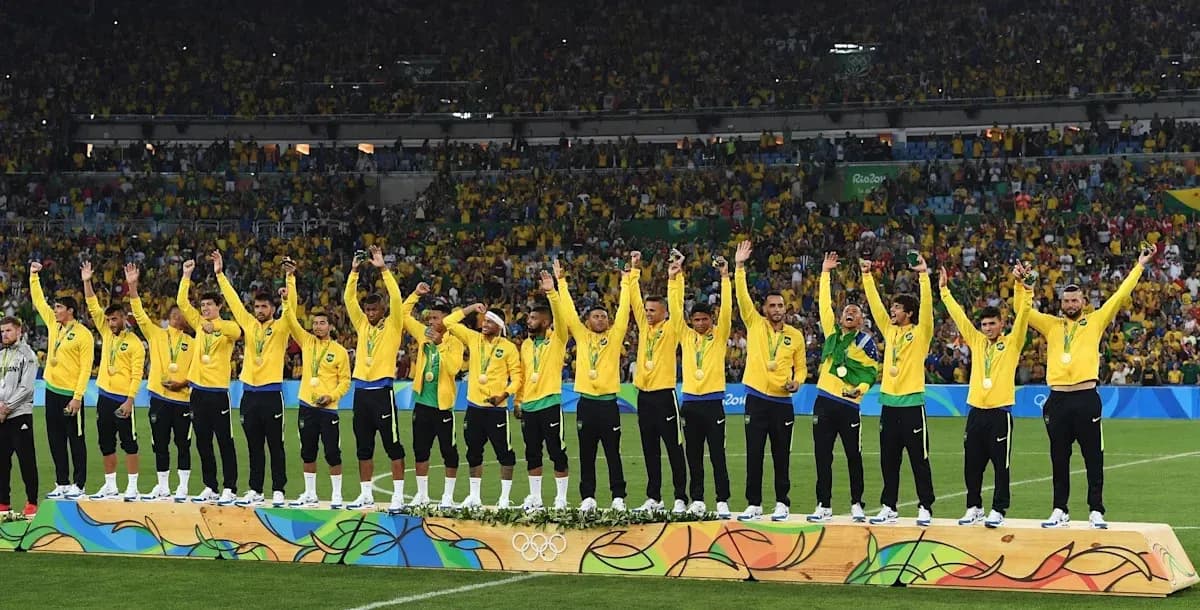
Eighteen players climbed the podium that night, the first Olympic football champions in Brazil’s history.
- Goalkeepers
- Weverton (Athletico-PR)
- Uilson (Atlético Mineiro)
- Full-backs
- William (Internacional)
- Douglas Santos (Atlético Mineiro)
- Zeca (Santos)
- Center-backs
- Rodrigo Caio (São Paulo)
- Luan Garcia (Vasco da Gama)
- Marquinhos (Paris Saint Germain, FRA)
- Midfielders
- Thiago Maia (Santos)
- Rodrigo Dourado (Internacional)
- Rafinha Alcântara (Barcelona, ESP)
- Renato Augusto (Beijing Guoan, CHI)
- Felipe Anderson (Lazio, ITA)
- Walace (Grêmio)
- Forwards
- Neymar (Barcelona, ESP)
- Luan (Grêmio)
- Gabriel Barbosa (Santos)
- Gabriel Jesus (Palmeiras)
One more name belongs to that story, even without a medal around his neck. Fernando Prass had been called up for the Games but saw his dream cut short by an elbow injury in the warm-up before a friendly against Japan at Serra Dourada in Goiânia, just days before the tournament began.
A decade on, that night at the Maracanã still stands apart. Brazil, the five-time world champion that had won everything else, finally claimed Olympic gold on home soil, against Germany, on penalties, with its No. 10 taking the final kick.
For a football nation obsessed with history, it was the one missing chapter. The question now is simple: how long until another generation writes one to match it?