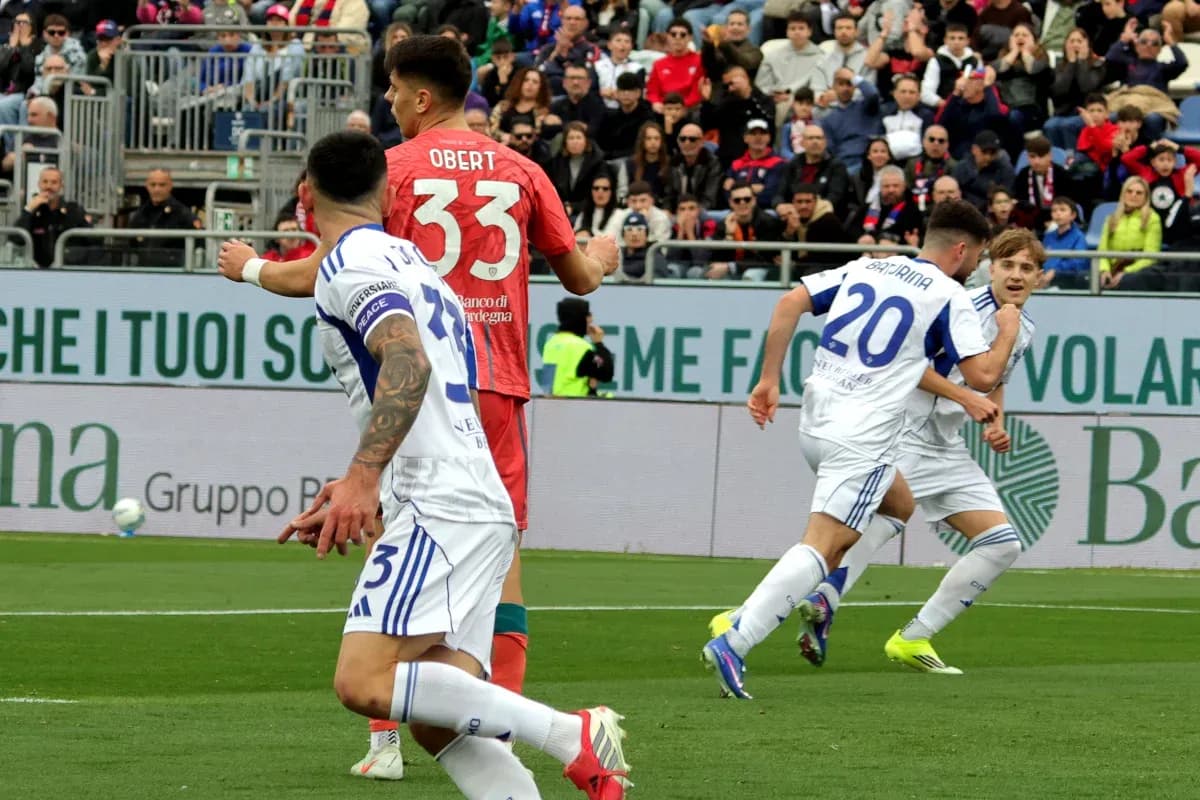
Cagliari vs Como: Tight Serie A Contest Ends 2–1
Cagliari’s push to climb away from the lower reaches of Serie A stalled on Matchday 28, as Como produced a composed 2–1 victory at the Unipol Domus that underlined the visitors’ credentials near the top of the table.
The result keeps Cagliari in 14th place on 30 points, while Como, starting the day in 4th with 51 points and a strong goal difference of +25, reinforced their status among the league’s Champions League contenders.
First half: Baturina strike gives Como control
Cagliari lined up in a 4-3-3, with S. Esposito spearheading the attack and M. Folorunsho and M. Palestra flanking him. Como responded with a 4-2-3-1, A. Douvikas leading the line ahead of an attacking midfield band featuring M. Baturina and L. Da Cunha.
The visitors settled more quickly and, fittingly, struck first. On 14', Como built a move in open play that culminated with Baturina finding the net. The midfielder finished clinically after being supplied by Da Cunha, whose involvement between the lines was already becoming a theme. It was a goal that reflected Como’s early sharpness in possession and their ability to connect midfield and attack.
From there, the game developed into a territorial arm-wrestle rather than a siege. Both sides would finish with 8 total shots, and neither goalkeeper was overworked in the opening period. Cagliari’s back line, marshalled by Alberto Dossena and A. Obert, had to stay alert as Como tried to exploit the flanks, particularly through I. Van der Brempt on the right.
On 36', Como made the first change: M. Perrone was withdrawn, with defender M. Vojvoda introduced. That early substitution hinted at a tweak in balance from the dugout, perhaps to tighten the structure without sacrificing the team’s composure on the ball.
Cagliari struggled to turn their 43% share of possession into sustained pressure before the interval, and with Como circulating the ball confidently, the visitors carried their 1–0 lead into half-time.
Second half: Esposito responds, Da Cunha decides it
Cagliari emerged after the break with more purpose, and their renewed aggression paid off. On 56', they found their equaliser through Esposito. The forward converted from open play after being set up by left-sided defender Obert, whose advanced positioning and delivery finally unlocked Como’s defensive shape. It was a rare moment when Cagliari’s front three combined effectively with the supporting cast.
The response from the Como technical area was swift and bold. On 62', centre-forward Douvikas made way for A. Morata. The introduction of the experienced striker freshened the attack and offered a different reference point up front.
The match grew increasingly fractious as Cagliari chased momentum. Palestra was booked for simulation on 65', and Esposito followed with a yellow card for the same offence on 71', two moments that underlined both the home side’s desperation and the referee’s low tolerance for theatrics.
On 73', Cagliari made their first change, right-back J. Pedro departing for defender G. Zappa. Five minutes later came a triple attacking reshuffle: at 78', J. Rodriguez was replaced by defender R. Idrissi, midfielder J. Liteta made way for forward S. Kilicsoy, and goalscorer Esposito was withdrawn for forward Y. Trepy. With an extra forward entering for a midfielder, the technical staff clearly opted for an attacking gamble in search of a winner rather than settling for a point.
Instead, it was Como who struck the decisive blow. On 76', Da Cunha capped an excellent individual display with the visitors’ second goal, finishing from open play after a contribution from Van der Brempt. The full-back’s involvement in the build-up and the midfielder’s composed end product highlighted Como’s quality in wide-to-central combinations.
The visitors then focused on game management. On 80', attacking midfielder N. Paz was replaced by defender Diego Carlos, a clear move to reinforce the back line. A minute later, left-back A. Moreno was withdrawn for defender A. Valle, and goalscorer Baturina came off for midfielder S. Roberto, further solidifying the structure in front of the back four.
Cagliari still had one late card to collect, Dossena booked for a foul on 89', shortly after striker L. Pavoletti was introduced on 88' in the final roll of the dice. Despite the aerial presence and a more direct approach, Como’s reconfigured defence held firm.
Statistical deep dive
The numbers underline how finely balanced the contest was. Both sides produced 8 total shots, but Como’s 57% possession and cleaner passing (493 total passes with 83% accuracy) allowed them to dictate tempo for long stretches. Cagliari, with 364 passes at 78% accuracy, were more direct and had to live off moments rather than sustained phases.
Defensively, Cagliari’s resistance was notable: they blocked 3 of Como’s attempts, while Como’s back line smothered 4 of Cagliari’s shots. The visitors also forced Cagliari into 7 offsides, a testament to a well-drilled defensive line stepping up at the right moments.
Expected goals (xG) reflected the marginal edge in Como’s chance quality: 0.55 to Cagliari’s 0.46. Neither goalkeeper recorded a goals-prevented value above zero, indicating that the finishing, rather than extraordinary saves, decided the outcome.
Discipline was another subplot. Cagliari committed 17 fouls and picked up three yellow cards, two for simulation, while Como conceded 18 fouls but saw only one booking, for Jacobo Ramón on 83' after a foul.
Standings and implications
For Cagliari, the defeat leaves them 14th on 30 points, with a goal difference of -8 and little margin for error as the season advances. Their 4-3-3 showed flashes of attacking promise, especially around Esposito’s equaliser, but the lack of sustained threat and the late reliance on crosses to Pavoletti underlined their limitations.
Como, by contrast, continue to look every inch a top-four side. Sitting 4th with 51 points and a formidable goal difference of +25, they combined technical assurance with pragmatic game management. The contributions of Baturina and Da Cunha in open play, allied to the defensive solidity after the second goal, offered a snapshot of why they occupy a position that currently carries a Champions League league-phase description.