Canberra United's New Era: Owners Secure Future and Plan Men's Team
Canberra United has a new life, a new landlord and, for the first time in its 18-year history, a private owner. The club that spent two years staring at the edge of the cliff has been hauled back to safety – and told to start dreaming bigger.
Australian Sports Group (ASG) has bought the licence from Capital Football, guaranteeing Canberra United’s place in the A-League Women for the 2026-27 season and committing to launch an A-League Men side in 2028-29.
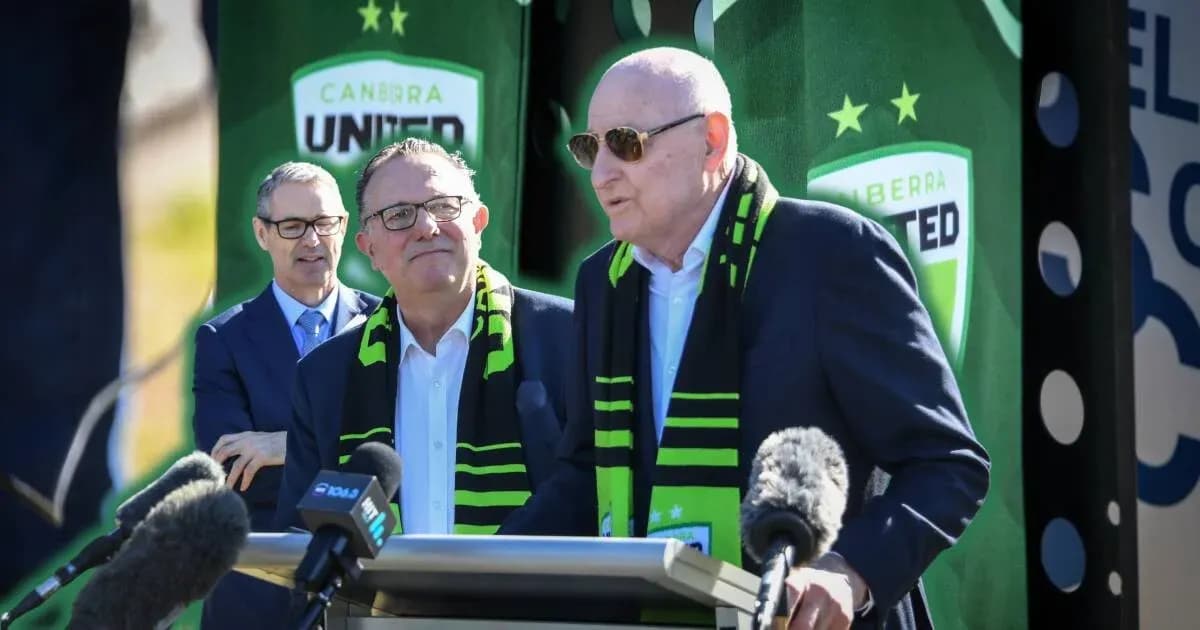
On Friday at McKellar Park, the spiritual home of United, ASG chief executive Theo Fotopoulos and chairman Morris McAlister stood on the turf and confirmed what Canberra’s football community has waited years to hear: the club is not only alive, it is back in expansion mode.
McKellar to remain home – and possibly much more
McKellar Park will stay the club’s match-day base. That much was non-negotiable for Fotopoulos.
“Football needs a home,” he said, and for Canberra United that home remains the compact, noisy ground in the city’s north.
ASG has gone a step further. The group is exploring the creation of a dedicated training base on the same six-hectare site, using the advantage of McKellar’s status as one of the few privately owned football grounds in the ACT. An office will be set up next door at the Belconnen Soccer Club, which Fotopoulos described as a “strategic partner”.
The move comes after the collapse of plans for a training facility at the Throsby Home of Football, where Capital Football and the ACT government had hoped to build a permanent base before the project became financially unworkable.
Fotopoulos has already spoken to key stakeholders and believes the prospects at McKellar are “very positive”. The message is clear: if the approvals fall into place, Canberra United could finally have the integrated home it has lacked for nearly two decades.
Coaching, contracts and a six-week clock
The off-field rescue has come just in time. Pre-season is due to start in six weeks, with the A-League Women draw to be released next month ahead of an October 16 kick-off.
ASG has moved quickly on football matters. The new owners have already held talks with head coach Antoni Jagarinec, who has guided United to the finals in each of the past two seasons, and want the coaching situation locked away as a priority.
“It’s never a no-brainer,” Fotopoulos said, “but I think [Jagarinec’s] results speak for themselves. We’re looking for continuity and consolidation. We’ll have those announcements out pretty soon.”
The same urgency applies to the playing squad. The Professional Footballers Australia (PFA) is currently working with players across the league, and ASG wants United’s roster settled “quicker than later”. Fotopoulos said the reaction from players so far had given the group confidence that deals can be done in haste.
The new regime inherits a club that has remained competitive despite financial strain and uncertainty. Now it has to turn stability into progress.
A men’s team promise – finally, a timeline
Canberra’s long, frustrating bid for an A-League Men side has taken so many twists that fans could be forgiven for greeting any new promise with scepticism. This time, there is at least a date.
ASG holds an option, not yet a full licence, for a men’s team to enter the competition in the 2028-29 season. That is three seasons away, later than many in the capital had hoped, especially after years of lobbying and the APL’s earlier designation of Canberra as a preferred expansion market.
Fotopoulos, though, was unequivocal when asked whether a men’s side would actually materialise.
“Well, we’re here today, so that’s your best guarantee,” he said. “That is part of our twin strategy. We believe the strength comes from both. It would be almost discriminatory not to work with the men. It’s always been part of our plans.”
APL chair Steve Conroy welcomed the deal, thanking the ACT government and the local football community for their backing.
“Following a competitive process, we’re excited to announce the Australian Sports Group as the new owner of Canberra United – securing the future of the women’s team and establishing a pathway to introduce a new A-League Men’s team in Canberra,” Conroy said. “This is an exciting next step for professional football in the ACT and highlights the growth opportunity for the A-Leagues and football in Canberra.”
For bid leader Michael Caggiano, who has spent eight years pushing for a men’s licence while watching other markets – including current champions Auckland – leapfrog Canberra into the competition, the hope is that this finally closes the book on failed attempts.
United by name – and maybe something more
One thing will not change. Canberra United will remain Canberra United.
Fotopoulos made it clear the brand, built over 18 seasons in the women’s game, is too valuable to discard. The men’s team, when it arrives, will carry the same name.
“You’ve got 18 years of Canberra United. Why would you change it?” he said. “Unless somebody or the general public have got a negative view towards the team – I don’t think that’s the case.”
What could change is the club’s identity around that core name. Fotopoulos wants the community to help craft a nickname through a public campaign, potentially run with The Canberra Times. The options are already being kicked around: Cosmos, Arrows, Greens, Lakers, Green Machine – or something nobody has thought of yet.
“If the Canberra community want a nickname for their team, Green Machine, whatever they come up with, we’re happy to look at that,” Fotopoulos said.
It is a small detail, but it signals a broader intent: this is a club that wants to be seen as belonging to the city, not just to its new owners.
Who’s behind the takeover?
ASG’s football credentials are not new. Fotopoulos and McAlister have both been around the Australian game long enough to have seen previous eras rise and fall.
McAlister, whose background is in commerce, is the governing director of Petron Plus 7 Australian and New Zealand, a company dealing in engine and machine products such as lubricants and grease. He also serves as senior consultant at MEC Team Consultants, a firm that links Australian businesses with markets in China.
Fotopoulos is a marketing executive and chief executive of FOS Group Australia. In football, he has previously been chief executive at Sydney Cosmos and Sydney Olympic, and he and McAlister were involved with the Newcastle Breakers in the old National Soccer League.
The pair now take charge of a club that, until this week, had never been privately owned. Capital Football has run Canberra United since its inception in 2008, but the financial load became too heavy for the federation. Last season was its last in control, and for months the future of the A-League Women side hung in the balance.
ASG’s purchase is understood to form part of a wider $15 million arrangement, which includes the men’s project, and involves an initial commitment to underwrite Canberra United up to $3 million over multiple years.
The A-Leagues will formally announce ASG as United’s new owner, confirming the women’s participation in 2026-27 and setting the clock ticking on the men’s debut.
Pathways, infrastructure and a reset for the capital
The takeover is not just about keeping a team on the pitch. Fotopoulos has pledged to rebuild Canberra’s academy pathways after Capital Football controversially shut down United’s academy three years ago, leaving a gap for local boys and girls with professional ambitions.
“We’re excited to be part of growing the A-Leagues and building a strong club focused on community engagement, football excellence, commercial growth, new infrastructure and strengthening the football development pathways for boys and girls in the territory and the capital region,” he said.
That means investment in infrastructure as well as people. The potential McKellar training base is one piece of that puzzle; broader facilities and an integrated academy system are others.
For now, though, the most important job has been done. Canberra United, once a case study in uncertainty, has been handed a future and a framework.
The next question is no longer whether the club will exist, but what kind of force it can become by the time that long-promised men’s team finally walks out in green.