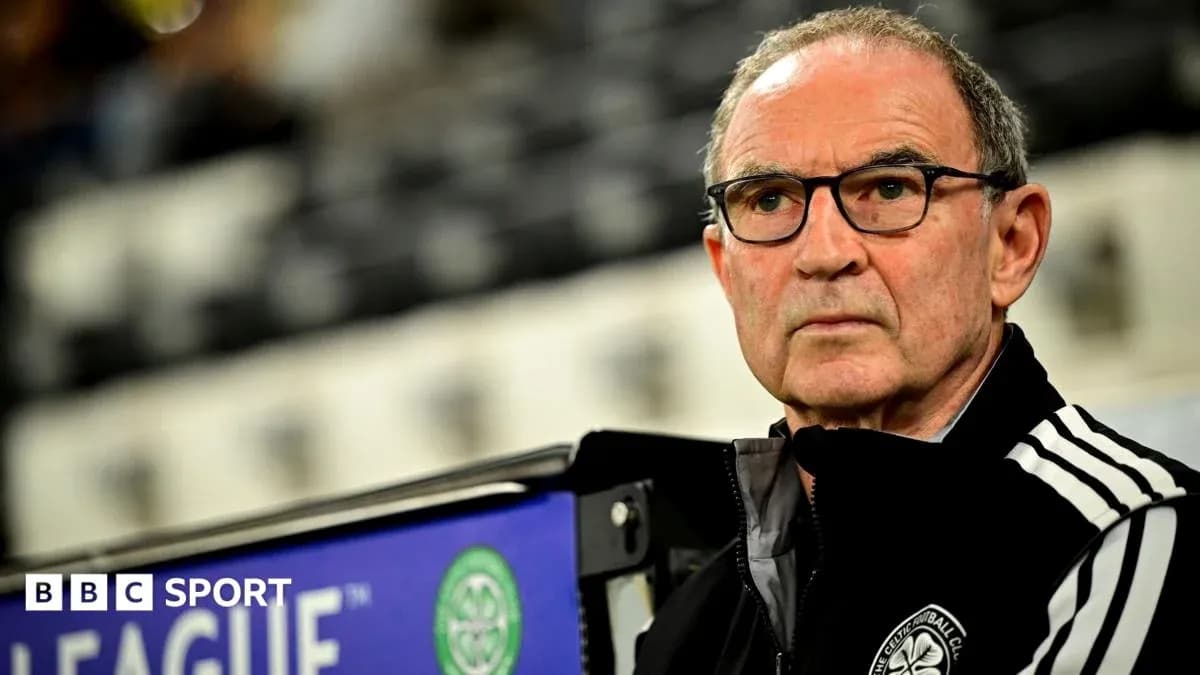
Celtic's Champions League Collapse: A Deeper Trauma
Six attempts in eight years. Six failures. Celtic’s Champions League trauma has slipped from trend to tradition.
Picking over another wrecked qualifying campaign has become an August ritual in Glasgow, but this one cuts deeper. This was not just elimination. This was a collapse that will linger.
Celtic led 3-0 from the first leg at home. In Linz, they scored first again. At 4-0 up on aggregate, three-quarters of the way through the tie, they looked to be strolling into the play-off round. Then the floor gave way.
LASK pummelled them after the break. The equaliser on aggregate, coming in the 90th minute to make it 4-4 over the two legs, felt less like a twist and more like the inevitable conclusion to a second-half siege. The Austrians’ fifth – the winner – had been signposted for a long time.
Just a few weeks ago, Martin O’Neill’s side had opened the season with four wins from four, 13 goals scored, optimism rising. Now, the questions are stacking up faster than the points in Europe.
On the pitch in Linz, captain Callum McGregor saw what everyone else saw. Celtic shrank. They were, in his own words, “scared” and “passive” as LASK launched attack after attack. The midfield vanished. The back line frayed.
Individual mistakes ripped the tie open. Benjamin Nygren, Auston Trusty and Luke McCowan all erred in ways that led directly to goals. Celtic never got a grip in the middle of the park. They were overrun.
O’Neill fronted up, insisting the responsibility lay with him. Former Celtic captain Scott Brown suspects that was an act of protection rather than confession.
“I feel for Martin because he's taking full responsibility,” Brown told BBC Scotland. “I've been in Martin's situation. When you get humiliated in a game, you need to take that pressure off the players because in a week's time they've got another game.”
By full-time, Celtic’s defence looked like something cobbled together in a training-ground emergency. Third-choice right-back Anthony Ralston on one side. Trusty, who had not trained in the build-up because of illness, in the middle alongside untested academy product Dane Murray. Liam Scales shunted out of position at left-back.
Brown’s verdict was blunt: Celtic’s depth is nowhere near the level required for the Champions League.
“The substitutes aren't Martin's players,” he said. “The strength and depth in areas still needs a little bit of quality because the players that came on didn't hit the same level as the ones that went off.”
The recruitment picture is muddled. Celtic have spent heavily this summer on forwards Kasper Hogh and Camilo Duran, and brought in midfielder Mika Baur and winger Haissem Hassan. At the same time, they have sold key figures Daizen Maeda and Arne Engels to Ipswich Town and West Ham United.
Former striker Chris Sutton took to social media to question why influential players were allowed to leave before such a pivotal qualifier. Brown focused on one absence in particular.
“What they're missing is probably another physical centre-midfielder that can be alongside [McGregor] in there to help him out,” he said. “Because Arne Engels is a huge miss physically, not just for the battle, but his legs and running power as well, getting in behind, but his mentality as well.”
The cost of this failure will not only be emotional.
When Celtic reached the Champions League play-off round in 2024-25, their revenue hit £143m, placing them among Europe’s top 60 clubs by income. That same season, Ipswich Town, then the lowest-earning club in the English Premier League, posted £155m. LASK, by contrast, last reported a turnover of just £42m.
Football finance expert Kieran Maguire estimates missing out on the Champions League this time will cost Celtic north of £20m.
“For every £100 generated in the Champions League in terms of prize money, it works out at about £22 in the Europa League and about £11 in the Conference League,” Maguire told BBC Sport Scotland.
“Celtic made about £45m in season 2024-25 when they got to the Champions League knockout play-off – that's total prize money, including the SPFL money, but it's still indicative of how successful the competition can be.
“Aston Villa, who won the Europa League last year, probably made somewhere in the region of £30-35m and at least they have the benefit of automatically qualifying for the Champions League.
“It is a blow for Celtic. If you look at their share price today, it is down about 4-5%, reflecting that impact on future revenues.”
The damage spreads beyond prize money. Two years ago, Celtic charged £44 more for an adult four-match Champions League ticket package than for the subsequent Europa League equivalent. Hospitality prices stretched even further apart.
O’Neill has already spoken about the need to reassess transfer targets after this defeat. Maguire underlined that sponsor bonuses are also likely to shrink.
“Celtic's fans will buy tickets whether it's Real Madrid or Raith Rovers, but in terms of the prices that can be charged – especially for corporate and hospitality – it's a licence to name your own price when big European clubs come to town.”
The anger from the stands and living rooms has been raw.
Gerry pointed straight at the hierarchy: “We are not a Champions League club. Simple. The board are a shambles and responsible for the club's failures again and again.”
Eamonn called the defeat “shocking but not surprised”, describing the squad as the product of “four or five disastrous windows” that four recent signings were never going to fix.
Martin railed at a board he feels spends only after the jackpot is hit, not before it. “We actually need a board that spends meaningful cash to ensure we have the best possible chance of negotiating these horrible qualifiers,” he said, calling the display “one of the worst results and performances in our modern history.”
Patrick offered rare praise – for one man. “Viljami Sinisalo is the only player who showed up, everyone else was a passenger.” His patience with others, including Reo Hatate and McCowan, had snapped. “Odds on Martin O'Neill gone by Christmas?” he asked.
Paul, like many, wondered if this level might be beyond Celtic right now. “Playing like that, it's probably best we're not in the Champions League,” he said, before naming players he believes should be moved on and insisting O’Neill “needs to take his share of the blame. Team didn't know whether to go for it or defend.”
The fallout stretches beyond Celtic and into the wider Scottish game.
Not long ago, Scotland sat as high as ninth in Uefa’s coefficient table, a position that feels almost fantastical in the current mood but was reality between 2021 and 2023. That ranking dictates how many places each country gets across the three European competitions.
Ninth place brought a guaranteed Champions League group-stage spot for the Premiership winners, while the runners-up had only two qualifying rounds to navigate in the same tournament. That era has gone. A sharp slide has dragged Scotland down to 18th, with this season’s champions now starting in the second qualifying round and the runners-up dropping into the Conference League qualifiers.
Celtic’s implosion against LASK is another marker of that decline. It is not, though, a death sentence for the coefficient.
When Celtic reached the Champions League knockout play-off in 2024-25, they banked 17.70 coefficient points. Rangers actually earned more that year – 19.750 – by reaching the last 16 of the Europa League. The message is clear: deep runs in the Europa League can still drive Scotland’s ranking.
Celtic will now have to try to do just that. In the live coefficient table, including this season’s results, Scotland have already slipped to 19th, but there is no risk of dropping further this year. The direction of travel, though, depends heavily on what happens next.
If Rangers, Hibernian and Motherwell fall in their Conference League qualifiers on Thursday, Scotland’s hopes of climbing back will suffer another blow. Returning to the top 15 – which would restore a Champions League route for the league runners-up – has to be the immediate target.
For Celtic, the equation is starker. Europe has exposed their flaws again. The question now is whether this latest scar finally forces the club to change, or whether next August will bring yet another post-mortem of a campaign that never truly got started.