Chelsea’s 3–1 Defeat to Nottingham Forest: Tactical Analysis
Chelsea’s 3–1 home defeat to Nottingham Forest at Stamford Bridge unfolded as a lesson in penalty-box clarity and game-state management. In a Premier League Round 35 fixture, Chelsea’s territorial dominance and structured 4-2-3-1 were repeatedly undone by Forest’s ruthless 4-4-2 transitions and early striking. Forest surged to a 2–0 lead by the 15th minute and extended it to 3–0 on 52', effectively deciding the contest before Chelsea’s late response. Despite 68% possession and 21 shots, Chelsea’s attacking scheme only broke through once in stoppage time, while Forest’s compact block and direct front pairing maximised limited ball share into high-quality chances.
Chelsea’s defensive structure was destabilised almost immediately. On 2', Forest’s front two exposed the back four: D. Bakwa broke lines from the right side of midfield and supplied T. Awoniyi, who finished a normal goal to make it 0–1. That early strike set the game-state: Forest could retreat into a mid-to-low 4-4-2 block and counter, while Chelsea were forced to chase.
Forest’s first disciplinary incident came on 10', when Morato received a yellow card for a foul, signalling how aggressively the visitors were prepared to defend their box and half-spaces. Three minutes later, Forest’s vertical threat produced a penalty sequence. On 13', VAR confirmed a penalty for Forest, with Taiwo Awoniyi at the centre of the incident. Two minutes later, on 15', Igor Jesus converted from the spot for 0–2, consolidating Forest’s early advantage and deepening Chelsea’s structural dilemma.
Chelsea’s first card arrived on 14', when Malo Gusto was booked for a foul. It reflected Chelsea’s increasingly stretched rest defence as they tried to compress the game high up the pitch while still coping with Forest’s direct front line. The halftime score, shaped by these early events and with no further goals before the interval, stood at Chelsea 0–2 Nottingham Forest.
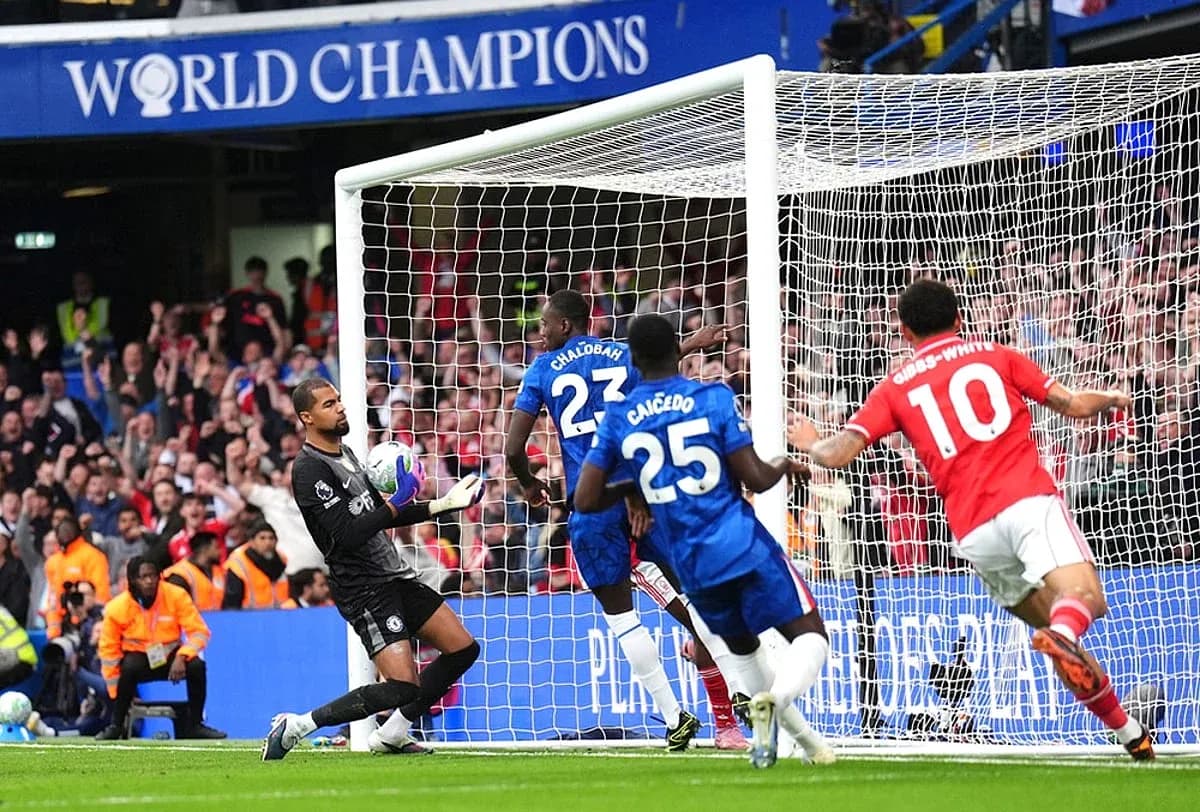
The second half began with a flurry of substitutions around the restart but the next major action again favoured Forest. On 52', Awoniyi struck his second normal goal, this time assisted by substitute M. Gibbs-White, taking the score to 0–3 and punishing Chelsea’s attempts to push their full-backs higher.
Chelsea’s bench activity intensified as they chased a route back. A key attacking flashpoint came on 75', when Joao Pedro had a goal cancelled by VAR, halting what could have been a lifeline at 1–3. Frustration then manifested in discipline: on 78', Liam Delap was shown a yellow card for argument, immediately followed by a yellow for Moisés Caicedo for a foul in the same minute. These were Chelsea’s second and third bookings, underlining emotional and tactical strain.
Forest’s only card remained Morato’s 10' yellow, while Chelsea finished with three cautions: Malo Gusto (14', foul), Liam Delap (78', argument), and Moisés Caicedo (78', foul). The final goal arrived on 90', when Joao Pedro finally registered on the scoresheet, finishing a normal goal assisted by M. Cucurella to make it 1–3. That late strike altered the scoreline but not the strategic verdict.
From the outset, Chelsea’s 4-2-3-1 aimed to dominate possession and compress Forest into their defensive third. R. Sanchez, with just 1 recorded save, functioned more as a high starting point behind a back four of M. Gusto, T. Chalobah, T. Adarabioyo and M. Cucurella. The double pivot of R. Lavia and Moisés Caicedo was tasked with both circulation and counter-pressing, while C. Palmer, E. Fernandez, J. Derry and Joao Pedro formed an attacking box designed to overload central zones and half-spaces.
The structure delivered volume but not efficiency: Chelsea produced 21 total shots, with 5 on goal and 8 blocked, indicating Forest’s penalty-area density and last-ditch interventions. Twelve of those efforts came inside the box, but the timing and body shapes of the final actions often favoured Forest’s defenders. With 10 corners and 649 passes at 91% accuracy, Chelsea recycled the ball well but struggled to unhinge Forest’s compact 4-4-2 lines.
Forest’s tactical identity was far more direct. In possession, the 4-4-2 morphed into a 4-2-4 in transition, with Bakwa and J. McAtee pushing high to support Igor Jesus and Awoniyi. Out of possession, the wide midfielders dropped to form a narrow four, forcing Chelsea outside and trusting central defenders Morato and Cunha (later replaced by N. Milenkovic) to clear crosses. Forest’s 6 total shots, 4 of them on target, show a focus on quality over volume, with all attempts inside the box except one.
The goalkeeper battle underlined the game narrative. Sanchez’s single save versus 3 goals conceded, despite an xG faced of around 2.07 for Forest’s attack, suggests that the chances allowed were both central and clean. On the other side, M. Sels made 4 saves and conceded once, with Chelsea generating 1.93 xG. Both keepers show the same goals prevented figure in the data, but the context differs: Sels was repeatedly called upon to manage crosses, cut-backs and late box entries, while Forest’s block limited the clearest looks.
Personnel changes shaped the second half but did not invert the pattern. For Chelsea, L. Delap (IN) came on for J. Derry (OUT) at 45+9', adding a more direct central reference. At 46', L. Colwill (IN) replaced T. Adarabioyo (OUT), a like-for-like defensive switch likely aimed at improving build-up angles. Andrey Santos (IN) for R. Lavia (OUT) on 58' suggested a push for more vertical running from midfield, while F. Jorgensen (IN) for R. Sanchez (OUT) on 66' was a notable change in goal, possibly injury- or performance-related but coming too late to alter the scoreline significantly.
Forest’s substitutions were largely about game-state management. N. Williams (IN) for Z. Abbott (OUT) at 45+5' freshened the right-back slot. On 46', N. Milenkovic (IN) for Cunha (OUT) and M. Gibbs-White (IN) for Igor Jesus (OUT) rebalanced the back line and added a ball-carrying threat between the lines. E. Anderson (IN) for N. Dominguez (OUT) at the same 46' mark injected energy into central midfield. Later, C. Wood (IN) at 66' and O. Hutchinson (IN) for D. Bakwa (OUT) on 80' maintained pressing intensity and provided fresh outlets as Forest defended deeper.
Statistically, Chelsea’s 68% possession against Forest’s 32% frames a classic control-versus-impact contrast. Chelsea’s 649 passes (591 accurate, 91%) and 10 corners reflect sustained territorial control and structured circulation. Forest, with 325 passes at 80% accuracy and only 1 corner, accepted long spells without the ball in favour of protecting central zones and springing forward quickly.
The xG comparison is revealing: Chelsea’s 1.93 versus Forest’s 2.07 underscores that, despite the shot and possession disparity, Forest generated slightly better chance quality. Both teams share the same goals prevented value in the data, suggesting that the difference lay less in goalkeeping heroics and more in defensive organisation and box defending. Fouls were relatively balanced (Chelsea 12, Forest 10), but Forest converted their early attacking moments into a decisive 3–1 lead, while Chelsea’s overall form with the ball outstripped their defensive index without it. The result underlines Forest’s tactical clarity in transition and Chelsea’s struggle to convert dominance into control of the scoreline.