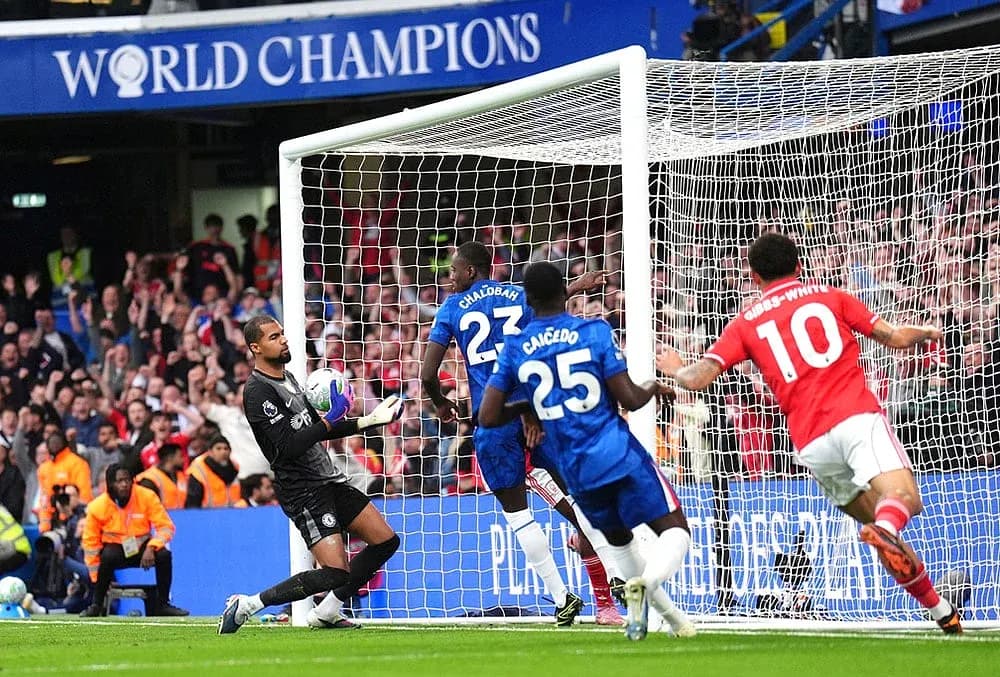
Chelsea's Tactical Struggles Exposed in Nottingham Forest Defeat
Stamford Bridge had the air of a crossroads rather than a coronation. Following this result, a 3-1 home defeat to Nottingham Forest in the Premier League’s Round 35, Chelsea’s season-long contradictions were laid bare: a side with top-four attacking talent, a mid-table defensive record, and a form line that has fallen off a cliff.
Forest, by contrast, arrived in London with momentum and left with validation. Sitting 16th with 42 points but boasting an away profile that belies their league position, they leaned into their identity: compact, direct, and ruthless in transition.
I. The Big Picture – Identities Colliding
Chelsea’s campaign numbers tell a story of imbalance. Overall they have scored 54 goals and conceded 48, giving them a goal difference of +6. Heading into this game, they had taken 48 points from 35 matches, their attack averaging 1.5 goals per game overall, but their defence allowing 1.4. At Stamford Bridge, those numbers flatten out: 24 goals scored and 24 conceded at home, an average of 1.3 for and 1.3 against. This is not the fortress Chelsea once was; it is a coin toss.
Forest’s profile is almost the mirror image. Overall they had 44 goals for and 46 against, a goal difference of -2, and 42 points from 35 games. On their travels, though, they are far more dangerous: 26 away goals at an average of 1.4 per game, conceding 25 at 1.4. That away attack, combined with their recent form line of WWWDW, framed this as a trap fixture for a Chelsea side arriving on a brutal LLLLL run.
The formations reflected those realities. Calum McFarlane stuck to Chelsea’s season-long blueprint, a 4-2-3-1 that has been used 30 times in the league. Robert Sánchez in goal; a back four of Malo Gusto, Trevoh Chalobah, Tosin Adarabioyo and Marc Cucurella; a double pivot of Romeo Lavia and Moisés Caicedo; an attacking band of Cole Palmer, Enzo Fernández and J. Derry behind top scorer João Pedro.
Vitor Pereira, though usually a 4-2-3-1 coach (29 games in that shape this season), came to Stamford Bridge in a 4-4-2: Matz Sels behind a back four of Z. Abbott, Cunha, Morato and L. Netz; a midfield line of D. Bakwa, Ryan Yates, Nicolás Domínguez and J. McAtee; and a front two of Igor Jesus and Taiwo Awoniyi. It was a structural bet: two strikers to pin Chelsea’s centre-backs and four midfielders to choke the central lanes where João Pedro and Palmer thrive.
II. Tactical Voids – The Missing Pieces
Both squads were quietly reshaped by absences.
Chelsea were without A. Garnacho, J. Gittens and Pedro Neto (all listed as inactive or injured), and crucially M. Mudryk, suspended. That stripped McFarlane of direct wide runners who could stretch Forest’s back line and left more creative burden on Palmer and Enzo between the lines. With no natural explosive winger on the left, Cucurella’s overlaps became a structural necessity rather than a bonus, increasing the exposure behind him.
Forest’s casualty list was even longer: O. Aina, W. Boly, C. Hudson-Odoi, John Victor, Murillo, D. Ndoye, I. Sangaré and N. Savona all missing. That forced Pereira into a back four without Boly’s aerial dominance or Murillo’s aggression, and a midfield without Sangaré’s physical screen. Yet it also nudged Forest into a more collective, compact block, with Yates and Domínguez tasked to do the dirty work centrally.
Disciplinary trends added another layer. Chelsea are a high-card side: their yellow-card profile peaks late, with 22.35% of bookings arriving between 76-90 minutes and another 20.00% between 61-75. Their reds are spread across the match, with a notable 28.57% in the 61-75 window. Forest, by contrast, cluster their yellows between 46-75 minutes (46.42% combined) and have just a single red all season, shown between 31-45 minutes. This game followed that pattern of edge and risk for Chelsea; the Blues once again flirted with disciplinary self-sabotage as they chased the match.
III. Key Matchups – Hunter vs Shield, Engine Room vs Enforcer
The headline duel was João Pedro versus Forest’s defensive structure. With 15 league goals and 5 assists in 33 appearances, plus 48 shots (28 on target), João Pedro is Chelsea’s primary finisher and creator rolled into one. He leads the league’s assist charts for Chelsea with 5 and has drawn 51 fouls, constantly destabilising back lines.
Forest’s “shield” was collective rather than individual. Morato and Cunha formed the central pairing, protected by Yates and Domínguez. Their brief was clear: deny João Pedro the half-spaces where he links with Palmer and Enzo, force him into wider zones, and win the second balls when Chelsea’s full-backs pushed on.
In the engine room, the duel was even more compelling. Moisés Caicedo is Chelsea’s metronome and enforcer: 1,877 passes at 92% accuracy, 83 tackles, 14 blocks and 56 interceptions, but also 10 yellows and 1 red. He is both the stabiliser and the risk. Against him, Pereira had Ryan Yates as the disruptor and Domínguez as the passer, with McAtee drifting in to overload the inside channels.
This is where Forest won the game. By playing 4-4-2, they constantly asked Caicedo and Lavia to defend wide and deep simultaneously. When Chelsea lost the ball, Forest’s first pass was vertical into Igor Jesus or Awoniyi, with the near-side winger (often Bakwa) sprinting beyond. Caicedo’s aggression, usually an asset, became a liability when Forest broke past his line; once he was bypassed, Chalobah and Adarabioyo were exposed 2v2.
IV. Statistical Prognosis – Why the Scoreline Made Sense
Strip away the emotion and the numbers underpin Forest’s triumph.
Chelsea’s home attack, at 1.3 goals per game, met a Forest away defence conceding 1.4. That projects a narrow Chelsea edge in chance volume but not dominance. Conversely, Forest’s away attack of 1.4 goals per game faced a Chelsea home defence also conceding 1.3. With Chelsea’s form plunging (LLLLL) and Forest’s surging (WWWDW), the visitors arrived with sharper execution and greater clarity.
Chelsea’s penalty record (7 scored from 7 overall, 100.00% conversion, no misses) offered a theoretical safety net, but in open play they remained reliant on João Pedro’s individual brilliance and Palmer’s creativity. Forest, meanwhile, spread their threat: Awoniyi’s runs into the channels, Igor Jesus’ link play, and Bakwa’s surges at Cucurella’s flank repeatedly turned Chelsea’s advanced full-backs into a weakness.
From an Expected Goals lens, this kind of game tilts towards Forest if they score first. Their structure is built to protect a lead: two banks of four, strikers ready to counter, and a goalkeeper in Sels comfortable under pressure. Chelsea’s need to chase, combined with their late-game card spikes (22.35% of yellows between 76-90), often leads to chaotic finales rather than controlled sieges.
Following this result, the tactical lesson is stark. Chelsea’s 4-2-3-1 can overwhelm weaker mid-blocks, but against a disciplined, transition-focused 4-4-2 like Forest’s, their structural imbalances – adventurous full-backs, a single true ball-winner in Caicedo, and overreliance on João Pedro – are brutally exposed. Forest, wounded by absences but clear in identity, turned those flaws into a statement away win.