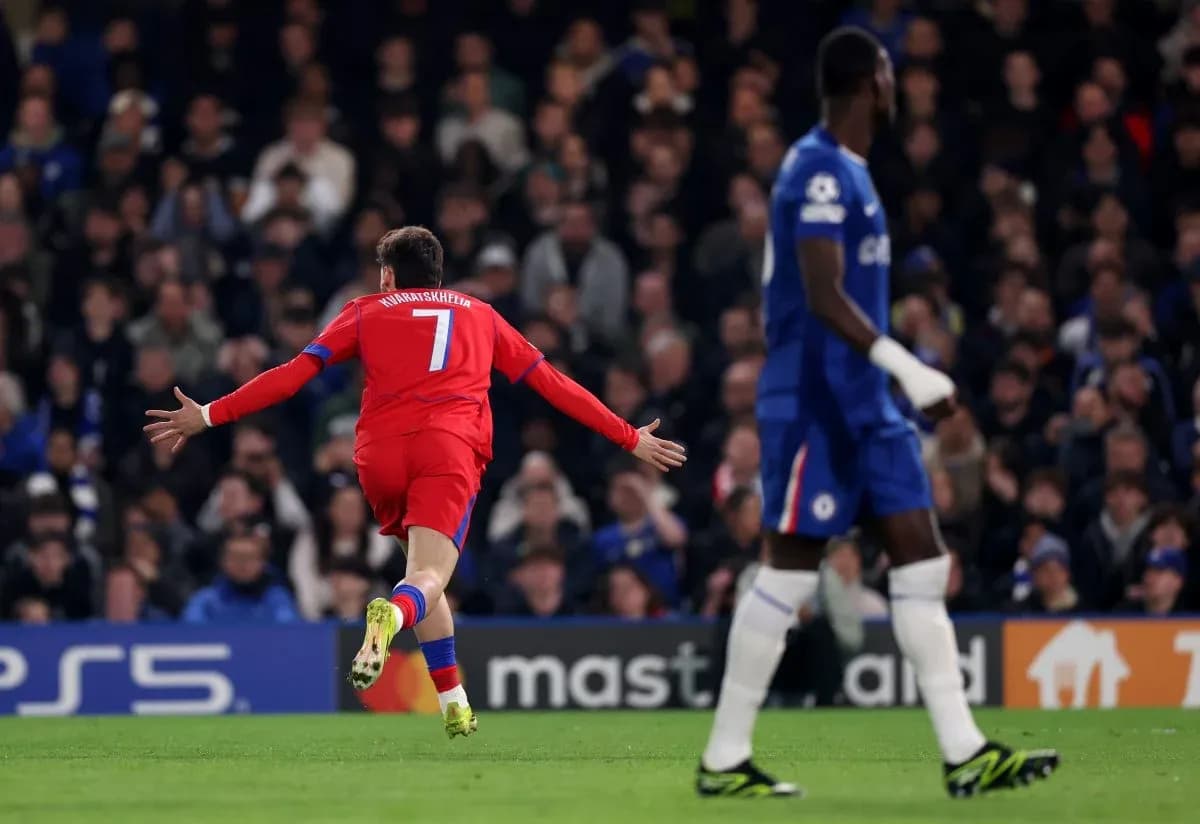
Chelsea vs Paris Saint Germain: UEFA Champions League 1/8 Final Review
Stamford Bridge hosts this UEFA Champions League 1/8 final second leg, where Chelsea (ranked 6th in the overall standings) fell 0–3 at home to Paris Saint Germain (ranked 11th). The match finished in regular time under referee S. Vincic, with the score 0–2 at the break and 0–3 at full time.
Squad Shapes and Tactical Setups
Chelsea – 4-2-3-1
Chelsea stayed loyal to their most-used shape this season, the 4-2-3-1 (used 9 times overall this season):
- Goalkeeper: Robert Sánchez (1)
- Back four:
- Right-back: Mamadou Sarr (19)
- Centre-backs: Trevoh Chalobah (23), Jorrel Hato (21)
- Left-back: Marc Cucurella (3)
- Double pivot:
- Andrey Santos (17), Moisés Caicedo (25)
- Attacking line of three:
- Right side: Pedro Neto (7)
- Central creator: Cole Palmer (10)
- Left side: Enzo Fernández (8)
- Centre-forward: João Pedro (20)
This structure reflects Chelsea’s broader-season identity: a team that wants control through a double pivot and a creative No.10, backed by aggressive full-backs. Overall this season, Chelsea have:
- Fixtures overall this season: 10 (5 home, 5 away)
- Record overall this season: 5 wins, 1 draw, 4 losses
- Goals scored overall this season: 19 (10 at home, 9 away)
- Goals conceded overall this season: 18 (4 at home, 14 away)
The big contrast between a very tight home defence (4 conceded in 5) and a leaky away unit (14 conceded in 5) underlines how much they rely on Stamford Bridge to stabilise their back line. Yet here, conceding three at home matches their worst home defeat overall this season (0–3).
Paris Saint Germain – 4-3-3
Paris Saint Germain lined up in their trademark 4-3-3, the only formation they have used in the competition (12 times overall this season):
- Goalkeeper: Matvey Safonov (39)
- Back four:
- Right-back: Achraf Hakimi (2)
- Centre-backs: Marquinhos (5), Willian Pacho (51)
- Left-back: Nuno Mendes (25)
- Midfield three:
- Right interior: Warren Zaïre-Emery (33)
- Central: Vitinha (17)
- Left interior: João Neves (87)
- Front three:
- Right wing: Bradley Barcola (29)
- Central: Ousmane Dembélé (10)
- Left wing: Khvicha Kvaratskhelia (7)
This XI is built around high technical security in midfield and an explosive front line. Across the Champions League campaign overall this season, PSG’s profile is that of a high-scoring, reasonably secure side:
- Fixtures overall this season: 12 (6 home, 6 away)
- Record overall this season: 7 wins, 3 draws, 2 losses
- Goals scored overall this season: 34 (18 at home, 16 away)
- Goals conceded overall this season: 17 (10 at home, 7 away)
Their away numbers – 16 scored, 7 conceded in 6 – show why they travelled to London with confidence. They are used to playing on the front foot in hostile environments and still controlling the scoreline.
Season Context and Statistical Profiles
Chelsea – Overall Season Lens
From the season statistics:
- Offensive output overall this season:
- 19 goals in 10 matches (1.9 per game)
- Strongest home attacking performance: a 5–1 win
- Defensive record overall this season:
- 18 goals conceded (1.8 per game)
- Only 4 conceded at home, but 14 away
- Clean sheets overall this season: 3 (all at home)
- Failed to score overall this season: 1 match before this – this 0–3 adds another blank at home in terms of the result, even if the season stat snapshot predates this fixture.
- Penalties overall this season:
- 3 taken, 3 scored, 0 missed – 3 successful penalties, a reliable source when they win spot-kicks.
In the standings snapshot, Chelsea sit 6th with:
- 8 games, 5 wins, 1 draw, 2 losses
- 17 goals for, 10 against, goal difference +7
- Perfect at home in that table sample (4 wins, 10 scored, 1 conceded)
This makes the 0–3 home defeat to PSG a major outlier against their previous Champions League home form.
Paris Saint Germain – Overall Season Lens
PSG’s season numbers are those of a side built to outscore opponents:
- Offensive output overall this season:
- 34 goals in 12 matches (2.8 per game)
- Away peak: a 7–2 victory
- Defensive record overall this season:
- 17 conceded (1.4 per game)
- Away: only 7 conceded in 6, a strong travelling defence
- Clean sheets overall this season: 3 (1 home, 2 away)
- Failed to score overall this season: just once, underlining how rare it is to keep them quiet.
- Penalties overall this season:
- 1 taken, 1 scored, 0 missed – 1 successful penalty, no waste from the spot.
In the standings snapshot, PSG are 11th with:
- 8 games, 4 wins, 2 draws, 2 losses
- 21 goals for, 11 against, goal difference +10
- Away in that table sample: 4 games, 2 wins, 1 draw, 1 loss (10 scored, 5 conceded)
The broader-season stats (34 for, 17 against) confirm that the league table numbers are conservative; PSG’s attack has been even more productive overall this season than the standings segment suggests.
Availability, Absences and Depth
Chelsea Absentees
Chelsea entered this 1/8 final with a long absentee list:
- Defensive absences:
- L. Colwill – Knee injury
- R. James – Hamstring injury
- F. Jorgensen – Groin injury
- Attacking / wide options:
- M. Mudryk – Suspended
- J. Gittens – Muscle injury
- Squad / depth options:
- D. Essugo – Inactive
- T. Sharman-Lowe – Inactive
- G. Slonina – Inactive
- C. Wiley – Inactive
- Questionable:
- M. Gusto – Illness
This forced Chelsea to lean heavily on Marc Cucurella at left-back and Mamadou Sarr on the right, with Trevoh Chalobah and Jorrel Hato as the centre-back pairing. Without Reece James and Levi Colwill, the back line lacked both its usual right-sided leader and a natural left-sided central defender with Premier League and Champions League experience.
In attack, the suspension of Mykhailo Mudryk removed a direct, high-speed wide threat from the bench, pushing more responsibility onto Pedro Neto and Cole Palmer to provide penetration and creativity.
On the bench, Chelsea still had attacking depth:
- Liam Delap, Alejandro Garnacho, Estêvão, Marc Guiu, Shumaira Mheuka, Ryan Kavuma-McQueen
But the absence of established, fully fit senior defenders reduced the manager’s ability to change the defensive structure mid-game without risking inexperience or imbalance.
Paris Saint Germain Absentees
PSG’s list was shorter:
- Q. Ndjantou – Muscle injury
- F. Ruiz – Knee injury
Both are useful squad pieces, especially Fabián Ruiz in midfield rotations, but the core spine – Marquinhos, Vitinha, Zaïre-Emery, João Neves, and the full attacking trio – was intact. Depth on the bench was strong:
- Defenders: Lucas Hernández, Lucas Beraldo, Ilya Zabarnyi
- Midfielders: Senny Mayulu, Kang-in Lee, Dro Fernández
- Forwards: Gonçalo Ramos, Désiré Doué, Ibrahim Mbaye
- Goalkeepers: Lucas Chevalier, Renato Marin
This allowed PSG to protect their structure and refresh energy lines without downgrading quality significantly.
Key Individual Weapons – Matchup Engine
Battle 1: Top Scorer vs Opponent Defence
Top Scorer:
- Khvicha Kvaratskhelia (PSG, ratingPosition 6 in top scorers)
- 7 goals and 4 assists in this Champions League campaign
- 20 shots, 10 on target
- 417 passes with 89% accuracy, 13 key passes
- 34 dribbles attempted, 18 successful
Opponent defence (Chelsea overall this season):
- 18 goals conceded in 10 matches (1.8 per game)
- At home: just 4 conceded in 5 before this fixture
- 3 clean sheets overall this season, all at Stamford Bridge
On paper, this was a clash between an elite, in-form scorer-creator and a defence that had been excellent at home but fragile away. The 0–3 outcome shows that Kvaratskhelia and the PSG frontline successfully stressed a Chelsea back line already weakened by injuries and suspensions. The fact that Chelsea’s worst overall home defeat this season is 0–3 underlines how much PSG’s attacking quality stretched them beyond their usual home baseline.
Battle 2: Playmaker vs Enforcer
With no specific top yellow-card data for Chelsea, we pivot to the available high-impact creators and disciplinary profiles.
Playmaker – Achraf Hakimi (PSG):
- 5 assists in this Champions League campaign – he is among the top assist providers.
- 630 passes, 20 key passes, 89% accuracy.
- 8 shots, 5 on target, plus 10 dribble attempts with 6 successes.
- Defensively, 15 tackles, 1 block, 6 interceptions, and only 1 yellow card.
Hakimi’s combination of chance creation and defensive reliability is central to PSG’s 4-3-3. His ability to overlap Dembélé on the right and still recover into the back four is vital when PSG push numbers forward.
Enforcer / Discipline – PSG’s defensive edge:
From PSG’s season card profile:
- Yellow cards are spread, with peaks in the 16–30 and 76–90 minute ranges.
- They also carry red-card risk: Ilya Zabarnyi and Lucas Hernández both appear in the top red cards list with 1 red each.
Zabarnyi’s profile:
- 198 minutes, 7 tackles, 4 blocks, 1 interception.
- 1 yellow, 1 red, and 2 penalties committed – a high-impact, high-risk defender.
Lucas Hernández:
- 164 minutes, 2 tackles, 1 interception.
- 1 red card, no yellows.
In this match, PSG could afford to keep that higher-risk pair on the bench, instead starting Marquinhos and Willian Pacho – a more controlled, positionally secure duo. That balance allowed Hakimi to play aggressively on the front foot without exposing the defensive structure to reckless disciplinary risks.
With no detailed Chelsea card distribution by player in the JSON, the contrast is clear in structure: PSG can field an attacking full-back (Hakimi) supported by a disciplined, experienced central pairing, while Chelsea’s back four were reshuffled by injuries and suspensions.
Battle 3 – The Void: Injured Star vs Replacement
Chelsea’s right side without Reece James
- Out: Reece James – hamstring injury. A natural leader, elite crosser, and one of Chelsea’s primary outlets on the right.
- In: Mamadou Sarr started at right-back.
James typically offers:
- High-level crossing and set-piece quality.
- Strong one-v-one defending against elite wingers.
- Leadership and experience in high-pressure European ties.
In his absence, Mamadou Sarr had to deal with:
- Khvicha Kvaratskhelia drifting across to his side at times.
- Overlaps and underlaps from Nuno Mendes on the opposite flank when Chelsea shifted their block.
- Rotations from PSG’s midfield three, particularly Vitinha pulling wide to overload zones.
Without James, Chelsea lost:
- A natural outlet to relieve pressure and turn defence into attack down the right.
- A proven defender against top-tier wide players, which is critical when facing Kvaratskhelia, Dembélé and Barcola.
The 0–3 scoreline and the fact that Chelsea’s usually solid home defence was breached three times underline the cost of that void. While Sarr is a talented option, the drop-off from an established Champions League-level full-back like James in a 1/8 final is significant.
On the PSG side, the absence of Fabián Ruiz was easier to absorb:
- João Neves and Warren Zaïre-Emery covered the interior roles alongside Vitinha.
- The midfield maintained its technical level and intensity without major disruption.
Bench Profiles and In-Game Flexibility
Chelsea Bench
- Goalkeepers: Teddy Sharman-Lowe, Max Merrick
- Defenders: Josh Acheampong, Tosin Adarabioyo, Wesley Fofana
- Midfielders: Roméo Lavia
- Forwards: Liam Delap, Alejandro Garnacho, Estêvão, Marc Guiu, Shumaira Mheuka, Ryan Kavuma-McQueen
This bench offers:
- Defensive reshaping: Fofana and Adarabioyo can form a more physically dominant central pairing if needed, while Acheampong offers another full-back option.
- Midfield control: Lavia provides a deeper playmaker/ball-winner profile alongside or instead of Caicedo or Santos.
- Attacking variety:
- Delap and Guiu as penalty-box strikers.
- Garnacho and Estêvão as wide dribblers and transitional threats.
- Mheuka and Kavuma-McQueen as high-energy, vertical forwards.
However, many of these options are either young or relatively untested at this level, which limits how aggressively the coach can overhaul the structure mid-game in a 1/8 final without risking cohesion.
Paris Saint Germain Bench
- Goalkeepers: Lucas Chevalier, Renato Marin
- Defenders: Lucas Hernández, Lucas Beraldo, Ilya Zabarnyi
- Midfielders: Senny Mayulu, Kang-in Lee, Dro Fernández
- Forwards: Gonçalo Ramos, Désiré Doué, Ibrahim Mbaye
This bench offers:
- Like-for-like defensive swaps:
- Hernández or Beraldo can replace either starting centre-back or Nuno Mendes, preserving the back-four shape.
- Zabarnyi adds height and aggression when defending leads or set pieces.
- Midfield creativity and control:
- Kang-in Lee brings extra playmaking between the lines.
- Mayulu and Dro Fernández provide fresh legs and pressing intensity.
- Attacking upgrades or changes:
- Gonçalo Ramos as a pure No.9 if PSG want more penalty-box presence.
- Désiré Doué as a versatile dribbler across the front line.
- Ibrahim Mbaye as an additional pace and pressing option.
Compared to Chelsea, PSG’s bench depth is both experienced and tactically flexible, making it easier to manage game states – whether protecting a lead or chasing more goals.
Team Discipline and Game Management
From the season card distributions:
- Chelsea overall this season:
- Yellow cards mostly between 31–60 minutes and 91–105, suggesting rising aggression as halves close.
- 1 red card overall this season, in the 91–105 minute range.
- PSG overall this season:
- Yellow cards concentrated between 16–30 and 76–90 minutes.
- 2 red cards overall this season (Zabarnyi and Hernández), split between 31–45 and 91–105 minutes.
In this tie, PSG’s ability to start a disciplined centre-back pairing (Marquinhos–Pacho) and leave the higher-risk red-card profiles on the bench was crucial. It allowed them to play aggressively in wide areas (Hakimi, Mendes, Dembélé, Kvaratskhelia) without destabilising the core of the defence.
With no per-match card breakdown in the JSON, the key is structural: PSG could separate their most aggressive defenders (who carry red-card histories) from the starting XI, while Chelsea, due to absences, had less freedom to balance risk and reliability in their back line.
Verdict – Statistical Edge and Squad Balance
Taking the full data set into account:
- Attack:
- PSG hold a clear edge. 34 goals overall this season (2.8 per game) versus Chelsea’s 19 (1.9 per game).
- Their top scorer, Khvicha Kvaratskhelia, is among the elite performers in the competition with 7 goals and 4 assists, supported by creators like Vitinha and Hakimi.
- Defence:
- PSG are marginally stronger overall this season: 17 conceded in 12 (1.4 per game) versus Chelsea’s 18 in 10 (1.8 per game).
- Chelsea’s home defence had been excellent (4 conceded in 5) but was undermined here by injuries and suspensions.
- Structure and depth:
- PSG’s 4-3-3 is stable and used in all 12 matches overall this season; they have a clear identity.
- Chelsea split between 4-2-3-1 (9 times) and 4-3-3 (once), and went into this 1/8 final missing several key defenders and one of their main wide threats (Mudryk).
- PSG’s bench is deeper and more experienced, offering more secure in-game adjustments.
- Discipline and control:
- Both sides carry some red-card risk overall this season, but PSG managed that risk better in selection, starting their most reliable central defenders.
- Hakimi’s profile (5 assists, only 1 yellow) epitomises a high-impact but controlled contributor.
The 0–3 result at Stamford Bridge is fully aligned with the statistical picture: PSG’s superior attacking power, slightly better defensive record overall this season, and more complete squad – especially given Chelsea’s injury and suspension issues – give them the clear edge at this stage of the Champions League 1/8 final.