Chelsea's Struggles Continue Amidst Managerial Pressure
Chelsea’s weekend unravelled in slow motion, then collapsed all at once.
By Saturday afternoon, Bournemouth and Brentford had already hauled themselves level on points with Liam Rosenior’s side, dragging Chelsea deeper into a bloated mid-table pack. A few hours later, under the Stamford Bridge lights, came another blow: a 1-0 home defeat to top-five rivals Manchester United that felt as grim as any of this troubled season.
Chelsea peppered United’s goal with 21 shots. United replied with four. One of them, Matheus Cunha’s ruthless first-half finish, was enough. Chelsea’s response? More pressure, more possession, no breakthrough. Their domestic run now stands at four straight league defeats without a goal. They have not scored in the Premier League since March 4, in that win over Aston Villa almost seven weeks ago.
By Sunday evening, the table looked worse. Agonising late winners for Aston Villa and Liverpool pushed those two clubs, sitting fourth and fifth, 10 and seven points clear of Chelsea. With the Premier League’s extra Champions League place already banked for next season, the Blues still find their hopes of qualifying hanging by a thread.
And the run-in offers little comfort. A midweek trip to Brighton, one of the division’s most coherent and confident sides, looms large. After that, there is Anfield. A home date with relegation-fighting Tottenham. A visit to Sunderland’s fiercely guarded Stadium of Light. It is a schedule that punishes any fragility.
A manager under strain
Rosenior did not try to dress it up.
"It gives us a mountain to climb," he admitted in the bowels of Stamford Bridge. "It's not insurmountable but it gives us a mountain to climb and we have to go into Brighton with an idea that we have to win that game and kickstart the rest of our season."
He knew how that sounded to a restless fanbase. "It's a really, really difficult one to take because people don't want to hear me say how well we played and didn't win the game. We're here to win," he said. He pointed to underlying metrics, to a process that, in his view, will eventually turn performances into points.
The reality, as he also acknowledged, is brutal: "Manchester United have come in, had one shot, won a goal against 10 men and won a game 1-0 which should be pretty much impossible."
Supporters are losing patience with the theory. Brighton, unbeaten in four and chasing European football themselves, can leapfrog Chelsea into sixth with a win at the Amex. Chelsea arrive on the south coast on a four-game losing streak, low on goals and lower on belief.
Behind the scenes, though, the message is that Rosenior is safe. For now. Reports indicate Chelsea’s hierarchy have no immediate intention of sacking him, even if he misses out on a top-five finish. The English coach has been involved in planning for the summer window, and the expectation has been that he would be judged only after a full season in charge, as Mauricio Pochettino and Enzo Maresca were.
That promise, though, has limits. If results do not turn quickly, that stance could be tested. There is a genuine danger Chelsea slide fully into mid-table obscurity and miss out on European football altogether. That is a scenario the ownership can hardly accept, not after four years of upheaval and enormous spending.
The FA Cup dangles as a lifeline. Win it, and there is a route into the Europa League. But Manchester City almost certainly lie in wait in the final, and Chelsea must first do something they have not managed yet this season: beat Leeds United.
Ownership on the spot
Since Rosenior’s appointment, Chelsea sit ninth in the Premier League form table. The argument that he needs a full pre-season persists, yet the comparison with Michael Carrick is unavoidable. Carrick, installed as Manchester United’s interim head coach around the same time, has lifted the Red Devils from seventh to third. It is proof, in the eyes of many, that it is not unreasonable to expect sharper progress.
Comments from co-owner Behdad Eghbali last week did little to calm the waters. Speaking at the CAA World Congress of Sports in Los Angeles, he offered qualified backing.
"I think we're behind Liam. Of course, it's a results business, but we think he can be successful long-term," he said. On Maresca’s mid-season departure, he admitted: "Getting that stability on the manager side is one of the things we haven't done right yet."
Eghbali insisted there is a plan, one that is constantly being "reflected on" and "tweaked" when it does not work. The commitment, he stressed, remains. But he also cut through the corporate language with one blunt line: "Can this be successful without winning? The answer is no. We've got to win."
A transfer rethink at last
Eghbali also nodded towards what many around the club have been saying for months: Chelsea’s transfer strategy is about to change.
Under BlueCo’s ownership, the club tried to build a data-driven, youth-heavy, "Moneyball"-style recruitment machine. The idea was to stockpile the best young talent, assemble a squad that was both future-proof and competitive now, and mirror the model that has turned Brighton into a selling powerhouse.
The reality has been far messier. While some young signings have developed, too many have not reached the required level. Tens of millions have been poured into prospects who neither strengthened the first team nor generated the resale value the model demands.
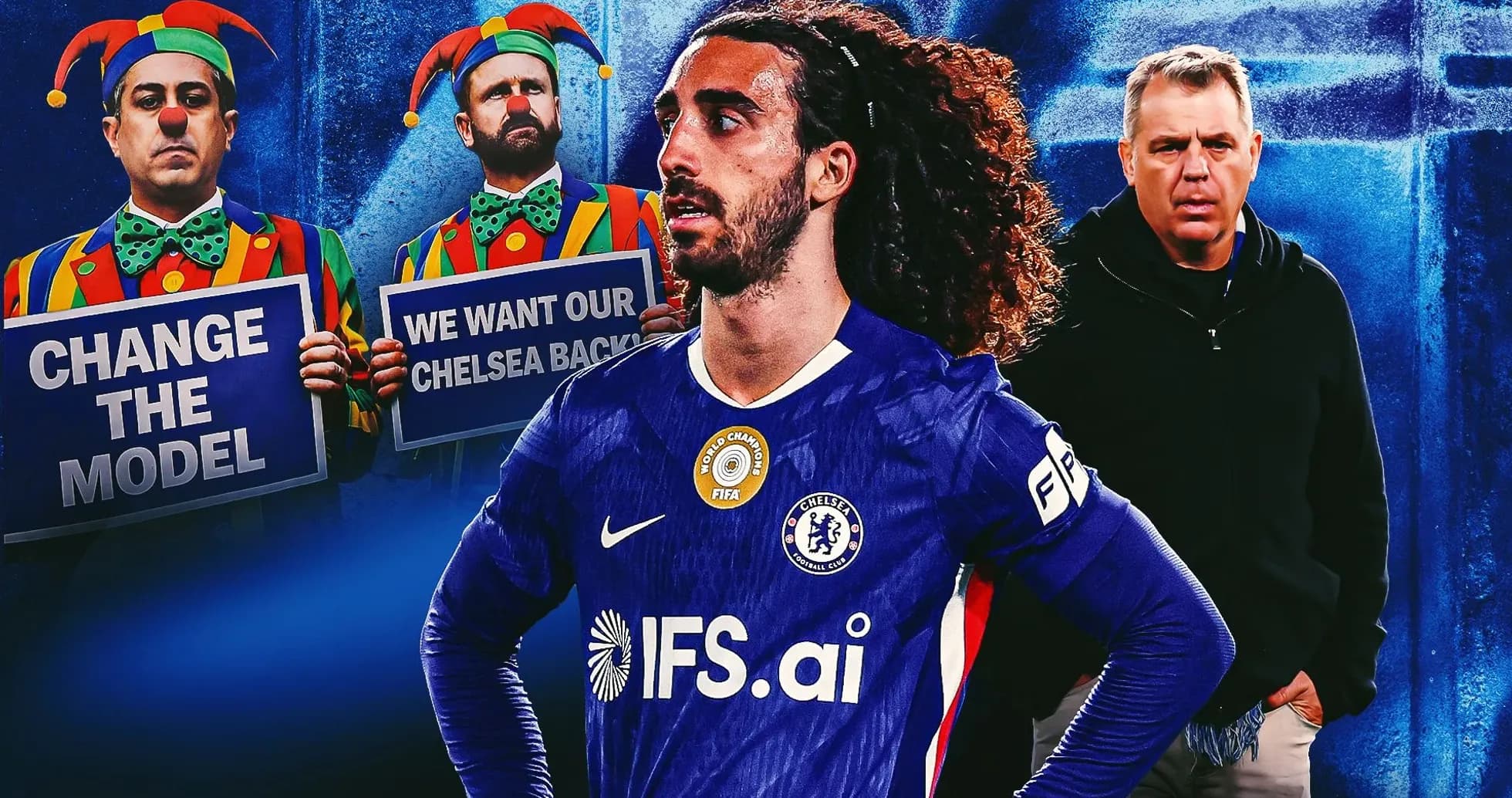
At the same time, Chelsea have spent more than £250 million on players from Brighton alone since 2023, bringing in Marc Cucurella, Moises Caicedo, Robert Sanchez and Joao Pedro. They also lured Graham Potter and sporting director Paul Winstanley away from the south coast. That Brighton raid, on and off the pitch, was supposed to import a model. Instead, it has become a symbol of a project trying to buy an identity rather than build one.
Now, the club accepts it needs a different balance. The new brief for this summer is clear: target "emotionally resilient", "mature" and "Premier League-proven" players who can deliver immediately. A centre-back is on the list. A midfielder too. Possibly a goalkeeper. The emphasis is on ready-made impact, not just potential.
That does not automatically mean a pivot to older stars, but it is a decisive move away from the endless churn of speculative youth deals.
"I think we've done a few things right, a lot of things right," Eghbali said. "We've got to be better on a few things, to add more ready-made players at this part of the project, to take (it) to the next level, to be consistent over time. We recognise we need balance. You tweak a model, you improve, you learn from mistakes."
He added: "The view is now that we're here with a great core base, to add some of that experience, to take the team to the next level and have consistency. That fact is not lost on us."
The irony is hard to miss. Chelsea arrive at Brighton at one of the lowest points of the BlueCo era, just as they prepare to abandon the very recruitment blueprint they tried to copy from the Seagulls, only with a billion-pound budget attached.
Fans demand their club back
Supporters have heard the talk before. What they see is a club that has burned through managers, muddled its squad planning and drifted away from the ruthless, coherent Chelsea that dominated the Abramovich years.
Last week, the Chelsea Supporters’ Trust published an open letter to the ownership, board and senior leadership team. Its tone was stark.
"Chelsea supporters have been asked to accept an unprecedented level of change in the name of a long-term vision that has never been clearly or consistently explained. Four years on, that vision has still not earned their trust," it read.
"This is not a reaction to a single result or a run of form. It reflects a deeper and more sustained concern about the direction of Chelsea Football Club, and the growing lack of confidence among supporters in the leadership, structure, and strategy that underpin it."
The letter went on: "The vision remains unclear, its execution inconsistent, and its leadership insufficiently accountable. That is why this matters. Chelsea supporters are not simply asking to win every year. They are asking to recognise the club they have always supported. At the moment, too many do not."
Before the United defeat, hundreds of fans gathered outside Stamford Bridge to protest. Banners declared "BlueCo OUT!" Chants of "we want our Chelsea back" echoed around the streets, alongside vocal support for former owner Roman Abramovich.
Those scenes are a warning. If this summer does not bring a clear shift — in recruitment, in results, in the sense of direction — the protests will not just return. They will grow, they will harden, and they will define the next chapter of a project that promised transformation and has, so far, delivered turmoil.
Chelsea go to Brighton needing a win to spark their season. Their owners go into the summer needing a window to save their project. Which comes first?