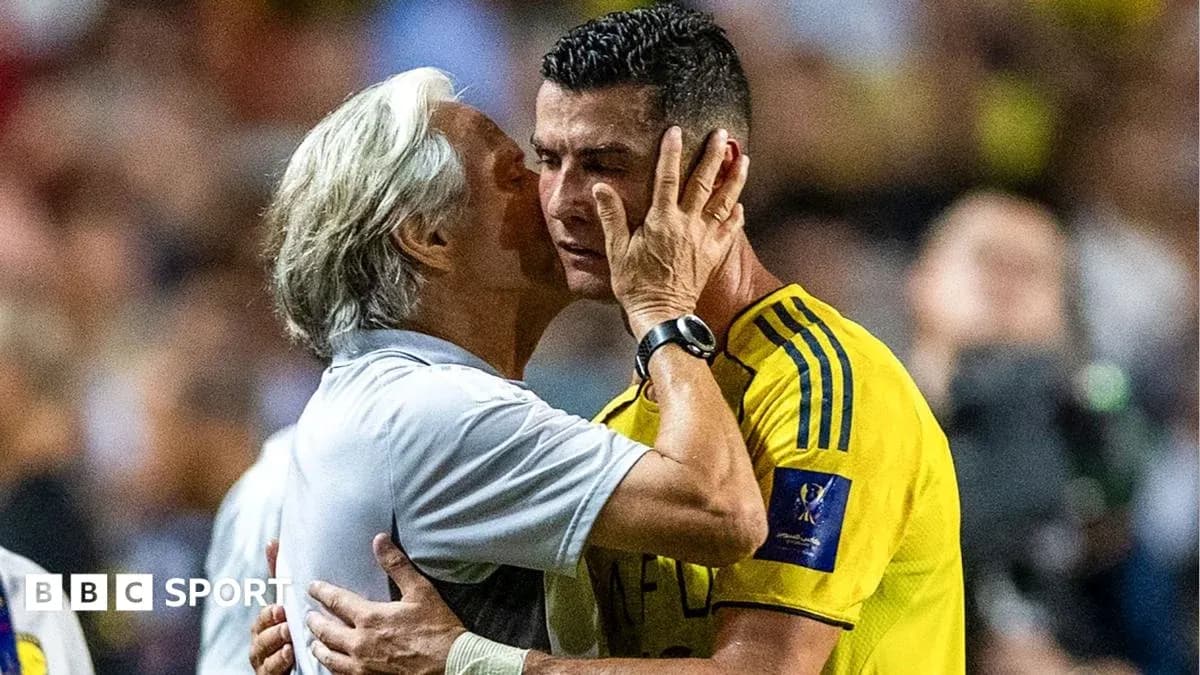
Cristiano Ronaldo's Portugal Exit Surprises Jorge Jesus
Cristiano Ronaldo chose his moment. Not on the pitch, not with a last-minute header or a free-kick bent into the top corner, but with an Instagram video that landed like a thunderclap across Portugal.
One day before Jorge Jesus was due to unveil his squad for this month’s Nations League fixtures, the 41-year-old captain announced he was retiring from international football. No leaks. No whispers. Just a message to the world.
And the national team coach found out like everyone else.
“I found out when we all did,” Jesus admitted on Friday, sitting in front of the cameras and microphones, clearly still processing the timing. “Until then, I knew nothing about it. He was playing, he was scoring goals; he was one of the players on my squad list.”
Ronaldo, in form again at Al-Nassr, had just served a 30-day suspension from international duty – a ban that, crucially, did not overlap with any Portugal fixtures. From a purely sporting perspective, he was available. Fit. Scoring. Selected in the coach’s mind, if not yet on paper.
Instead, the greatest player in Portugal’s history chose to close the book himself.
A Fractured Final Chapter
This was not a farewell scripted in harmony.
The tension between Ronaldo and Jesus had been simmering since September. The five-time Ballon d’Or winner left the Portugal camp after being told he would not start a Nations League match against Denmark four days later. It was a brutal call on a player who had spent two decades as the first name on every team sheet.
Ronaldo later accused Jesus of having “broken his word”, accepted that he deserved punishment for walking out, and insisted at the time that he would not retire from international football. The relationship never fully recovered.
On 27 September, away to Norway, Ronaldo sat on the bench and stayed there. Unused. His final international appearance had already been played three days earlier, a 1-0 win over Wales in Lisbon. No guard of honour. No lap of appreciation. Just another victory, another cap, another goal-less but decisive contribution in a long line of them.
Only now does that night carry the weight of history.
It was his 234th game for Portugal. He finished with 146 international goals. Both are men’s world records. The numbers feel almost unreal, but they are carved into football’s record books as firmly as his role in Euro 2016, when he helped drag Portugal to their first major trophy.
Jesus Stands His Ground
By Friday, the focus at the Portugal news conference had shifted away from tactics and squad balance. Every question circled back to one man. Every angle probed the same sore point: the rift with Ronaldo.
Jesus’ patience thinned as the interrogation went on. His voice hardened.
“All my decisions were made with the team in mind,” he said. “As a manager, I have always defended what was best for the team. I am at peace with my decision.”
He repeated that he had received no prior warning from Ronaldo and confirmed he had not contacted the forward since the announcement. For now, there is distance – emotional and literal – between the coach and the captain who used to define Portugal’s identity.
The message from Jesus was clear: he will not rewrite his choices, even if those choices helped accelerate the end of an era.
A Legend the Federation Cannot Ignore
If the coach sounded firm, the Portuguese Football Federation spoke with something closer to reverence.
PFF president Pedro Proenca promised that Ronaldo will be honoured properly, whenever the moment can be arranged and whatever form it takes.
“No tribute will ever be enough to thank him for everything he has done for Portuguese football, for Portugal,” Proenca said. “The best way to honour and celebrate him is to honour his boundless ambition, to always play to win, to never be afraid of being the best in the world. Thank you for everything, captain. This is and always will be your home.”
The contrast was striking. On one side, a coach defending his authority and his decisions. On the other, an institution already preparing the stage for a farewell befitting a global icon.
Between them stands Ronaldo’s legacy: 21 years, 234 caps, 146 goals, a European Championship, and a standard of competitiveness that reshaped what Portugal expects from itself.
He did not get the farewell match he once seemed destined for. No choreographed goodbye. No final roar from a packed Estadio da Luz with everyone knowing it was the last dance.
Instead, the end arrived with a video, a decision taken on his own terms, and a national team forced to move on overnight.
Portugal will find new heroes. They always do. But they will never have another first like Cristiano Ronaldo.