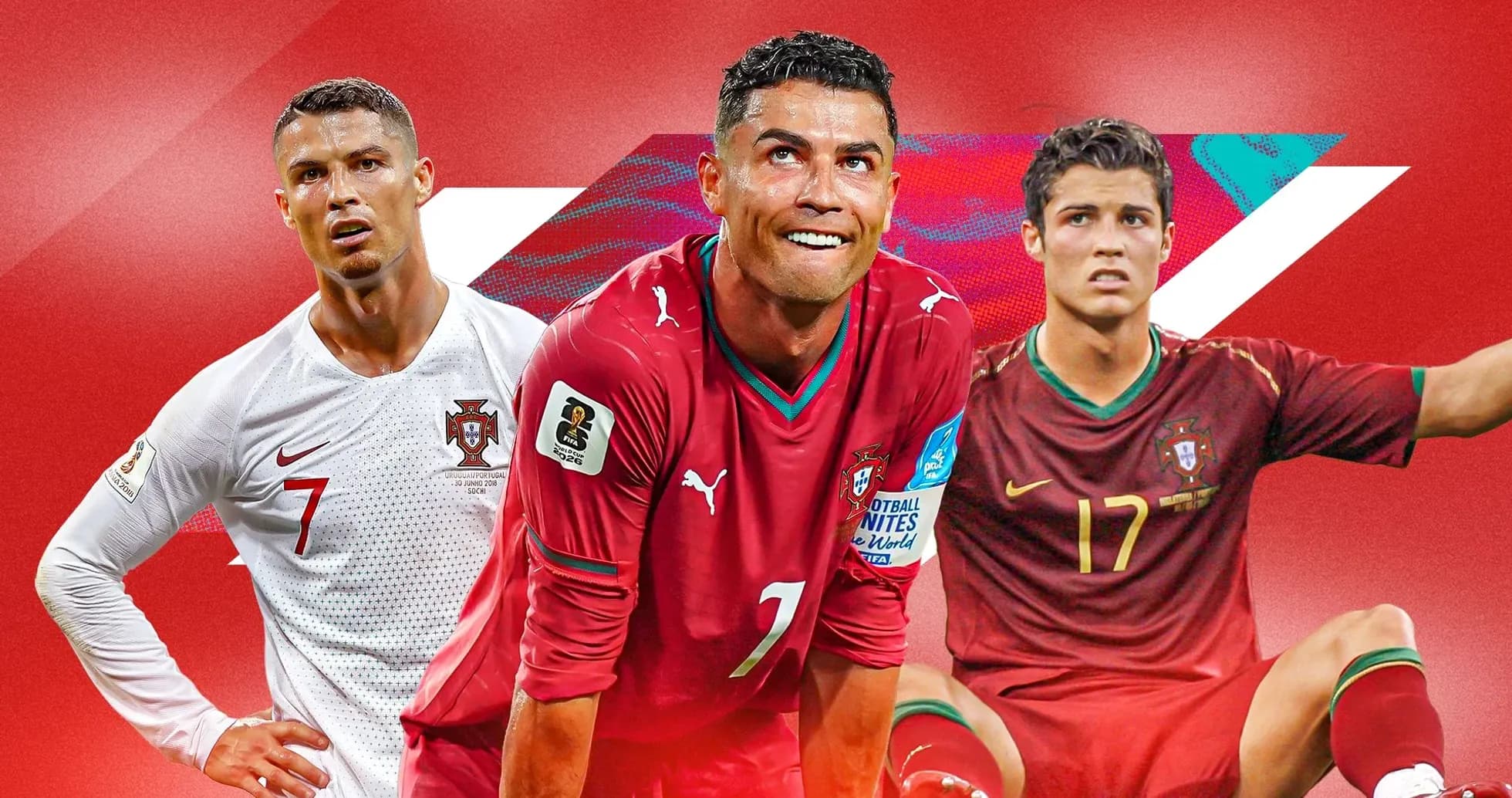
Cristiano Ronaldo’s World Cup Journey: A Tale of Triumph and Heartbreak
Cristiano Ronaldo’s World Cup story has never been simple. It has been loud, polarising, often brilliant, and, crucially, incomplete.
It began in 2006 with a penalty against Iran, a neat finish that made him Portugal’s youngest-ever scorer on football’s biggest stage. One goal, group stage, job done. At 21 he was still all step-overs and raw electricity, a winger rather than the penalty-box predator he would later become. The lack of goals in the knockout rounds barely registered.
His behaviour did.
In the quarter-final against England, Wayne Rooney saw red for a foul on Ricardo Carvalho. Cameras caught Ronaldo racing towards the referee, protesting furiously. When Rooney walked, Ronaldo’s infamous wink towards the Portugal bench detonated a storm.
Steven Gerrard did not hold back. He claimed Ronaldo had effectively “given” the referee the card and said he would be “absolutely disgusted” if a club team-mate had done the same. Frank Lampard called it “not nice” and pointed out that players had been warned about trying to influence cards.
Ronaldo converted the decisive penalty in the shootout win over England and insisted he had done nothing wrong. FIFA’s technical study group saw it differently. In a nod to sportsmanship, they handed the young player of the tournament award to Lukas Podolski instead. Holger Osieck, who headed the group, made the message clear: players should be role models, and they had been “critical” of Ronaldo’s behaviour.
The world had been introduced not just to his talent, but to the theatre that would follow him for the rest of his career.
By 2010, the boy had become the face of a nation. Ronaldo arrived in South Africa as Portugal’s captain and undisputed talisman. The campaign fizzled. One goal, the sixth in a 7-0 demolition of North Korea, was his only strike at the tournament and his first at international level for 16 months.
When Spain edged Portugal 1-0 in the last 16, it cut deep. Ronaldo spoke of feeling “completely disconsolate, frustrated and an unimaginable sadness.” Then came the flashpoint. Asked to explain the defeat, he was caught on camera saying, “Ask that question of Carlos Queiroz.”
At home, the reaction was swift. Was the captain hanging his coach out to dry? Ronaldo later tried to soften the blow, explaining that Queiroz was about to hold a press conference and insisting he meant no disrespect. He reminded everyone that he was human, that he suffered, and that he accepted his responsibilities as captain.
Queiroz’s reply was pointed. He said he would never accept “anyone placing himself above the best interests of the national side.” Portugal needed Ronaldo, he argued, and Ronaldo needed Portugal – but if the shirt unnerved a player, they had no right to wear it.
The tension between individual and collective, between global icon and national servant, was out in the open.
Four years later, Ronaldo dragged Portugal to Brazil almost single-handedly. His four goals in the play-off against Sweden, including a devastating hat-trick in Solna, effectively punched their ticket to the 2014 World Cup.
He arrived insisting he was “100 percent fit” despite nagging knee and thigh issues. The pitch told a different story. He looked diminished, a shadow of the Real Madrid superstar who had terrorised Europe.
Germany tore Portugal apart 4-0 in their opening game. Ronaldo barely flickered. He produced a brilliant late cross for Silvestre Varela’s equaliser in a 2-2 draw with the United States, then struck an 80th-minute winner against Ghana. It was not enough. Portugal finished third in Group G and went home early.
The criticism came, as it always does. Missed chances, subdued performances, questions over his fitness. Coach Paulo Bento stepped in front of the bullets. He refused to blame individuals, took responsibility himself, and stressed that Ronaldo, usually so ruthless, had simply lost his edge at the wrong moment. One player, he insisted, would not be made the scapegoat.
Russia 2018 felt like Ronaldo’s riposte.
On opening night against Spain in Sochi, he delivered one of the great World Cup performances. A hat-trick in a 3-3 classic, capped by a sensational late free-kick – his first from a dead ball at a major international tournament. He tore at Spain, twice put Portugal in front, and still had enough left to bend that final set piece into the top corner.
Afterwards, he spoke of a “personal best” but quickly shifted the spotlight to the team. Portugal had faced one of the favourites, he said, and earned a fair draw. The group, he insisted, would “do well for sure.”
They did not. Portugal reached the last 16, but Ronaldo went quiet again when it mattered most. Against Uruguay, in a cagey, bruising contest in Sochi, he failed to score or assist as the Seleccao fell 2-1. At 33, with four World Cups behind him and no goal in a knockout round, the obituaries for his tournament career began to write themselves.
Ronaldo refused to confirm anything. He told FIFA it was not the right time to discuss his future, but backed the squad, calling it a fantastic, ambitious group that would keep Portugal among the world’s best. The door remained half-open, half-closed.
Qatar blew it off its hinges.
He arrived under a cloud, his second spell at Manchester United ending in chaos and acrimony. This was supposed to be the great last act: critics silenced, reputations repaired, the missing trophy finally in reach.
Instead, the World Cup mirrored his Old Trafford exit. One goal, from the penalty spot against Ghana. Frustration boiling over when Fernando Santos substituted him in the defeat to South Korea. Reports that he had threatened to walk out after being dropped for the last-16 tie with Switzerland.
On the pitch, his replacement Goncalo Ramos hit a stunning hat-trick in a 6-1 win. Off it, Ronaldo’s body language and visible anger jarred with the image of the eternal leader.
After Morocco ended Portugal’s run in the quarter-finals, Ronaldo headed straight down the tunnel, in tears, offering a stark picture of a superstar wrestling with the end. Later, on social media, he pushed back. He insisted his dedication to Portugal had “never wavered for an instant” and that he would never turn his back on his team-mates or his country. He thanked Portugal, thanked Qatar, and left the rest to “time” and public judgment.
He also admitted something more personal: the dream of winning a World Cup for Portugal, the biggest ambition of his career, had ended. Five tournaments, 16 years, everything left on the pitch – but no trophy. The words carried the weight of finality.
The consensus hardened. At 37, with his only goal in Qatar coming from the spot, with public spats and benchings overshadowing his football, many concluded that the World Cup chapter of his career had closed.
Yet here he is again.
In a 5-0 win over Uzbekistan, as the final whistle sounded, Ronaldo turned to a nearby camera and shouted, “I’m back! I’m back!” It was pure Ronaldo: defiant, theatrical, utterly convinced.
The evidence remained mixed. He had laboured in the opening draw with DR Congo. His two goals against Uzbekistan came against a side ranked 60th in the world. The temptation to declare a renaissance was strong; the wiser heads held back.
They were right to. Against Colombia, in a game that decided top spot in Group K, Ronaldo struggled again. Portugal were held to a controlled 0-0 draw in Miami, second place secured, but momentum blunted. Colombia finished above them, and the path immediately grew more complicated.
Now comes Croatia. Luka Modric still pulls the strings, even if the legs around him are not what they once were. It is a side that looks past its peak but remains dangerous, awkward, proud.
The same description fits Ronaldo.
At 41, he has already shown he can still find the net at this level. The penalty against Ghana in 2022, the brace against Uzbekistan, the flashes of movement that hint at the old instincts. Yet the one statistic that stalks him refuses to budge: no goal in a World Cup knockout match.
For all the records, all the goals, all the nights when he bent tournaments to his will, that blank line remains. One more chance now, against a fading but wily Croatia, to scratch it out.
The stage is set again. The question has not changed.
Can Cristiano Ronaldo, in what feels like the final reel of this long-running drama, finally score the World Cup knockout goal that has eluded him his entire life?