Daniil Medvedev Critiques Roland Garros Tennis Balls
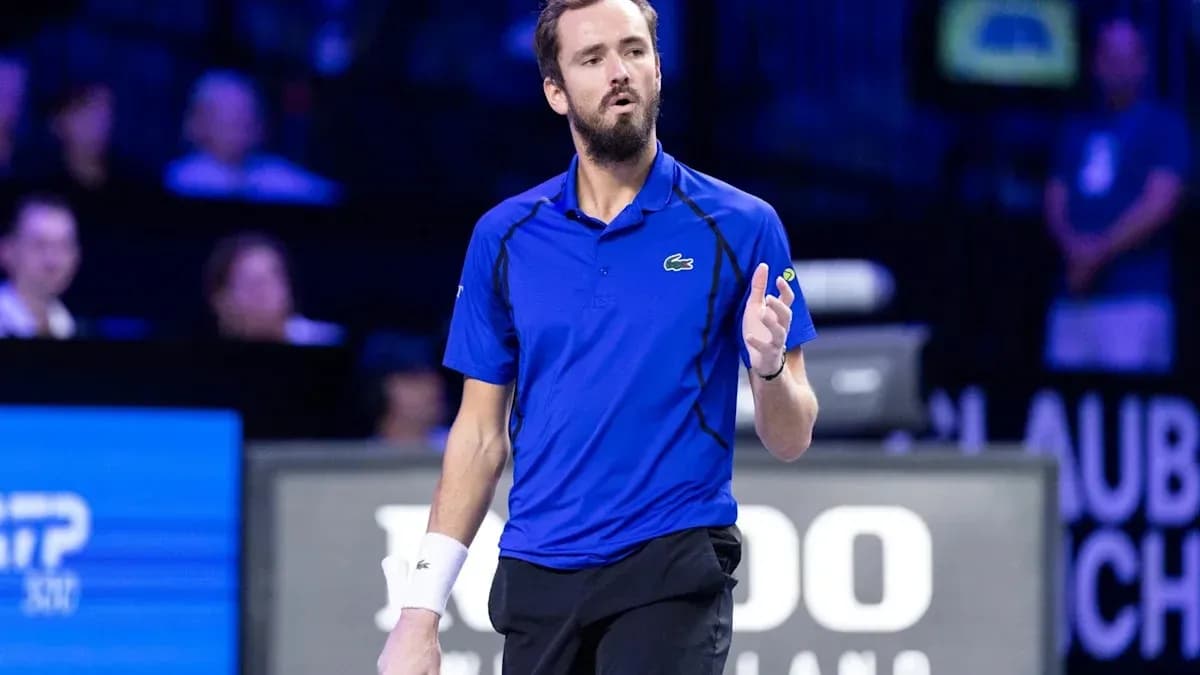
Daniil Medvedev has never been shy about saying what he thinks. Courts, crowds, schedules – nothing is off limits. Now, he’s gone after something far smaller but just as contentious: the tennis balls at the Grand Slams.
Fresh from winning the Almaty Open, Medvedev sat down with Russian outlet Bolshe and was presented with a curious stat. This season, he has held serve in 81.4% of his service games when using Wilson balls. With other brands, that number jumps to 87.1%. The numbers opened the door, and Medvedev walked straight through it.
“Probably the worst ball”
The world No. 4 drew a sharp line between the Wilson balls used at the US Open and those used at Roland Garros. Same manufacturer, completely different verdict.
“Wilson balls are different. The Wilson US Open ball is completely different from the Wilson Roland Garros ball,” he said, before launching into a brutal assessment of the clay-court major’s choice. “Wilson Roland Garros, in my opinion, is probably the worst ball, worse than the Head ball in Rotterdam. That’s just my opinion, of course.”
He did add context. These aren’t the complaints of a player who has never managed to win with them.
“I played a quarter-final with them, so it’s not like I’ve never won a single match with them. I reached the Roland Garros quarter-final with them, but for me they’re just terrible,” he said. “Before that they were Babolat. I always lost with them in the first round, I think I didn’t win a match, but in my opinion they were much better balls. You can play better tennis with them.”
It is a striking contrast. On paper, Medvedev achieved more at Roland Garros with Wilson balls than with Babolat. On court, he still feels the older ball let him “play better tennis.” The numbers say one thing; his arm, and perhaps his instincts, say another.
The US Open ball gets a longer leash
His view of the Wilson ball in New York is less explosive, but still layered with doubt.
“Wilson US Open is a different, longer story. In general, I liked them more than not. Whether they’ve changed over the years, I don’t know,” he admitted.
That uncertainty turned into a talking point on the road. In China, before Hangzhou, he and Andrey Rublev compared notes during practice.
“We were in China, practicing before Hangzhou, where we both reached the final and it just felt better than how it felt in America for those six weeks. We were just playing well,” Medvedev recalled.
The debate quickly became about whether the balls had changed, or the players had.
“I said to him, ‘Listen, we used to play fine, so it’s probably something that changed in us, not the balls.’ He said, ‘Listen, I don’t know, it seems to me that the balls have changed.’ I was like okay I hope that’s the case, because it means it wasn’t just me who played badly in America, the balls also contributed to that.”
The comment says plenty about the mental side of the sport. When the feel goes, players search for answers. Sometimes they look at their technique. Sometimes they look at the equipment.
When the backhand disappears
Medvedev then went straight to the heart of his discomfort in the US swing.
“You showed the serving stats, but in America I couldn’t hit a backhand in the court, it just flew straight into the net no matter what I did and when I can’t hit a backhand, I can’t win tournaments. It’s not going to happen,” he said.
The description is vivid, and brutally honest.
“When the ball flies into the net on the backhand, I get lost. I start thinking about playing pickleball, curling, and so on.”
It is partly a joke, but it underlines a serious point. At the highest level, a small change in ball feel – the way it grips the strings, the way it reacts to spin, how quickly it fluffs up – can tilt a player’s entire game off balance. For a flat, aggressive hitter like Medvedev, that margin is even thinner.
Roland Garros: the outlier in a Grand Slam career
There is also an awkward truth sitting behind his criticism of the French Open ball. Roland Garros is the only major where Medvedev has not gone beyond the quarter-finals. It is also the only Slam where he failed to win a single match this year.
Surface plays a huge part. Clay has never been his natural habitat. Still, when the same tournament stands out as a statistical and emotional outlier, the equipment inevitably comes under the microscope.
His comments land in a wider debate. Players across the ATP Tour have raised concerns about the variety of balls used week to week and their possible link to a rise in wrist and elbow problems. Medvedev’s words don’t directly address injuries, but they feed into the same conversation: consistency, feel, and the physical toll of constant change.
A very different tune in 2020
What makes his latest blast at Roland Garros especially intriguing is how far it sits from his stance when the tournament first switched to Wilson in 2020.
Back then, the move away from Babolat stirred up immediate controversy. Even Rafael Nadal, the ultimate authority on Parisian clay, criticised the change. Medvedev, though, sounded almost optimistic.
“Maybe it can help me that it’s a bit colder, so the balls don’t fly as much, don’t go as spinny,” he said at the time. “So maybe I can play some flat tennis in practices. I think it can be an opportunity for me actually, an advantage.”
He even went as far as to say he liked the new ball.
“I like the balls because, yeah, tennis is a funny and interesting sport… It’s normal that when one player doesn’t like something, second one maybe is going to like it. So far I like it. I think it suits me not bad.”
Four years on, the tone could hardly be more different. The ball he once saw as a potential advantage has become, in his words, “probably the worst.”
Maybe his game has evolved. Maybe the balls have. Maybe the expectations around him have shifted so dramatically that what once felt acceptable now feels like a barrier. Whatever the reason, Medvedev has drawn a clear line in the clay.
The next time he walks into Roland Garros, he will do so with a Grand Slam title on hard courts, a complicated history on clay, and a very firm opinion about the ball in his hand.