Dortmund's New Dimension: Konstantelias and Karetsas Shine in Bundesliga Opener
Borussia Dortmund had been crying out for this. For players who don’t just keep the ball moving, but rip games open. On Saturday night at Signal Iduna Park, they finally got them – and then, just as quickly, they might have lost one.
“These are two lads who can and will give us a different dimension here, and they showed that today,” Niko Kovac told Sky after the 2-0 win over Hamburger SV. He meant Giannis Konstantelias and Konstantinos Karetsas, two Greek newcomers who turned Dortmund’s Bundesliga opener into a showcase of what this team could become.
Not the sterile, possession-heavy stuff that has too often drifted through this stadium in recent seasons. This was spectacular football with purpose. Flicks and feints that hurt the opponent, not just pleased the crowd.
Kovac had hinted at it before kick-off. The new personnel, he said, bring “spectacular things” that people demand, technically strong players who can finally raise the bar again. Ninety minutes later, he had his evidence. And a problem.
A new dimension between the lines
The contrast with Julian Brandt’s era was obvious. Brandt, now at Ajax, was Dortmund’s long-time creative hub. Konstantelias and Karetsas can do much of what he did – but they add a gear he never quite had.
Both can explode from a standing start. Both are more proactive, more insistent. In those tight spaces between the lines where games are won, they don’t just keep the ball alive; they generate chaos, force defenders into bad decisions, create new situations out of nothing.
Against HSV, that quality lit up the first half.
Karetsas and Konstantelias repeatedly drove Dortmund forward, demanding the ball, turning on the half-space, slicing through Hamburg’s midfield. Konstantelias built on the flashes he had shown in the Super Cup defeat to Bayern Munich: tight control at full speed, low centre of gravity, effortless changes of direction. When Dortmund lost the ball, he didn’t drift. He hunted.
One ball win in midfield after around half an hour, followed by an immediate surge towards goal, drew a roar from the Südtribüne that felt like a collective exhale. This, at last, was something different.
Then came the goal.
Konstantelias lights it up – then limps off
Shortly before the break, Konstantelias made it 2-0 and marked his Bundesliga debut with his first BVB goal. The finish carried a touch of fortune – the ball deflected off a Hamburg defender – but the idea behind it showed his class. The Greece international shaped for the near corner and struck a no-look effort that wrong-footed everyone.
“First half top, it was perfect. We implemented everything we wanted to implement,” defensive leader Waldemar Anton told Sky, raving about Dortmund’s display before the interval.
Within roughly 100 minutes in a black-and-yellow shirt – Super Cup and league combined – Konstantelias had already positioned himself as a potential fan favourite. The verve, the courage, the constant willingness to take responsibility in tight zones: you could see the future being sketched out.
Then it twisted. Literally.
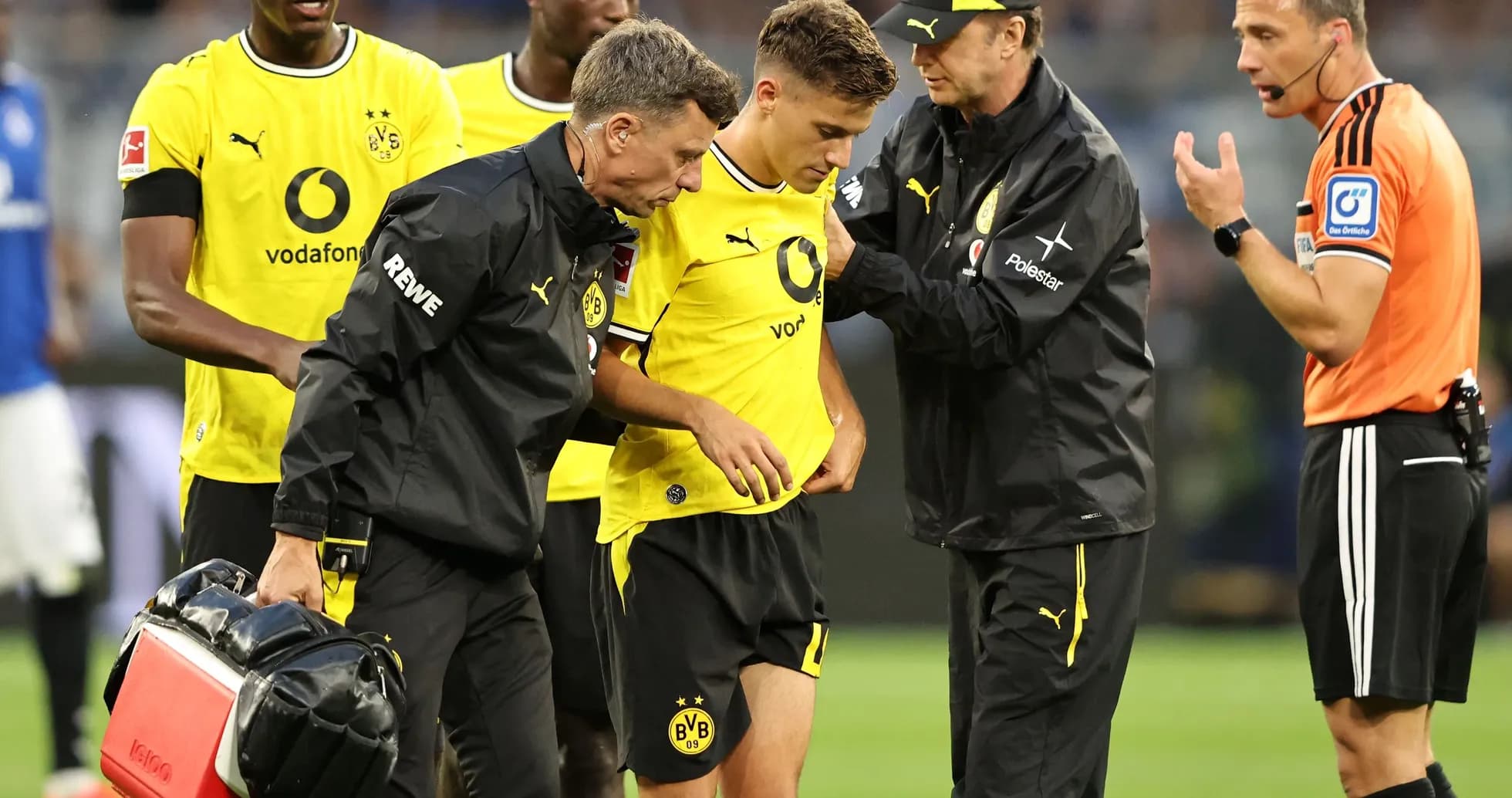
Just after narrowly missing his second goal, Konstantelias went into a challenge, his knee seeming to give way with an awkward movement. He dropped to the turf. The stadium fell quiet. When he left the pitch in the 54th minute, his face said everything: he feared what everyone else did.
Fear of the worst
“Of course, we should be a little bit careful today about what we communicate. But we are certainly concerned about a more serious injury,” sporting director Ole Book told Sky. Asked directly whether a cruciate ligament tear was on the table, he didn’t dodge it: “That concern is there.”
Kovac’s tone after the game matched the mood. “We will have the examination on Sunday. But at least it doesn’t sound good from what the doctor told me,” the coach admitted.
If Sunday’s scans confirm those fears and Konstantelias is ruled out for months, the blow would be brutal. For a player who had just kicked the door open on a new chapter in his career. For a club that had just watched him transform their attacking play in real time.
The difference without him was immediate.
From flow to friction
The 26-million-euro signing had already shown exactly why Dortmund pushed so hard to bring him in. With him on the pitch, attacks had a rhythm, a tempo, a sense of inevitability. Without him, the second half felt heavier.
HSV improved, yes. They stepped higher, took more risks. But Dortmund also lost a huge amount of mobility and inventiveness when Konstantelias walked off.
“When Dortmund play from right to left, play into the spaces in between, then first of all you do a lot of chasing and don’t really manage to get into the press. That was our problem,” Hamburg captain Nicolai Remberg explained on Sky, summing up the torment of that first half.
At the heart of that torment: Konstantelias and Karetsas.
The two Greeks constantly rotated, dropped into pockets, switched sides, and kept the ball moving at a speed HSV couldn’t handle. Perfect first touches, quick decisions, sharp angles. Anton called their performance “brutal” – meant as the highest compliment.
“The mobility they have, how dangerous they are, that is a great quality at that age and we need that for the future as well. I am glad we have them with us,” he said.
Which is why the thought of Karetsas now having to operate without his ideal partner, potentially for a long spell, feels like such a waste of momentum.
The replacement puzzle
Dortmund now face a pressing question: how do you replace a profile like Konstantelias at such short notice?
“I felt incredibly sorry for the lad. He has had a great presence here from day one, also in the dressing room. We all already like him very much,” Book stressed. “When you then play such a good first half and have to be substituted and something more serious is feared, it is just unbelievably annoying.”
On Saturday, Kovac turned to Marcel Sabitzer. The Austrian offered defensive stability, positional discipline – but not the same spark. That’s not his game.
On paper, Samuele Inacio looks the closest like-for-like option in the squad. The 18-year-old has the talent, the dribbling, the courage between the lines. What he doesn’t yet have is trust and rhythm at this level, and his lightning red card cameo against HSV did nothing to ease those doubts.
Maximilian Beier is the more seasoned choice, but using him centrally would force Kovac to abandon his plan of deploying the Germany international on the flank. Solve one problem, create another. The wing role Beier was earmarked for would suddenly be vacant again.
All of this is playing out with the transfer window about to slam shut. The deadline looms on Tuesday, 1 September, at 8pm. Officially, Dortmund are not planning any late moves.
“Depending on how serious the injury actually is, we will align our next steps accordingly. But one thing is certain: over the next three days, we are not planning anything,” said sporting managing director Lars Ricken.
That sounds calm. It doesn’t sound definitive.
The Sancho question
Some options are already off the table. Said El Mala, once high on Dortmund’s list before the Konstantelias deal, has extended his contract at 1. FC Köln. That door is closed.
Another, more familiar name, may now drift back into focus: Jadon Sancho.
On paper, he fits. A similar type of player to Konstantelias, capable of creating dynamism from a standing start, combining one-on-one brilliance with playmaking between the lines. His name has hovered around Dortmund for months, speculation bubbling in the background. The double signing of Karetsas and Konstantelias seemed to shut that down.
Now? The equation changes.
Sancho’s best football came in Dortmund colours. Since leaving Manchester United as a free agent, the 26-year-old has yet to find a new club and would cost no transfer fee. Financially, the risk is low – if he accepts a significant pay cut for what would be a third spell at BVB.
The sporting risk is another matter. Can he still reach those old heights? His recent loans at Chelsea and Aston Villa were largely underwhelming. The explosiveness, the joy, the end product that once made him one of Europe’s most feared young attackers have been missing for some time.
Dortmund suddenly stand at a crossroads they didn’t expect to face this early in the season. Do they trust the internal solutions and ride out a potential long-term absence for Konstantelias? Or do they roll the dice on a familiar face whose past in black and yellow shines brighter than his present?
The answer might define what this “different dimension” Kovac talked about really becomes – a fleeting glimpse, or the start of something lasting.