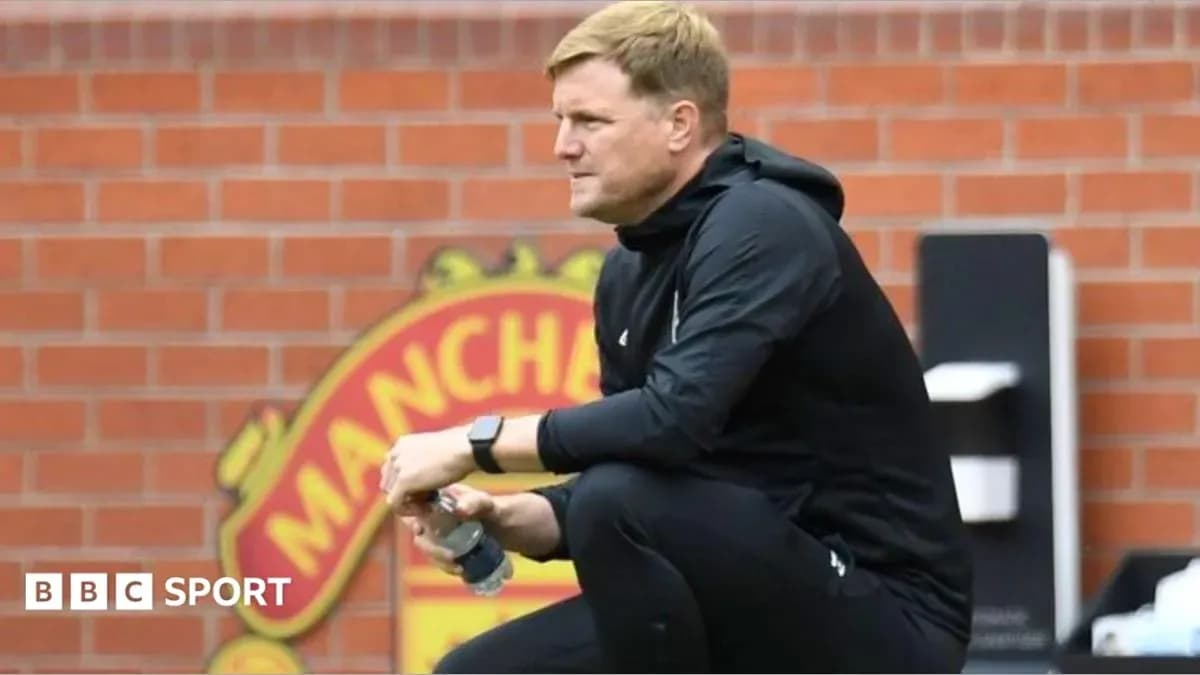
Eddie Howe's Candidacy for Manchester United: The Future of a British Rebuild
When Sir Jim Ratcliffe bought into Manchester United in early 2024, he sold a clear idea: a rebuilt club with a hard British spine, from the dugout to the dressing room. It was a vision steeped in heritage and identity, a deliberate tilt back towards the club’s roots.
Less than two years on, that romantic notion is running headlong into reality.
Michael Carrick, the first permanent British manager of the Ineos era, is fighting to keep his job. Performances have dipped, results have followed, and the mood around Old Trafford has curdled. The experiment is under strain.
Yet if Carrick cannot arrest the slide, United are not preparing to abandon the British blueprint. They are looking at Eddie Howe.
Howe’s body of work
On paper, it is not a hard sell.
Howe’s reputation has been built the hard way, far from the cosseted comfort of superclubs. At Bournemouth, he walked into a club staring at relegation from League Two in January 2009 and dragged them not just to safety, but all the way to the Premier League by 2015. He then kept the Cherries in the top flight and made them feel like they belonged there before his second departure in 2020.
At Newcastle, he repeated the trick on a bigger stage. Appointed in 2021 with the club in relegation trouble, he steered them clear of danger and then into the Champions League on two occasions. In 2025 he delivered the EFL Cup, Newcastle’s first trophy in 56 years. That is not a fashionable résumé. It is a substantial one.
Those who have worked with Howe talk about an obsessive on the training ground, a coach who hammers home detail and demands improvement every day. They describe a manager who treats culture as a non‑negotiable, building habits and standards rather than relying on slogans.
He has never led one of England’s traditional “big six”. But his work at Bournemouth and Newcastle has been about transformation, not maintenance. That is precisely what United need.
A divided audience
And yet, the reaction to Howe’s emergence as a serious contender for the United job has been laced with scepticism.
Sections of the fanbase have made their feelings clear on social media: Howe, they argue, is not a big enough name to manage Manchester United. The badge, in their eyes, demands a superstar. A Champions League winner. A serial title collector. Not the man who built Bournemouth and rebuilt Newcastle.
Former players have not exactly smoothed the path. On their podcast, Paul Scholes and Nicky Butt stopped short of offering full-throated backing for Howe, even if they had spoken positively about his potential appointment back in January when Ruben Amorim was sacked. The tone has shifted with the pressure.
Others from United’s past see it differently. Roy Keane has publicly backed Howe as a realistic and credible successor to Carrick. Darren Bent, Gareth Barry and Jack Wilshere have also put his name forward as the right fit for Old Trafford.
As always in a club of this size, every candidate attracts noise. The job is too big, the spotlight too harsh, for unanimity. The real decisions will not be made on podcasts or timelines, but in meeting rooms.
Chief executive Omar Berrada, sporting director Jason Wilcox and director of recruitment Christopher Vivell will lead the process. Their first call is not about Howe at all. It is about Carrick, and whether Saturday’s match against Chelsea becomes a turning point or a full stop.
The money and the mechanics
If Carrick goes, the numbers start to matter.
United have spent heavily in recent years not just on players, but on the churn of managers and their backroom teams. Paying off Carrick and his staff would be the first bill before any new head coach walks through the door.
Howe, despite leaving Newcastle in the summer, does not come free. The details of his agreement with the club remain confidential, but the broad outline is understood. Any club or national team that wants him right now would need to pay a seven‑figure compensation fee to Newcastle.
Multiple sources have indicated that Newcastle, wary of seeing Howe walk straight into another job, put in place a compensation structure that reduces over time. The figure is believed to have started at £6m and has already dropped by half. That leaves a maximum of around £3m at present.
There is also an expiry date, understood to fall before the end of the season. After that, Howe can be appointed without any payment to Newcastle.
In a sport awash with vast sums, £3m for a manager of Howe’s calibre is not eye‑watering. Yet for a club that has burned through fortunes on managerial changes, it is no surprise if Berrada and Wilcox want to keep every cost under scrutiny.
Competing visions
Inside United’s football structure, Howe is not the only name in play.
Jason Wilcox is thought to favour the 48‑year‑old, seeing in him a coach who can impose a clear style and build a culture over time. Christopher Vivell, by contrast, is understood to prefer Julian Nagelsmann, the former Bayern Munich and Germany coach, whose profile fits more neatly with the “big name” bracket some fans crave.
Their recommendations will land on Berrada’s desk. From there, the decision moves upwards again. Sir Jim Ratcliffe, still the minority owner but heavily influential in football matters, and co‑chairs Joel and Avram Glazer will have the final say.
The choice between Howe and a figure like Nagelsmann is about more than tactics or formations. It is a statement of direction. A commitment either to the idea of a British‑led rebuild with a long‑term builder at the helm, or to the allure of a continental strategist with a different kind of glamour.
A club at odds with itself
The resistance to Howe among some United supporters is not entirely about him.
There is a wider disillusionment among matchgoing fans with the football decisions taken since Ratcliffe’s minority stake was confirmed. They have seen Erik ten Hag, Ruben Amorim and Michael Carrick all backed in turn, each bringing their own philosophy, each leaving behind a different imprint on the squad.
Wilcox himself has been a target, notably during the 3-0 home defeat by Bournemouth, when anger spilled over and the recruitment team felt the heat. In that context, any move he appears to champion is bound to be scrutinised and, in some quarters, opposed on principle.
Behind all of this sits a brutal truth: United’s squad is a patchwork. It has been assembled by six permanent managers, each with their own style, their own preferences, their own list of “must‑have” players. Any coach walking into that dressing room inherits a puzzle that does not quite fit.
Some argue no manager can truly succeed at Old Trafford until the structure above them is fully aligned and the squad is reshaped with a coherent plan. Others believe the right coach, with the right authority and clarity, can cut through the chaos.
That is the question Ratcliffe and his hierarchy must answer now. Is Eddie Howe that coach – the builder with the patience and steel to turn a fractured giant into a functioning team – or will United again reach for a different kind of name, and a different kind of gamble?