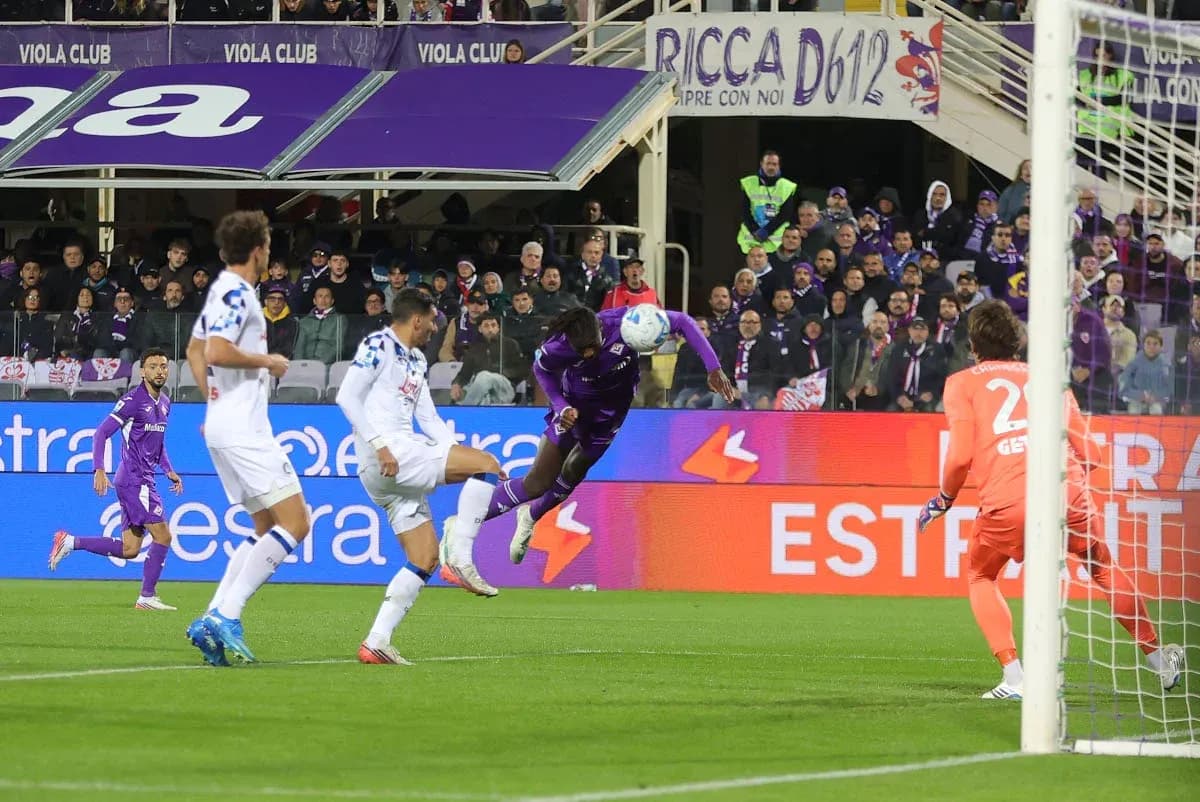
Fiorentina and Atalanta Share Points in Tactical Standoff
Under the Florence floodlights at Stadio Artemio Franchi, this felt less like “Regular Season - 9” in Serie A and more like a crossroads for both Fiorentina and Atalanta. The scoreboard finally froze at 2-2, but the 90 minutes told a richer story: a fragile Fiorentina clawing for identity and survival, and an Atalanta side torn between their attacking talent and structural absences.
I. The Big Picture – Two teams with opposite problems
Heading into this game, Fiorentina were 17th with 5 points from 9 matches, their goal difference a stark -10, built from 11 goals scored and 21 conceded overall. At home they had been particularly brittle: 5 matches, 0 wins, 2 draws, 3 defeats, with 5 goals for and 11 against. The numbers painted a side that scores 1.0 goals per game at home but ships 2.2 – a relegation trajectory if left unchecked.
Atalanta arrived in Florence in mid-table but with their own scars. They sat 12th on 11 points from 9 games, with a goal difference of -1, having scored 16 and conceded 17 overall. The split was telling: at home they were strong, with 3 wins from 5 and 11 goals scored, but on their travels they were fragile – 0 wins, 1 draw and 3 defeats away, conceding 9 and scoring only 5. Their away average of 1.3 goals for and 2.3 against suggested vulnerability whenever they stepped outside Bergamo.
This 2-2 draw, with Fiorentina overturning a 0-1 half-time deficit, fits both teams’ seasonal DNA: Fiorentina’s chaos, Atalanta’s away looseness, and a shared inability to close games down.
II. Tactical Voids – Absences that bent the game’s shape
The teamsheet was as much about who was missing as who started. Fiorentina were stripped of defensive and wide depth: A. Atta (abdominal strain), F. Parisi (knee injury), M. Pongracic (muscle injury), L. Ranieri (leg injury) and R. Sottil (back injury) were all ruled out. For a side already conceding 2.3 goals per game in total, losing three defenders and a winger forced P. Vanoli into a bold but risky 4-3-3.
The back four of Álex Jiménez, Radu Drăgușin, Viery and João Mário in front of David de Gea was therefore not a luxury choice but a necessity. Without Pongracic or Ranieri, Drăgușin and Viery had to anchor the line, and Vanoli leaned on Jiménez’s two-assist, two-goal league form to provide thrust from full-back.
Atalanta’s absentees were even more structural. R. Bellanova, I. Hien, F. Kessie, S. Kolasinac, O. Kossounou, G. Raspadori and G. Scamacca were all unavailable, almost an entire defensive and attacking spine removed. M. Sarri responded with a 4-2-3-1: M. Carnesecchi in goal, a back four of D. Zappacosta, T. Kristensen, R. Obrić and L. Bernasconi, with G. Gaetano and Éderson as the double pivot. Ahead of them, E. Elmas, C. De Ketelaere and N. Zalewski floated behind lone striker N. Krstović.
The disciplinary backdrop added another layer. Fiorentina’s season-long yellow-card distribution shows a peak between 61-75 minutes at 30.00%, with another 15.00% between 46-60. Atalanta, by contrast, concentrate their yellows late, with 33.33% between 61-75 and another 33.33% from 76-90, and their reds have come exclusively late as well, split 50.00% between 76-90 and 91-105. With Elmas and Gaetano both already on the red-card ledger this season, Sarri’s midfield had to walk a disciplinary tightrope.
III. Key Matchups – Hunter vs shield, engine room vs press
Hunter vs Shield: Krstović vs a leaky Viola back line
Nikola Krstović entered as one of Serie A’s most efficient forwards: 6 goals and 2 assists in 9 appearances, from 21 shots and 11 on target, with a rating of 7.21. He duels constantly – 65 contests, 30 won – and is comfortable attacking crosses or running channels.
He was up against a Fiorentina defence that, in total this campaign, had conceded 21 goals in 9 matches, with 10 of those on their travels and 11 at home. At home, they allow 2.2 goals per game; overall, they concede 2.3. The centre-back pairing of Drăgușin and Viery is physically imposing, but still learning. Viery, in particular, is a magnet for disciplinary drama: 3 yellow cards in 8 appearances, 9 fouls committed and 3 shots blocked, a defender who steps out aggressively and sometimes late.
The dynamic was clear: Krstović drifting onto Viery’s side, using his movement to exploit any mistimed step. Atalanta’s away scoring rate of 1.3 goals per game suggested they would not create a barrage, but with Krstović’s conversion and De Ketelaere’s service, they needed only moments rather than dominance – reflected in their ability to strike in the first half and remain dangerous in transition.
Engine Room: De Ketelaere and Gaetano vs Fagioli and Ndour
The true tactical heart of this match lay in the midfield duel. Atalanta’s creative axis is Charles De Ketelaere, one of the league’s top assist providers with 3 assists and 1 goal, 21 key passes and 273 total passes at 73% accuracy. He operates between the lines, drifting left or right, and his 26 dribble attempts (12 successful) make him a constant threat at receiving between pressure lines.
Behind him, Gianluca Gaetano and Éderson formed a double pivot. Gaetano’s numbers underline his two-way importance: 267 passes at 88% accuracy, 9 tackles and 9 interceptions. He is not just a recycler; he breaks up play and launches transitions. Éderson, more physical, adds 8 tackles and 3 blocks, reinforcing the central shield.
Fiorentina’s trio of C. Ndour, N. Fagioli and M. Brescianini were tasked with disrupting that structure. With Fiorentina having failed to keep a single clean sheet in total this season and conceding heavily in both halves, Vanoli needed their midfield to be more than a passing carousel – it had to be a pressing engine. The risk of over-aggression was baked in by the card profile: Fiorentina pick up 20.00% of their yellows between 16-30 minutes and another 30.00% from 61-75, a pattern of early over-commitment and late desperation.
On the ball, Fiorentina’s full-backs and wide forwards had to exploit Atalanta’s away fragility. Jiménez’s 12 key passes and 2 assists this season signpost him as a primary playmaker from deep. The front three of Franco Mastantuono, Mateo Pellegrino and A. Njie gave Vanoli verticality and one-v-one threat, ideal to attack the spaces behind Zappacosta and Bernasconi whenever De Ketelaere and Zalewski pushed high.
IV. Statistical Prognosis – Chaos, goals and fragile control
Overlaying the seasonal numbers with the tactical picture, a goal-heavy, unstable contest was always likely. Fiorentina’s overall scoring average of 1.2 goals per game and concession rate of 2.3, combined with Atalanta’s 1.8 scored and 1.9 conceded overall, skewed the probability towards a multi-goal draw or narrow away win.
Atalanta’s single penalty this season was converted, but with no misses and no further data, spot-kicks were unlikely to define the narrative. Instead, the late-game card trends hinted at a frantic final quarter: Fiorentina, already prone to late bookings, pushing desperately; Atalanta, whose yellows and reds cluster from 61-90, increasingly stretched and reckless as legs tired and distances grew.
The 2-2 final scoreline is therefore less a surprise than a statistical confirmation. Fiorentina’s defensive issues remain unsolved despite the point; Atalanta’s away problem persists, their attacking quality – led by Krstović, De Ketelaere and Zalewski – again undermined by a back line that cannot close a game. From a tactical lens, both coaches leave Florence with more questions than answers, and the table – 17th for Fiorentina, 12th for Atalanta – still feels like an honest reflection of who they are.