Eddie Howe's Newcastle: A Season of Struggles and Changes
Eddie Howe set off alone.
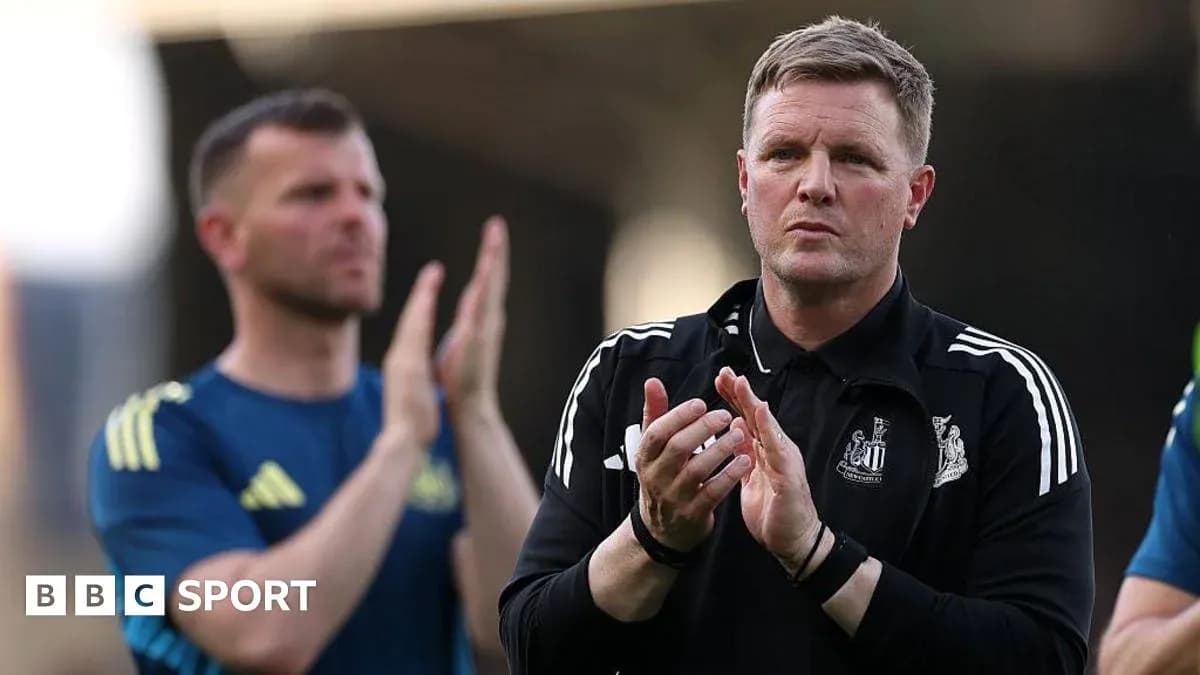
Newcastle United’s head coach walked towards the Gallowgate End at St James’ Park for the traditional lap of appreciation after the final home game of the season. Alone in body, perhaps, but not in sound. The noise wrapped around him.
“Eddie Howe’s black and white army.”
The chant rolled down from the stands, just as it had on those euphoric evenings when Newcastle clinched Champions League qualification in 2023 and again in 2025. Players, staff, families on the pitch; flags, scarves and disbelief in the stands. Back then, it felt like a beginning.
This time, it felt like a rescue act.
Newcastle had taken seven points from their last three home matches, a late flicker in a draining season that had stripped away so much of the optimism of the past two years. The crowd stayed behind in big numbers. They sang for Howe, they sang for the shirt, and for a moment it looked as if a bruised club had finally found a little momentum again.
There was still one more game.
And there was still time for Newcastle to fall back into bad habits.
From lap of honour to Groundhog Day
Fulham away on the final day should have been a chance to sign off with purpose. Instead, it became a familiar, joyless watch. Newcastle were limp, again. Beaten 2-0, again. A 17th league defeat of a season that never quite found its rhythm.
Heads dropped as players and staff walked towards the away end at full-time. Some clapped, some stared at the turf. It felt like Groundhog Day, the same old story looping back on itself.
“There have been a lot of bruises this season,” Howe said afterwards.
That barely covered it.
The bruises are not just emotional. They are strategic, financial, structural. Earlier in May, with the season still stuttering, Newcastle’s owners and senior executives had gathered in Northumberland for their annual summit. The mood was serious. How do you stop a slide without losing your nerve?
“We are in a moment right now and they want to understand why, what we are doing about it and how to fix it,” said a senior club figure.
The response from the top has been deliberately cool-headed. No knee-jerk sackings, no public ultimatums. Instead, a forensic review of where the project has drifted and what has to change.
Change is coming.
This squad will not look the same when next season kicks off. It cannot.
A reset after Howe’s worst Newcastle season
Anthony Gordon, one of the club’s standout performers, is at the centre of a tug-of-war between Bayern Munich and Newcastle. There is still a gap in valuation and Newcastle insist they will only sell on their terms, but he looks a likely departure.
Factor in other possible exits and the scale of the rebuild becomes clear. At the very least, Newcastle are braced to move for a goalkeeper, a full-back, a midfielder and a couple of forwards. That is the bare minimum.
Howe, who has grown “frustrated” by recurring problems he has not been able to iron out, insists the club are “very clear” on what is required this summer after finishing 12th. For a team that had reintroduced itself to Europe’s elite, mid-table mediocrity is a jolt.
New signings alone will not fix everything. Howe knows that. But he has pointed to clubs who have leapt up the table after one smart window. Newcastle’s sporting director Ross Wilson will lead what amounts to a crucial summer surgery on a squad that has lost its edge.
Howe is not standing outside that conversation. He is part of the diagnosis and part of the solution.
That in itself is not shocking. This is the coach who, only last season, delivered Newcastle’s first major domestic trophy in 70 years with the Carabao Cup. He restored pride, identity and a snarling intensity that made St James’ Park one of the most hostile grounds in the league.
Those standards have slipped. Inside the club, there is no attempt to sugar-coat it. This season has not been good enough.
On the pitch, Howe has often looked like a manager searching for a formula rather than refining one. Line-ups changed, shapes shifted, principles bent under the strain of injuries, fatigue and expectation. For the first time in his reign, the bar has to be reset downwards before it can be raised again.
“It’s something we need to address and we need to address it very quickly,” Howe said.
From ruthless to brittle
The numbers tell the story of that slide.
Newcastle used to be ruthless. In 2024-25, no team in the Premier League surrendered fewer points from winning positions than Howe’s side. Once they got in front, they usually stayed there.
Alexander Isak was central to that. He scored first, he equalised, he killed games. When he left for Liverpool in a protracted £125m move, Newcastle not only lost their most reliable finisher, they lost the man who often tilted tight matches in their favour.
This season, that resilience has crumbled. Newcastle have thrown away more points from winning positions (27) than anyone else in the division. They have conceded more goals (21) in the final 15 minutes than any other side.
A team once defined by its ferocity has become flaky.
The comparison with Aston Villa is unavoidable. Villa, Europa League winners, managed the demands of European football and domestic competition far better, even though they exited both domestic cups earlier than Newcastle. Howe’s team, by contrast, looked stretched on multiple fronts for months on end.
There were flashes of evolution late in the campaign, hints that Newcastle were learning to manage games and rotate more intelligently. The fixture list eased. Training and recovery time increased. The expected surge never really came.
This was a slog. Fifty-eight matches. For many in the dressing room, it was the first taste of a truly gruelling, European-level season.
“Bloody hell, it’s not easy,” said a source close to one regular.
Even wins came with a warning label. Staff barely celebrated, aware that another game – and another potential setback – was only days away. Newcastle never stitched together the kind of defining run that had powered them up the table in previous years. Remarkably, 71% of their league defeats were by a single goal. The margins were small; Newcastle kept ending up on the wrong side of them.
Howe has to change that quickly.
A fanbase ready to back – and to judge
Season-ticket holder Liam Phillips has watched the arc of Howe’s tenure from the same seat through the good and the grim.
“He badly needs a good start next season,” he said. “If Newcastle are not in the top six or seven in the first few games, I think the crowd will quickly turn.
“There has been a patience and understanding this season but if the team start badly after spending more money in the transfer market, I don’t think people will be quite as forgiving.”
The goodwill built up over those Champions League nights and that Carabao Cup triumph still counts for something. But it is not limitless. Newcastle’s owners know this summer has to be handled with far more precision than last year’s chaotic window.
Back then, the club missed out on several first-choice targets. Most of the signings that did arrive came late. There was no chief executive, no sporting director in place. The recruitment operation felt disjointed.
On deadline day, after holding firm for so long, they buckled and sold Isak. The message that sent – to the dressing room, to the supporters, to the rest of the league – still lingers.
Brentford and Bournemouth have shown that you can sell key players and still rebuild smartly. Newcastle, despite a net spend north of £100m last summer, have not seen enough return on that investment. Howe was heavily involved in those decisions. Only defender Malick Thiaw can be described as an unqualified success.
The strain of the step up
The schedule between September and March left almost no room for the kind of on-pitch drilling that has underpinned Howe’s previous success. New signings had to learn on the fly, leaning on analysis sessions rather than the relentless, detailed training that defines life under this manager.
Jacob Ramsey’s experience captured that culture shock. He only had a short spell of full training with Howe before the fixtures piled up. Even in that window, the midfielder is understood to have been taken aback by the volume of high-intensity running in the drills. This is a player who had worked under Unai Emery at Aston Villa, hardly a soft-touch operator, yet the jump in physical demands still surprised him.
That is the adjustment curve many new arrivals face. Howe believes those who came in last summer will be better for it, more attuned to what he wants when the new campaign starts. They will need to be.
For all his reputation as a coach who outperforms budgets, Howe ended this season with a side marooned in the bottom half, overtaken by more coherent, more consistent rivals. Sunderland twisted the knife by beating Newcastle home and away and securing European football in a year when eight places were available. Newcastle missed out entirely.
That kind of boom-bust cycle cannot continue. Howe has previously thrived when he has had clear weeks to prepare, to coach, to adjust. Next season, with no European commitments, he is likely to have that luxury again.
He has to make it count.
“Every experience makes you stronger and makes you appreciate the good times,” Howe said. “We will all try and come back a better team.”
The fans who sang his name around St James’ Park in May will expect nothing less when he sets off on that lap again.