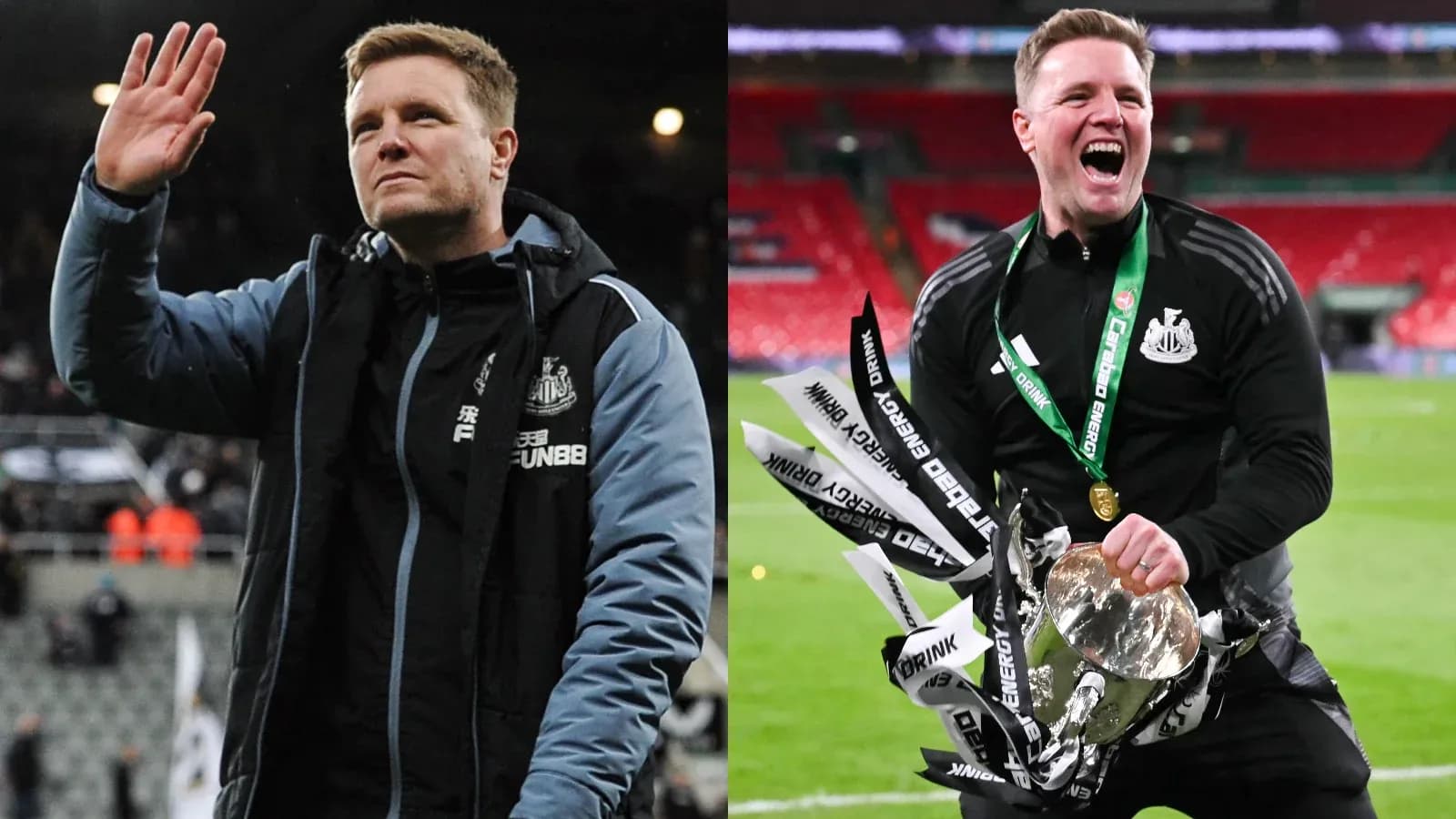
Eddie Howe’s Newcastle Transformation: From Relegation to Champions League
Eddie Howe walked into St James’ Park with Newcastle United staring into the abyss. He leaves with the club unrecognisable from the one he inherited – and with a legacy that will loom over whoever dares to follow.
Appointed in November 2021, days after the Saudi-led takeover, Howe took over from Steve Bruce with Newcastle marooned in the bottom three, five points from safety and drifting. Relegation felt less like a threat and more like a trajectory.
He changed that almost immediately.
From relegation scrap to Champions League nights
Howe’s first job was survival. He delivered it with room to spare. Newcastle surged away from danger in 2021/22 and finished 11th, a mid-table position that barely hinted at the scale of the transformation underway.
The real statement came a year later. In his first full season in charge, Howe drove Newcastle into the Premier League’s top four, finishing fourth in 2022/23 and dragging the club back into the UEFA Champions League for the first time in 20 years. The roar that greeted those European nights on Tyneside told its own story: Newcastle were back among the elite, not as a novelty act, but as a serious contender.
They didn’t just make up the numbers, either. Under Howe, Newcastle reached the Champions League twice and last season broke new ground by reaching the round of 16 – the first knockout appearance in the club’s history in Europe’s premier competition.
The numbers underline his impact. Howe leaves with 84 Premier League wins, more than any other Newcastle manager in the competition’s era, and a win percentage of 46.9 per cent. Only the late Kevin Keegan, the architect of the Entertainers, sits above him in that metric with 51.2 per cent.
For a club that had grown used to stagnation, Howe delivered momentum, relevance and trophies.
Ending a 56-year wait
The moment that will define his tenure came at Wembley.
In 2025, Newcastle ended a 56-year trophy drought by beating Liverpool 2-1 in the EFL Cup final. One game, one afternoon, but generations of frustration and near-misses poured out in those celebrations. It was the club’s first major silverware in more than half a century and a tangible symbol of the new era Howe had helped to build.
From the bottom three to lifting a cup at Wembley and hearing the Champions League anthem at St James’ Park – it is a journey that will be hard to replicate, let alone surpass.
“Heart and soul” and a hard decision
So why walk away now?
“After a period of personal reflection, I have decided that now is the right time for me to step away from my role as head coach of Newcastle United,” Howe said, announcing his departure after almost five years in charge.
“After nearly five years of giving my life, heart and soul into the club with unrelenting energy, I feel that it is in the best interests of both myself and the club to step away, recharge and take a break.
“Although it’s been incredibly difficult to make this decision, I know in my heart that it’s the right one. I have always put the best interests of Newcastle before my own in every single decision I have made whilst I’ve been here and this one is no different.
“It has been the privilege of my lifetime to have been the manager of Newcastle United."
The club, in turn, acknowledged the scale of his work. In a statement, Newcastle said they had accepted Howe’s decision and thanked him for his “extraordinary contribution”, adding that the search for a new head coach is already at an “advanced stage”.
Howe’s final game was a sobering one: a 4-1 pre-season defeat away to Bristol City on 29 July. A low-key ending to a high-impact reign.
A squad turning the page
His exit comes amid a broader reset on Tyneside.
Two key players have already gone: Anthony Gordon has joined Barcelona, while Sandro Tonali has moved to Tottenham Hotspur. Those departures strip away some of the star power that helped fuel Newcastle’s surge under Howe.
The recruitment strategy points in a different direction. Newcastle have targeted youth this summer, betting on potential rather than ready-made names. Winger Bazoumana Toure has arrived from Hoffenheim, midfielder Sean Steur from Ajax, goalkeeper Ewen Jaouen from Reims and defensive midfielder Alhadji Bamba from Monaco.
The average age of those four signings is just 19.5. This is a squad being built for the long haul, one that will need time, patience and a coach comfortable shaping raw talent into a cohesive, competitive unit.
In that context, a change in the dugout feels less like a shock and more like a deliberate pivot. Howe, the man who stabilised and then accelerated Newcastle, hands over a club structurally stronger but tactically at a crossroads.
The next man in
Newcastle insist the process to appoint a successor is close to completion, with the club promising updates “shortly”. The profile they appear to be chasing is clear enough: a modern, progressive coach who can work within a project already in motion.
The 38-year-old German tipped for the role brings a striking CV. He has won back-to-back AFC Champions League titles with Al-Ahli, managing a squad that includes former Premier League names Ivan Toney and Edouard Mendy, and previously worked with Riyad Mahrez and former Newcastle favourite Allan Saint-Maximin in Saudi Arabia.
Before that, he dominated in Austria with Red Bull Salzburg, winning consecutive Bundesliga titles and the Austrian Cup after cutting his teeth with Salzburg’s reserve side, FC Liefering. It is a pathway familiar to Europe’s new generation of tacticians – and one that fits neatly with Newcastle’s youth-focused recruitment.
If he is the man they turn to, he will inherit a club transformed in expectation and ambition, but also one in transition.
A new season, a new era
There is no time to dwell.
Newcastle still have four pre-season fixtures before the Premier League kicks off: Valencia away on 8 August, Everton at a neutral venue on 12 August, then home games against Bayer Leverkusen and Strasbourg on 15 and 16 August.
The league campaign begins on Sunday 23 August, with five matches to navigate before the first international break of the 2026/27 season. By then, the new head coach will have had only a handful of games to stamp his authority on a dressing room reshaped by youth and stripped of some of its established figures.
Howe departs having dragged Newcastle from fear to hope, from survival mode to trophy lifts and Champions League knockouts. The bar is set high now. The question for Newcastle’s hierarchy is simple and unforgiving: can the next man in not just maintain that standard, but raise it again?