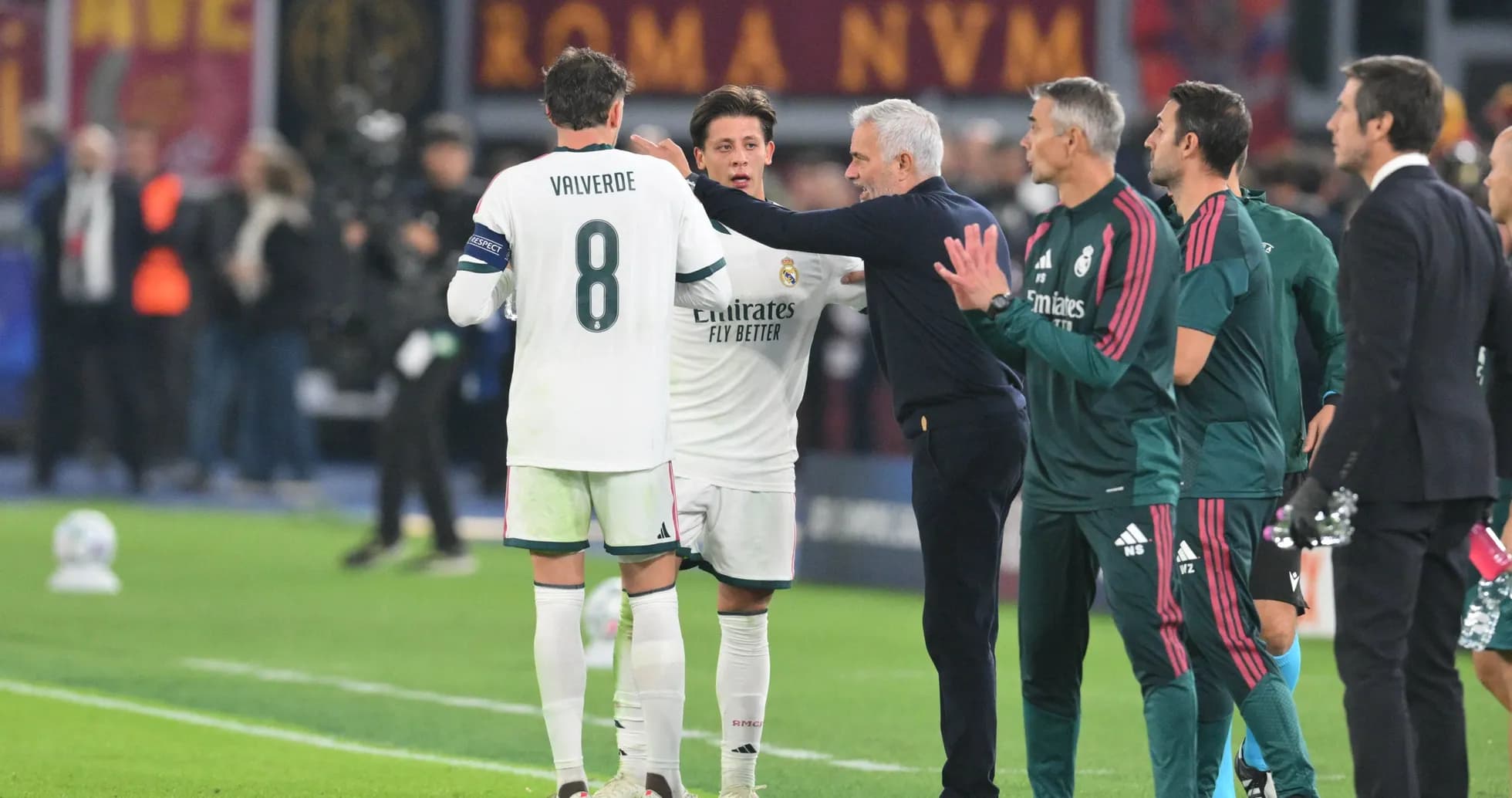
Fede Valverde: From Midfielder to Key Right-Back for Real Madrid
Fede Valverde needed less than half an hour in Athens to change everything.
Sent on from the bench, he grabbed hold of Real Madrid’s midfield, bent the game to his will and, in a flash, became their most dangerous creator. Three chances carved out, constant pressure on AEK’s back line, and then the moment that will live longest: a thunderous strike from around 25 metres that tore past Brignoli and into the net.
That goal, reported by Spanish newspaper AS as Madrid’s third of the night, wrapped up a seventh straight win and kept the mood at Valdebebas light and loud. It also nudged Madrid closer to the last eight and dragged Valverde back to a more familiar memory: the days when Carlo Ancelotti let him roam the middle of the pitch, bursting forward to score goals like this, long-range bolts that announced his arrival as one of Europe’s most complete midfielders.
Back then, Ancelotti was also the first to push him somewhere else. In 2021, during the closing minutes of a Champions League tie against Sheriff Tiraspol, Valverde suddenly found himself at right-back, a tactical tweak that felt like an experiment rather than a plan.
Reality has caught up with that experiment now.
Despite the praise José Mourinho heaped on Valverde at Real Madrid’s training complex — “He is an excellent professional, a friend to his team-mates, and although he is not a voice heard every second, he is always present as a role model for everyone” — the Uruguayan’s present is not in the centre. Against Valencia at Mestalla, he will start at right-back again, the position where he has quietly, then loudly, started to shine and lift the entire side’s level.
Mourinho’s coaching career has been built on tactical detail, but his greatest strength has often been psychological. With Valverde, that side of him has taken centre stage. He has persuaded a player who once resisted the idea of defending the flank to embrace it, step by step, until it became a weapon.
Neither Trent Alexander-Arnold nor Denzel Dumfries has fully convinced him yet. Alexander-Arnold did not disappoint in Santander, and Dumfries comes off a decisive assist against AEK, but Mourinho sees something different in Valverde. With the Uruguayan at right-back, the rest of the team breathes. The balance improves. The freedom to attack grows. For a coach obsessed with control, that is gold.
The timing has helped. Valverde is in peak physical condition, and the shift has not just suited him; it has reshaped the entire structure. With him on the flank, Madrid gain an extra card on the table, a player whose positioning and intensity dictate the movements of both team-mates and opponents in clear, almost pre-programmed patterns.
The first real evidence came against Sevilla. On his first start as a right-back, Valverde delivered a performance that looked anything but improvised. Six ball recoveries. Five duels won, the highest figure in the team. Three interceptions. Two clearances. One shot blocked. Numbers that tell a story of a player who didn’t just fill a gap, but owned the channel.
Since then, his level has held. The old line from Almaty – “I was not born to play at full-back” – feels like it belongs to another player, another era. Back then he was keen to deny any clash with his coach at the time, Xabi Alonso, over that role. Today, the debate is over. The pitch has answered it.
Mourinho has also had to confront his own words. He once insisted Valverde would never play there under him. Then he put him there, saw the impact, and refused to turn back. In that contradiction, he found a solution: a full-back who runs like a winger, thinks like a midfielder and defends like someone who understands the weight of the badge on his chest.
The relationship between the two has become a pillar of this project. Mourinho leaned on his man-management, Valverde responded with a gesture that went beyond tactics. By accepting the role and thriving in it, the Uruguayan helped tighten the dressing room around a single, shared idea.
Valverde himself frames it simply: “When we all work together and move in the same direction, we become stronger. And as the team's captain, I took the step everyone was waiting for from me, and I provide a role model for my team-mates.” It is not just a quote; it is a manifesto for how he now sees his responsibility.
Mourinho has seized on that. He has held Valverde up as proof that commitment still matters at the highest level, that a star can sacrifice his favourite position for the good of the structure and emerge even more important. For the coach, it is a message to the squad and the outside world: this project is moving, and it does not intend to slow down.
Tonight, at Mestalla, the theory meets the noise again. Valverde will walk out not as the roaming midfielder of old, but as Madrid’s right-back, the unlikely cornerstone of a new idea.