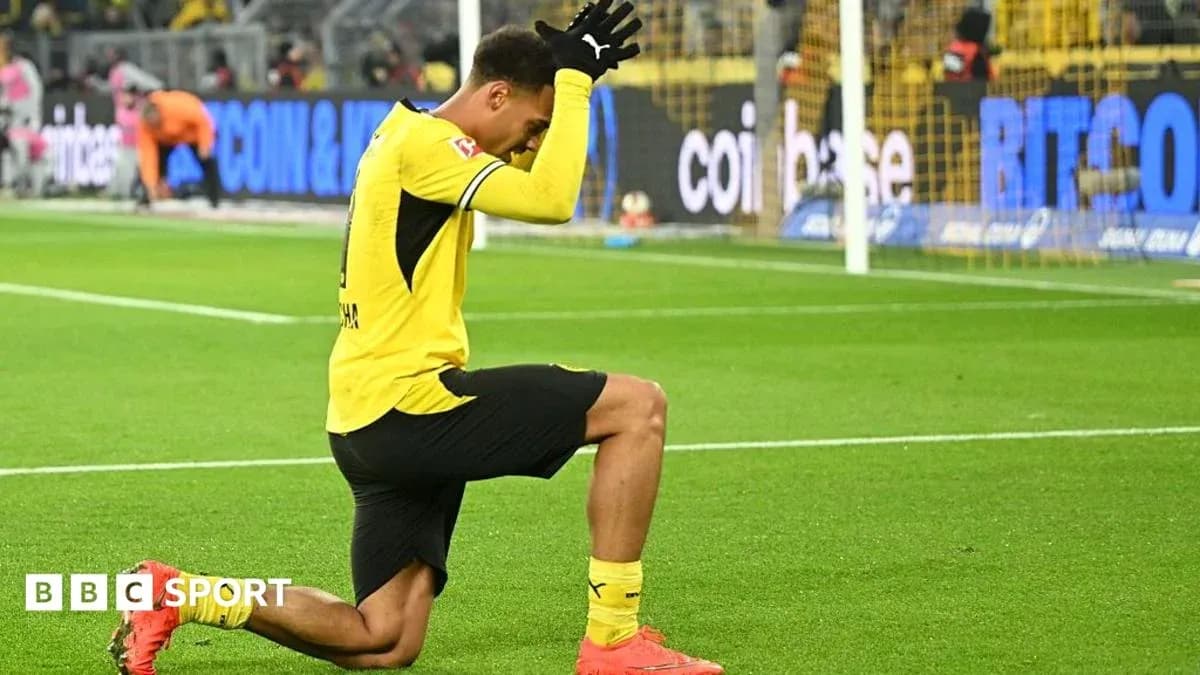
Felix Nmecha's Goal Celebration Sparks Controversy at Dortmund
In Dortmund, a goal celebration has ignited a familiar fault line in modern football: where personal faith meets club values and fan identity.
Felix Nmecha’s two goals in Borussia Dortmund’s 2-1 win over Elversberg on Saturday should have been a straightforward story of a midfielder playing his way into form. Instead, what followed has dragged him, and a Christian players’ movement, into the centre of a cultural argument that stretches well beyond the pitch.
A Crown, a Gesture, and a Backlash
After scoring, Nmecha pointed to the sky, then mimed lifting a crown from his own head and placing it on the ground. To many, it looked like a standard piece of faith-driven celebration. To a section of Dortmund supporters, it meant something far more loaded.
A fans’ group publicly objected, saying the celebration referenced “The King’s Return”, a campaign associated with Ballers in God, a Christian organisation founded by former Crystal Palace and Tottenham midfielder John Bostock. The group accused the campaign of pushing views that clash directly with Dortmund’s proclaimed values of tolerance and diversity.
Citing a recent investigation by German broadcaster ARD, the supporters’ group argued that “extremely conservative positions against homosexuality and transgender identity are advocated” under The King’s Return banner. They also highlighted messaging that portrays abortion as “Satan’s plan”, framing it as fundamentally incompatible with the club’s inclusive stance.
In Dortmund, that matters. This is a club that has repeatedly presented itself as a standard-bearer for openness and anti-discrimination. When a player’s celebration appears to tap into a movement criticised for the opposite, fans react – and they have.
Nmecha and Ballers in God Respond
Nmecha moved quickly to clarify his intent. He insisted there had been “misunderstandings” around the celebration and stressed it was “not intended to promote myself or any organisation”.
He went further, stating: “My message has never been about promoting intolerance, discrimination, or hate in any form.” For a player already under scrutiny from some Dortmund fans over previous social media activity before his arrival at the club, every gesture is being examined in detail.
Ballers in God, whose network includes high-profile names such as England internationals Marc Guehi and Bukayo Saka and former Brazil forward Kaka, also responded to the criticism. The group said it felt “encouraged by player-led movements such as The King’s Return, where footballers themselves take the initiative to express their faith in Jesus”.
Their statement leaned heavily on language of inclusion and respect.
“Our desire is not only to share our hope, but to demonstrate love and respect towards everyone, including those who do not share our beliefs,” the organisation said. “Our focus has always been, and will always be, to point people to Jesus with grace and love.”
In other words, they reject the idea that their campaign is about hate. The fans’ group, pointing to ARD’s reporting, argues the problem lies not in the tone, but in the underlying positions.
Football’s Uneasy Line Between Faith and Inclusion
This is not an isolated flashpoint. Across European football, the tension between personal religious conviction and institutional support for LGBTQ+ inclusion has become a recurring storyline.
Last year, the Premier League stepped away from the Rainbow Laces campaign and ended its formal partnership with LGBTQ+ charity Stonewall. The league framed the shift as part of a broader equality approach, but the move underlined how sensitive and contested this space has become.
On the players’ side, individual acts have laid bare the fault lines. In 2024, then Ipswich captain Sam Morsy, a Muslim, said he did not wear a rainbow armband because of his “religious beliefs”. At Crystal Palace, Marc Guehi chose a different path, writing “I [heart] Jesus” on his rainbow armband when he captained the club – blending a clear expression of faith with a symbol of LGBTQ+ solidarity.
Not every club has found a way through. Manchester United abandoned plans to wear a jacket in support of the LGBTQ+ community after a player refused to take part. One dissenting voice was enough to derail a collective gesture.
Dortmund now finds itself in that same contested territory. A club that markets its values of tolerance is dealing with a player whose chosen expression of faith is tied, in the eyes of some supporters, to a movement they view as discriminatory.
A Debate That Won’t Stay Off the Pitch
At the heart of this row is a simple, uncomfortable question: how far can a player go in publicly expressing personal belief when those beliefs are linked, fairly or not, to exclusionary views? And how far should a club bend to accommodate that expression when its own identity is built on inclusion?
Ballers in God insists it wants to “demonstrate love and respect towards everyone”. Nmecha says he does not stand for intolerance or hate. The supporters’ group points to concrete statements and positions around homosexuality, transgender identity and abortion that they say contradict those assurances.
No goals, no assists, no trophies will make that debate disappear. As long as football remains a global stage for both identity and belief, every raised arm, every armband, every celebration – even the placing of an invisible crown on the turf – will keep asking the same question of clubs, players and fans: whose values truly rule the game?