Inside Formula 1’s Club of Beautiful Failures
You get the call.
You pull on the overalls with your name on the chest.
You strap into 1,000 horsepower on the grid of a Formula 1 Grand Prix.
And you know, deep down, this might never happen again.
For a tiny, strange fraternity of drivers, F1 is not a career. It is a single afternoon. One set of lights. One shot. Then it’s gone.
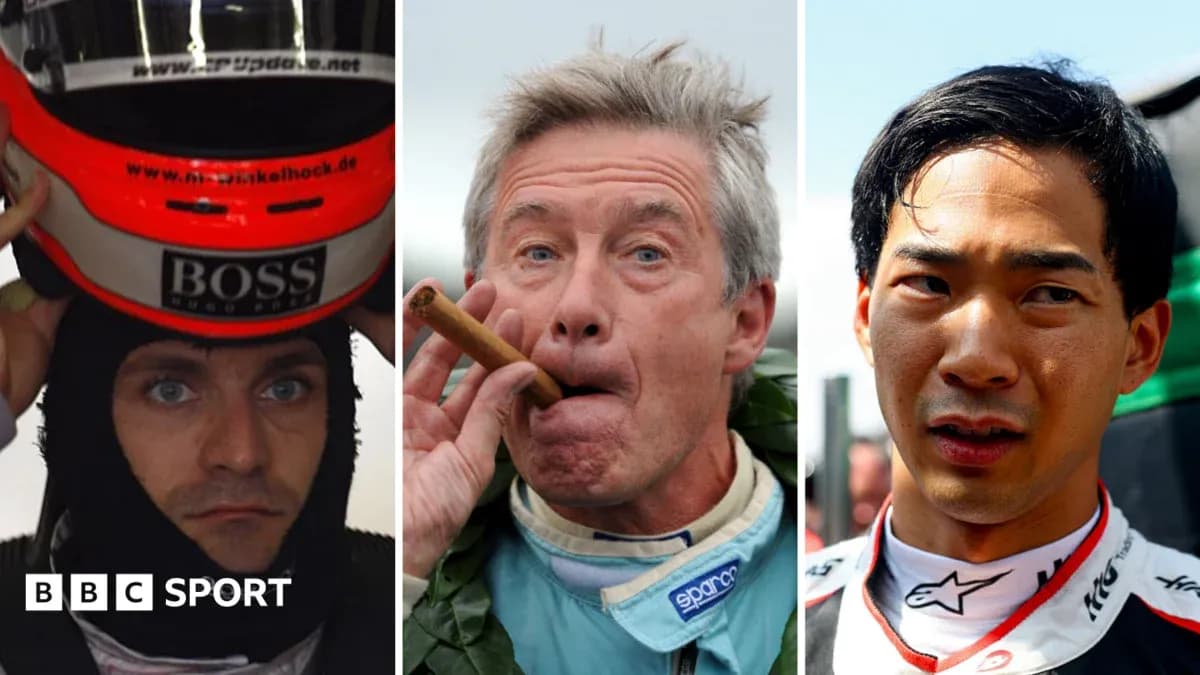
Tiff Needell belongs to that club.
“I sang the Grand Prix theme tune while I was sat on the grid. I thought I was watching it on telly,” he recalls. One race, 1980 Belgian Grand Prix, and out. One of just 166 drivers to start exactly one F1 race in the championship’s history.
Some got there by luck. Some by politics. Some by injury to others. All of them got there by obsession.
And the phenomenon hasn’t died with the romantic, half-amateur days of the 1960s and 1970s. It’s still alive in the polished, hyper-professional paddock of today.
Just ask Ryo Hirakawa.
Hirakawa’s Dream, Cut Short in a Week
Last month in Mexico, the Japanese Toyota factory driver finally stepped into the world he had chased for years. A Haas seat, a Grand Prix start, a point on debut – helped by penalties for others, but the record will always show his name in the top 10.
“I just need to taste this moment. I'm really happy,” he said afterwards. “Just enjoy this moment and see what we can do.”
What they could do, as it turned out, was replace him.
Within a week, Hirakawa’s F1 story was effectively over. Haas pulled forward the arrival of their 2027 signing Rafael Camara, handing the Brazilian the seat for the rest of 2026. Hirakawa, there through Haas’ technical association with Toyota, found himself exactly where so many test and reserve drivers end up: back on the sidelines, a dream briefly lived and then folded away.
The numbers are brutal. The majority of test and reserve drivers never see a starting grid. Those who do often get one chance, usually in chaotic circumstances – injuries, sponsorship collapses, political fallouts, even cheating scandals. And then the door slams shut again.
Modern F1 no longer has room for the wealthy amateur “having a go”. To even stand in the garage, you need years of junior formulas, simulator work, fitness, data, money. Always money.
Yet the core story hasn’t changed. One phone call can still change everything.
Just as it did for Tiff Needell.
From Magazine Prize to the Back of the Grid
Needell’s road to Zolder in 1980 didn’t begin in a kart at five years old. It started with a magazine competition.
“I won a car in a magazine competition,” he says. “I was the kid on the terraces, on the fences – and made it on to the grid. We had no money at all in our family, so I was a working civil engineer five days a week and a mechanic in my garage five nights a week. At the weekend I was the van driver, the mechanic and the racing driver.”
He clawed his way up the British scene, first as a national-level hopeful, then into Formula 3, then into the now-defunct British Formula 1 championship. Nothing about it was glamorous.
“I bumbled my way up to the top of the national scene and then got offered a professional drive in Formula 3. And after two years of that I moved up into the Formula 1 British championship.”
He went hunting for a break the old-fashioned way: by physically hanging around paddocks, trying to hustle a drive.
“I was out at the Nurburgring trying to get an F1 drive when I got the call. I was hanging around the paddock trying to chat up an F2 team, trying to say I had a sponsor, which of course I didn't.
“Ensign called me and said: ‘This weekend would you like to drive?’ I rushed home from the Nurburgring in my orange Ford Capri, had half a day's test at Donington and on to qualifying for the Belgian GP at Zolder.
“I got my chance because Clay Regazzoni crashed and hurt his back at Long Beach.
“A lot of that in the olden days was due to injuries – chances would come up when someone had crashed and got injured. It was dangerous back then.”
Dangerous, and crowded.
This was the era of pre-qualifying, when simply being on the grid counted as an achievement. Dozens of hopefuls, a handful of slots.
“There was something like 30 drivers trying to pre-qualify, and somehow I made it to the back of the grid – 23rd in the Ensign. It was so much cheaper then – aluminium chassis and a Cosworth DFV engine and away you go.”
Back of the grid or not, look at the name next to him.
Humming ‘The Chain’ Beside a Legend
On that Belgian grid, a 29-year-old Needell found himself lined up alongside a double world champion having a miserable weekend: Emerson Fittipaldi.
“I found myself on the back row of the grid, sitting by one of my big heroes. It was all a bit of a dream,” Needell says.
There was no VIP hospitality for his family. No private jets. No paddock passes for life.
His parents and girlfriend – now his wife – drove to Belgium in the family car and watched from the public areas, just like any other fans, as he took his place on the grid.
Then came the moment. The mechanics fired up the engine and walked away, leaving Needell alone in the cockpit, next to Fittipaldi, waiting for the start.
“When the mechanics started the engine and left me sitting there – me and Emerson – I actually started humming the theme tune [to Fleetwood Mac's The Chain],” he says.
For 12 laps, Needell and Fittipaldi fought for the most inglorious prize of all: last place at the 1980 Belgian Grand Prix.
“For 12 laps I battled with Emerson for the honour of being last place at the 1980 Belgian Grand Prix. Then the engine broke.”
A week later, he failed to qualify at Monaco. The dream, at least in F1 terms, was over almost as soon as it had begun. He pivoted to a successful career in sportscars at Le Mans and then into television, where most people would come to know him.
But that one race never left him.
The Super-Sub Who Led the Field
So what’s the ceiling for a one-race wonder? A point, like Hirakawa? A midfield finish? Simply making the grid?
Dorino Serafini’s shared second place at Monza in 1950, alongside Alberto Ascari in F1’s debut season, remains a high-water mark for a one-off appearance. Yet in modern times, one name stands out for sheer drama: Markus Winkelhock.
The German touring car driver got his call in 2007. Spyker, slow and struggling, needed a last-minute stand-in for the European Grand Prix at the Nurburgring. Winkelhock climbed into a car that had no realistic business scoring points.
He started where so many super-subs do: dead last.
F1 ran deep in his family. His father Manfred started 56 Grands Prix in the 1980s before dying in a sportscar crash in 1985. His uncle Jo tried seven times to qualify for a Grand Prix and never made the cut.
Markus went one better than both – and then some.
By his own admission, he wasn’t truly ready for the step.
“I had one day testing in Silverstone and one day in Paul Ricard,” he told Motorsport magazine. “The first couple of laps it felt like a PlayStation – so unreal, everything was so fast. You're accelerating till you reach the braking point.
“But after all the [practice] sessions I could feel my neck already.
“I told my mechanics to put some beddings on the side of the headrest, in case the neck is completely done, to lean on with the helmet.”
Then the Eifel weather intervened.
Early rain rolled in, and with nothing to lose, Spyker rolled the dice. Winkelhock started on the right tyres at exactly the right moment. The rest of the field did not.
As the rain intensified, chaos erupted. Lewis Hamilton, Jenson Button and others slid helplessly into the gravel. Cars aquaplaned off in all directions.
The orange Spyker, slow in the dry, became a miracle on wheels in the wet. Winkelhock sliced through the rivers of water as if they weren’t there, building a lead that looked absurd on timing screens: 33 seconds clear of the field. In F1 terms, that’s another postcode.
He didn’t even realise what he was doing.
“I didn't know it was for the lead. I was just driving. At the point they told me, 'You're P1'. I really didn't understand anything that was going on because this race was really crazy.”
For six laps, a backmarker team and a one-off driver led a Grand Prix on merit of strategy and nerve.
Then the track dried. Reality bit. Faster cars devoured the Spyker, and a hydraulic failure ended his race on lap 15.
One race. Six laps in the lead. No points. An indelible memory.
When ‘Failure’ Is Just a Different Kind of Success
The romantic version of the story says that a lost F1 seat equals a ruined career. The truth is more complicated.
A door closing in F1 often opens another in endurance racing or in IndyCar. Le Mans is full of drivers who never got a proper F1 chance, or who tasted it once and moved on. They become factory aces, multiple winners, respected veterans. Their bank balances and trophy cabinets don’t scream “failure”.
Even in the 1980s, with Group B rallying packing out stages and sportscar racing booming, the gravitational pull of F1 remained overwhelming.
“Being a grand prix driver was where you wanted to go,” Needell says. “But I always had my eye sideways for any other drives.
“Single-seaters are the best cars to drive and they are made and designed to race. And the ultimate is the grand prix car. Everything else is second best.
“I was so proud I got there on no sponsorship and no money. I suppose I was a bit annoyed I couldn't stay for longer.
“But as I always say, ‘unluckier than a few, but luckier than millions’.”
That’s the heart of the one-race club. Not bitterness. Not regret. Pride. A sense that, for one weekend, they sat where almost every racing driver on earth dreams of sitting.
Lights on. Engines screaming. Theme tune playing in their heads.
One race. Enough to last a lifetime.