Lewis Hamilton's Call for Precision in F1 Diversity Efforts
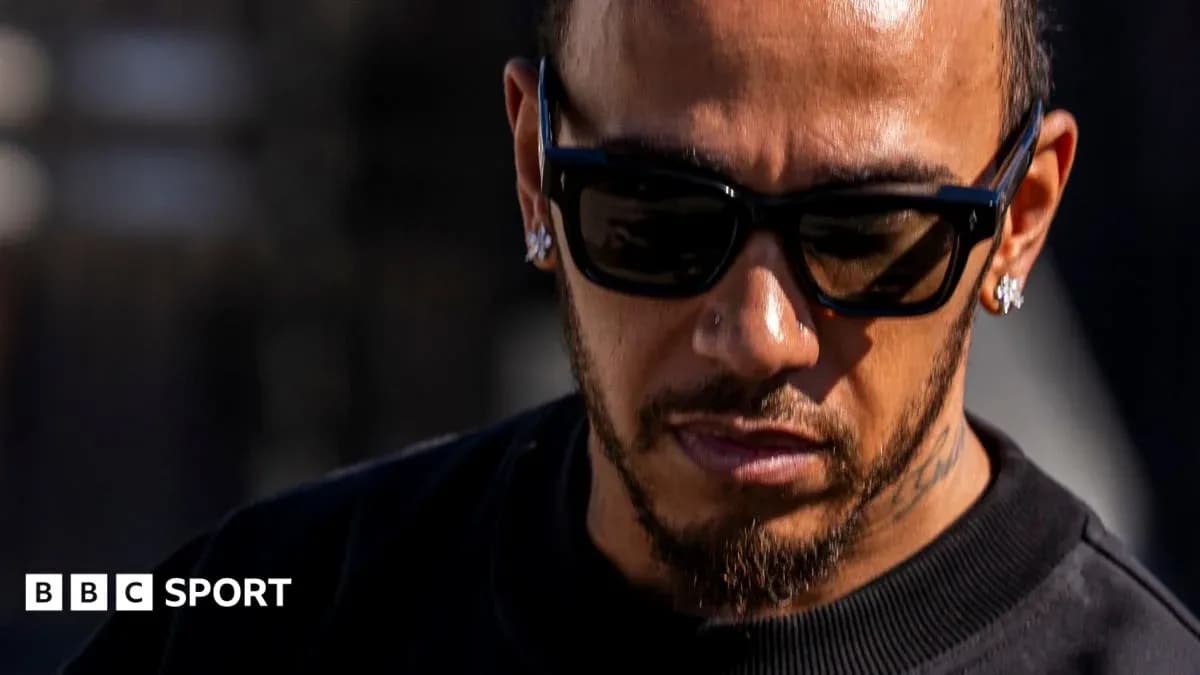
Lewis Hamilton has spent a career obsessed with tiny margins – thousandths of a second, millimetres on the racing line, the smallest hint of grip. Now he wants Formula 1 to apply that same forensic precision to something far less comfortable: who actually gets to be part of the sport.
Five years after launching his Mission 44 charity, Hamilton has used its latest report to issue a pointed challenge to F1. Progress, he says, is visible. Proof is not.
“We’ve opened the door – but who’s getting through it?”
Hamilton’s own words frame the tension at the heart of the report.
“When I walk through the paddock now, I see more women, more Black and Brown faces, more people who look like the fans in the grandstands than at any point since I started. That is heartening, and the people behind it deserve credit,” he said.
“And yet, there is much still to do. We have opened the door, but we have not yet learned to count how many people walk through it, or how many stay.
This is a sport that measures performance to the thousandth of a second. We can measure this too.”
That is the crux. The report recognises that teams, F1 and the FIA have taken visible steps on diversity and inclusion. Programmes exist, schemes are running, young people are being engaged around the world. But when Mission 44 went looking for hard evidence that these efforts are changing who enters, progresses and stays in motorsport, the numbers simply were not there.
The sport’s first social impact report, published recently, mapped the scale of activity. Mission 44’s response asks a sharper question: what does all that activity actually add up to?
Three clear demands for a data‑driven era
The report strips its recommendations down to three blunt priorities.
- First, measure the basics: who joins, who is promoted and who stays. Track it properly and recognise best practice. Without that, the report argues, F1 cannot answer even the most fundamental questions about representation in its workforce.
- Second, ring‑fence investment in people. Mission 44 wants spending on talent pathways taken out of the F1 cost cap, and for the sport to fund the pipeline collectively. In other words, don’t make long‑term inclusion compete with downforce and upgrades.
- Third, publish the number of paid places on offer each year. That means transparency on internships, apprenticeships and structured entry routes – the kind of roles that often decide who gets a foothold in the paddock and who is left on the outside.
Behind those headlines sits a larger financial ask. The report proposes that F1, the FIA, the teams and the sport’s major sponsors commit at least £50m of new money over the next five years. The target: support young people from underrepresented backgrounds into motorsport careers and, crucially, help them to stay there.
F1 points to scale – Mission 44 points to gaps
F1, for its part, insists the sport is already moving at pace.
“We are proud of the programmes and initiatives which help inspire the next generation of Formula 1 and how they continue to increase access and opportunity across our sport,” an F1 spokesperson said.
Following recommendations from the Hamilton Commission, F1 signed its first diversity and inclusion charter in 2024. In 2025 it ran its first sport‑wide data‑gathering exercise on social impact, capturing the reach of education and STEM initiatives.
The numbers are not small. In the 2025 season alone, F1 says more than 500,000 young people engaged with education, STEM and inspiration programmes globally, and over 1,000 structured skills and talent development opportunities were created across the sport.
As F1’s global profile has exploded, its leadership insists its social ambitions have grown with it, stressing a commitment – alongside teams, the FIA and other stakeholders – to deepen and evolve that work.
Mission 44 does not dispute the activity. It questions whether anyone can yet show what that activity is changing.
The report states it cannot say whether diversity initiatives are actually increasing representation because there is “no collated data on the entire motorsports workforce, only on the ‘activity and reach’ of social impact programmes”.
Teams self‑report figures through structured data requests, but there are major blind spots. The data does not track who is recruited as a direct result of those programmes, who stays in the sport or who progresses. Demographic details of participants are not consistently recorded. Different teams use different definitions for “underrepresented groups”. That makes comparisons unreliable and trends hard to prove.
The most telling line cuts right back to where this all started.
“The original question of the Hamilton Commission was how many Black people worked in motorsport. Five years on, the sport cannot say exactly how that number has changed.”
Mercedes, McLaren show what measurement can look like
Where teams have chosen to publish detailed data, the picture is more encouraging – and more precise.
Mercedes, the team with which Hamilton won six of his seven world titles, set itself clear targets in 2020 after discovering only 3% of its workforce came from minority ethnic backgrounds and just 12% were women.
It responded with targeted training, recruitment and development processes. By 2025, Mercedes reported that 20% of its employees were women and 10% were from minority ethnic backgrounds. In the first half of that year, 37% of new joiners came from underrepresented groups.
McLaren has gone further on transparency, publishing detailed workforce data annually. Its 2025 sustainability report showed that 36% of staff identified with one or more underrepresented characteristics, against a 2030 target of 40%. Almost 45% of new starters in 2025 were from underrepresented groups.
Inside McLaren’s F1 operation, women make up 22% of the workforce and 10% of technical roles – that latter figure up from 7% the previous year. Incremental, measurable change, backed by public numbers.
Not every team has followed suit. Mission 44 notes that some did not report workforce data at all, underlining the patchwork nature of the current picture.
A sport built on precision, still guessing on people
On paper, F1 has never been more aligned on its intentions. All 10 teams, F1 itself and the FIA have signed a diversity and inclusion charter. The sport has produced its first social impact report. Outreach programmes are reaching hundreds of thousands of young people.
Hamilton’s message cuts through the noise: intention is no longer enough. Not for a sport that prides itself on measuring everything.
The question now is whether F1 is prepared to apply the same relentless scrutiny to its own workforce that it applies to tyre degradation, fuel loads and aero maps. Because for all the glossy campaigns and packed fan zones, the most telling statistic in this story is the one the sport still cannot answer.
How many of the people building, designing and running these cars truly look like the world that watches them?