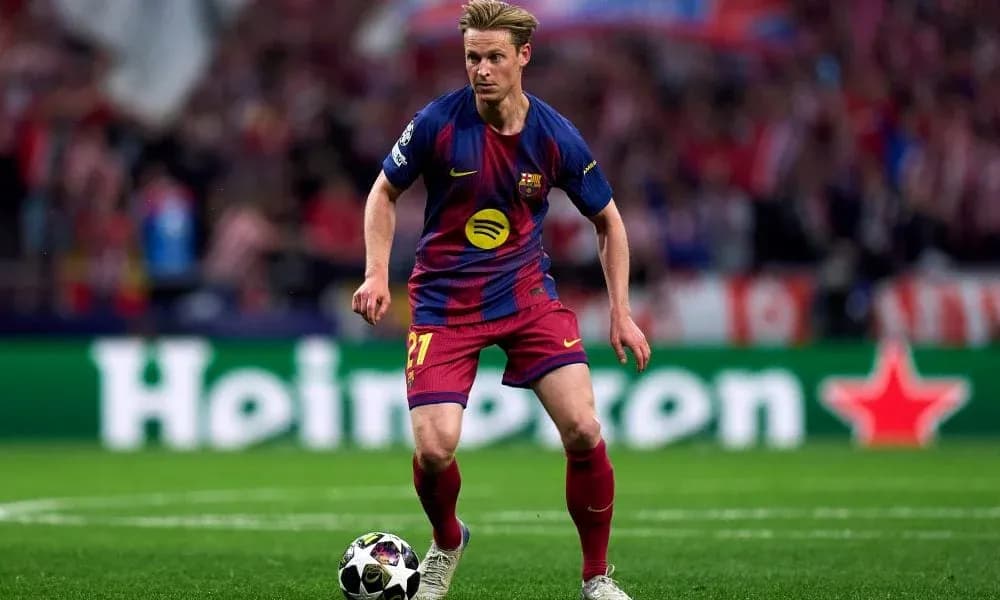
Frenkie de Jong's Future at Barcelona: Is This His Last Season?
Frenkie de Jong’s Barcelona future is back under the microscope. This time, the scrutiny comes with a new twist: Rodri has arrived, De Jong is injured, and a prominent voice in the Netherlands believes the clock is ticking on his time at Camp Nou.
“His last season at Barça”
Dutch journalist Valentijn Driessen has gone as far as to claim that the 2026/27 campaign could be De Jong’s final year in Barcelona colours.
On De Telegraaf’s podcast, Driessen painted a stark picture of the midfielder’s situation, pointing to a combination of injuries, previous attempts by the club to move him on, and the signing of Rodri.
“He has been injured a lot; they already tried to get rid of him before, and now they bring Rodri,” Driessen said. “I don’t think that now that he’s injured they’re trying to transfer him – I can’t imagine it – but I do think he’s in his last season at Barça.”
It’s a sharp contrast to De Jong’s own stated dream: to spend the rest of his career at Barcelona. Driessen doesn’t see that happening.
“He wanted to stay at Barcelona until the end of his career, but that’s a privilege granted to very few players,” he added. “He’s not the sort of player you’d think would remain a first-team regular at Barcelona until he’s 35. In short, he won’t see out the end of his career there.”
Rodri changes the equation
Barcelona’s move for Rodri has altered the landscape in midfield. One of the most accomplished holding midfielders in the game, the Spain international is expected to become a central pillar in Hansi Flick’s structure.
Driessen doesn’t argue that Rodri’s arrival means Barcelona will immediately look to cash in on De Jong while he is sidelined. That, he insists, is not the scenario.
But he does believe the signing changes the hierarchy.
Competition is about to spike. And with that, the Dutchman’s status as an automatic starter is under threat.
“You always have to perform to keep playing,” Driessen said. “If an excellent player comes in who plays in your position, I can’t imagine those two playing together.”
That is the crux of his argument: not that De Jong is unwanted, but that the margin for error has shrunk.
Can De Jong reinvent himself?
For years, De Jong has thrived as a deep-lying controller. He drops to receive the ball, glides past pressure, links phases, and dictates tempo from the back of midfield. That’s his game. That’s his comfort zone.
To coexist with Rodri, Driessen believes something has to give. Specifically, De Jong.
According to the Dutch journalist, the only realistic way for both to start consistently is if De Jong steps higher up the pitch and embraces a more attacking brief. And he is far from convinced that the Barça midfielder can do it.
“He might be able to try, but he needs to be more attacking, and that’s usually the point of criticism: that he lacks that. He’s never managed it,” Driessen argued.
It’s a harsh assessment, but it taps into a long-running debate around De Jong: can he add goals, final passes, and penalty-box presence to his repertoire, or is he destined to remain a conductor from deep?
Flick’s call – and a crowded midfield
What Hansi Flick makes of all this will define the next chapter.
Barcelona’s midfield is stacked with profiles capable of filling different roles. Systems can shift, shapes can be tweaked, and Flick has the tactical range to accommodate multiple playmakers if he chooses.
There is no guarantee that Rodri’s arrival automatically forces De Jong out of the XI. A fit, in-form De Jong remains one of the most gifted midfielders in Europe, and big clubs rarely complain about having too many elite options.
But the reality is simple: the competition just got fiercer, the margin for comfort slimmer.
If this really is the start of De Jong’s last season at Barcelona, as Driessen predicts, the question is no longer whether he belongs at this level. It’s whether he can adapt quickly enough to keep his place in a team that is already evolving without him.