Fulham vs Manchester United: Tactical Insights from a 1–1 Draw
Craven Cottage, under a grey London sky, staged a meeting of two clubs searching for clarity in their 2026 Premier League story. Fulham, rooted in 19th place with 2 points and a goal difference of -3 (5 scored, 8 conceded overall), hosted a Manchester United side sitting 12th with 5 points and a goal difference of 0 (8 scored, 8 conceded overall). The 1–1 full-time score felt less like a conclusion and more like a chapter in two evolving tactical identities.
I. The Big Picture: Structures, Stakes, and Seasonal DNA
Both managers doubled down on a shared blueprint: 4-2-3-1. ÁLvaro Arbeloa’s Fulham leaned into structure and industry, while Michael Carrick’s Manchester United sought control and vertical threat.
Heading into this game, Fulham’s campaign was defined by imbalance. At home they had scored 5 goals and conceded 7 in 3 matches, an attacking pulse of 1.7 goals per game at Craven Cottage offset by 2.3 conceded. On their travels, they were toothless but tighter: 0 goals for and just 1 against in 2 away fixtures, for overall averages of 1.0 scored and 1.6 conceded per match. The pattern suggested a side that opened up too much in front of its own fans.
Manchester United arrived as a paradox of their own. Overall they were scoring 1.6 goals per match and conceding 1.6, with a more expansive face at home (2.5 scored, 1.5 conceded per game) and a more restrained, less efficient version away (1.0 scored, 1.7 conceded per game). No clean sheets in 5 matches underscored a team still searching for defensive stability.
Within that context, a 1–1 draw — after a goalless first half — mirrored the table: Fulham still winless, United still unconvincing but hard to fully dismiss.
II. Tactical Voids: Absences and the Edges of Risk
The team sheets were shaped as much by who was missing as who started.
Fulham were again without T. Cairney (knee injury) and K. Tete (concussion). Without Cairney’s calm distribution between the lines, Arbeloa leaned on the physicality and running of S. Berge and S. Charles as the double pivot. The absence of Tete forced the reliance on T. Castagne at right-back, a defender whose season so far has been defined by high involvement and disciplinary risk: 2 yellow cards already, 9 fouls committed, and enough aggression to feature among both the league’s yellow and red card leaders, even if he has not yet seen a dismissal.
Manchester United’s absences were even more structural. A. Diallo, T. Heaton, B. Sesko, M. Ugarte, and M. de Ligt all missed out. The lack of Ugarte’s ball-winning presence and de Ligt’s authority in the back line left Carrick doubling down on Lisandro Martínez’s leadership alongside H. Maguire, with K. Mainoo and Y. Tielemans tasked to protect the back four. It is no coincidence that United, without a specialist destroyer, have still not kept a single clean sheet this season.
Disciplinary trends also framed the risk profile. Fulham’s yellow cards have come in waves late in games: 25.00% between 31–45 minutes, another 25.00% between 46–60, and a striking 50.00% between 76–90. This is a side that grows ragged as legs and concentration fade. United, too, skew late: 50.00% of their bookings arrive in the 76–90 window, with another 16.67% in the 31–45 and 61–75 ranges each. The closing stages were always likely to be fractured and tense, and the match duly tilted into that familiar chaos after the interval.
III. Key Matchups: Hunter vs Shield, and the Engine Room
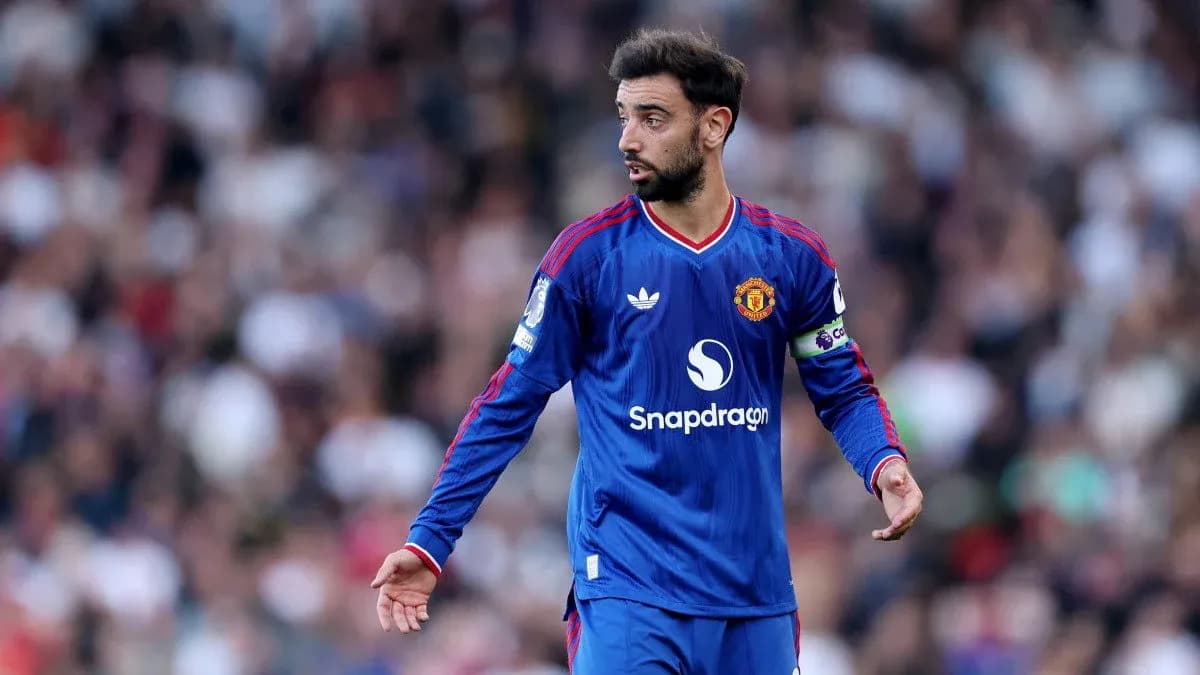
The headline duel was clear: Bruno Fernandes against Fulham’s back line and double pivot.
Bruno arrived as one of the league’s most productive midfielders. In total this campaign he had 3 goals and 1 assist from 5 appearances, with 11 shots (5 on target), 325 passes at 84% accuracy, and 13 key passes. He had also scored from the spot, converting Manchester United’s only penalty so far with a 100.00% success rate. This is a creator-finisher hybrid who dictates rhythm and punishes lapses.
His job was to probe the seams between Fulham’s centre-backs D. Affengruber and C. Bassey and the shielding duo of Berge and Charles. Fulham’s defensive record — 8 conceded overall, including 7 at home — suggested those seams exist, particularly when the full-backs push on. Arbeloa’s solution was to compress the central corridor: Berge screening passes into Bruno’s feet, Charles tracking runners and shuttling wide when Oscar Bobb and A. Iwobi were forced to press.
On the flanks, the contest of Castagne versus M. Rashford carried its own narrative. Castagne’s numbers — 6 tackles, 2 blocked shots, 4 interceptions and 35 duels (14 won) in total this season — tell of a defender constantly in the firing line. His aggression is an asset when Fulham push high, but against Rashford’s direct running it also risked exposing that disciplinary edge. Any mistimed lunge could have tilted the match.
Up front, Gonzalo García’s lone-forward role for Fulham contrasted with Matheus Cunha’s more mobile interpretation for United. García needed service from Joshua King and Iwobi, while Cunha benefited from the layered support of Rashford, B. Mbeumo, and Bruno. Yet United’s away record — just 3 goals in 3 road games — hinted at a tendency for their front four to dominate territory without always converting.
In midfield, the engine room battle between Berge/Charles and Mainoo/Tielemans was about control versus incision. Mainoo’s calm circulation and Tielemans’ passing range were designed to pull Fulham’s block apart. Fulham, however, have been at their most resilient when compact: 1 overall clean sheet may not sound like much, but given their attacking openness at home, the ability to keep games close is rooted in this central work rate.
IV. Statistical Prognosis and Post-Match Reading
From a statistical lens heading into this fixture, Manchester United’s slightly higher scoring rate and Fulham’s porous home defence pointed towards a marginal United edge. United’s overall 1.6 goals scored per match, allied with Bruno’s form and a perfectly converted penalty record, contrasted with Fulham’s habit of conceding 2.3 goals per home game.
Yet United’s own defensive frailty — 1.7 goals conceded per away match and no clean sheets at all — always left the door ajar. Fulham’s 1.7 goals per home game suggested they would find a way through, especially against a visiting back four missing de Ligt and protected by a more technical than destructive midfield.
The 1–1 outcome therefore sits precisely at the intersection of those trends: United threatening but not ruthless away, Fulham spirited but still error-prone at home. Tactically, Arbeloa will take heart from the structure of his 4-2-3-1 and the resilience of his back line under pressure, but he cannot ignore that his side remain winless after 5 matches. Carrick, meanwhile, can point to control phases and Bruno’s ongoing influence, but the inability to translate territorial dominance into victories — especially away from Old Trafford — remains the defining question of United’s early season.
In narrative terms, this was a match where systems mirrored each other, stars tried to bend the script, and the numbers quietly dictated that neither side had yet earned the right to escape their own flaws. The draw felt less like a shared point, and more like a shared reminder: both Fulham and Manchester United still have to solve themselves before they can truly solve each other.