Germany's Winger Battle: Klopp's Search for the Next Star
The spine of Jürgen Klopp’s Germany is already etched in ink. It is the paint on the wings that keeps smudging.
In goal, Marc-André ter Stegen has the gloves and, for now, the trust. Jonathan Tah and Nico Schlotterbeck look nailed on as the central pairing in front of him. Nathaniel Brown and Philipp Treu, the big revelation of Klopp’s first international window, have surged to the front of the full-back queue.
In midfield, the hierarchy is just as clear. Joshua Kimmich wears the armband and runs the show, Florian Wirtz drifts between the lines, and a young trio – Aleksandar Pavlovic, Tom Bischof and Felix Nmecha – scrap for the remaining minutes. Once Jamal Musiala returns, he will barge his way into that mix as well. Kai Havertz, meanwhile, still leads the line, even as Niclas Füllkrug, 33 and resurgent, breathes down his neck.
Everything seems ordered. Everything, except the flanks.
A battle with no owner
Klopp’s beloved 4-3-3 demands wingers who can hurt teams, press like lunatics and still track back. Right now, both wide berths are wide open – not only for this international window in Serbia on Friday and against the Netherlands on Tuesday, but as far ahead as Euro 2028.
Kevin Schade and Karim Adeyemi got the first crack under Klopp, starting the early matches against the Netherlands (1-1) and Greece (0-1). They did not seize the moment. Adeyemi squandered a golden chance and drew criticism for his work without the ball. Schade flickered rather than burned.
Their club form then sagged. Adeyemi has gone five competitive games without a goal or assist for FC Barcelona. Schade’s drought at FC Brentford is even longer at seven. Neither has made Klopp’s 24-man squad this time.
The next wave did little to slam the door shut. Serge Gnabry, Lennart Karl and Said El Mala all struggled to truly convince in the following fixtures against Serbia (2-0) and Greece (0-0). Only Derry Scherhant, the SC Freiburg debutant, offered real spark. For now, he looks set to edge ahead of El Mala on the left.
El Mala is back in the squad, Karl too. Gnabry misses out through injury. The competition remains messy, unresolved, tantalising.
On the right, though, a new duel is taking shape – and it has the feel of a turning point. Lennart Karl, reborn after a chastening start to the season and a public rebuke from Uli Hoeneß, has scored big goals for Bayern Munich against Atletico Madrid and 1. FSV Mainz 05. Across from him, in the other corner, stands Brajan Gruda, the dribbling phenomenon from RB Leipzig.
That contest could define the next era of Germany’s attack.
Gruda’s long road to his first cap
Gruda’s path to the national team has not been straight. It has been stop-start, almost teasing.
He first came into the Germany setup in 2024, when Julian Nagelsmann invited the then-Mainz prospect, along with Rocco Reitz, as an additional training player before Euro 2024. Gruda even made the squad for a friendly against Ukraine but never got off the bench.
Then came the move that was supposed to launch him. Brighton & Hove Albion paid €31.5 million to bring him to England. The Premier League, the big stage, the promise of a breakthrough. It never really happened. Gruda remained a squad player, more potential than presence.
Everything changed with the loan to RB Leipzig last winter. In Saxony, his game has accelerated. He looks bolder, sharper, more ruthless with the ball at his feet. Klopp wanted him in September already, only for a strained abdominal muscle to force a late withdrawal.
Now, at the third attempt, the door is open again – and this time Gruda arrives with a tailwind.
Messi’s nod and the birth of a dribbling king
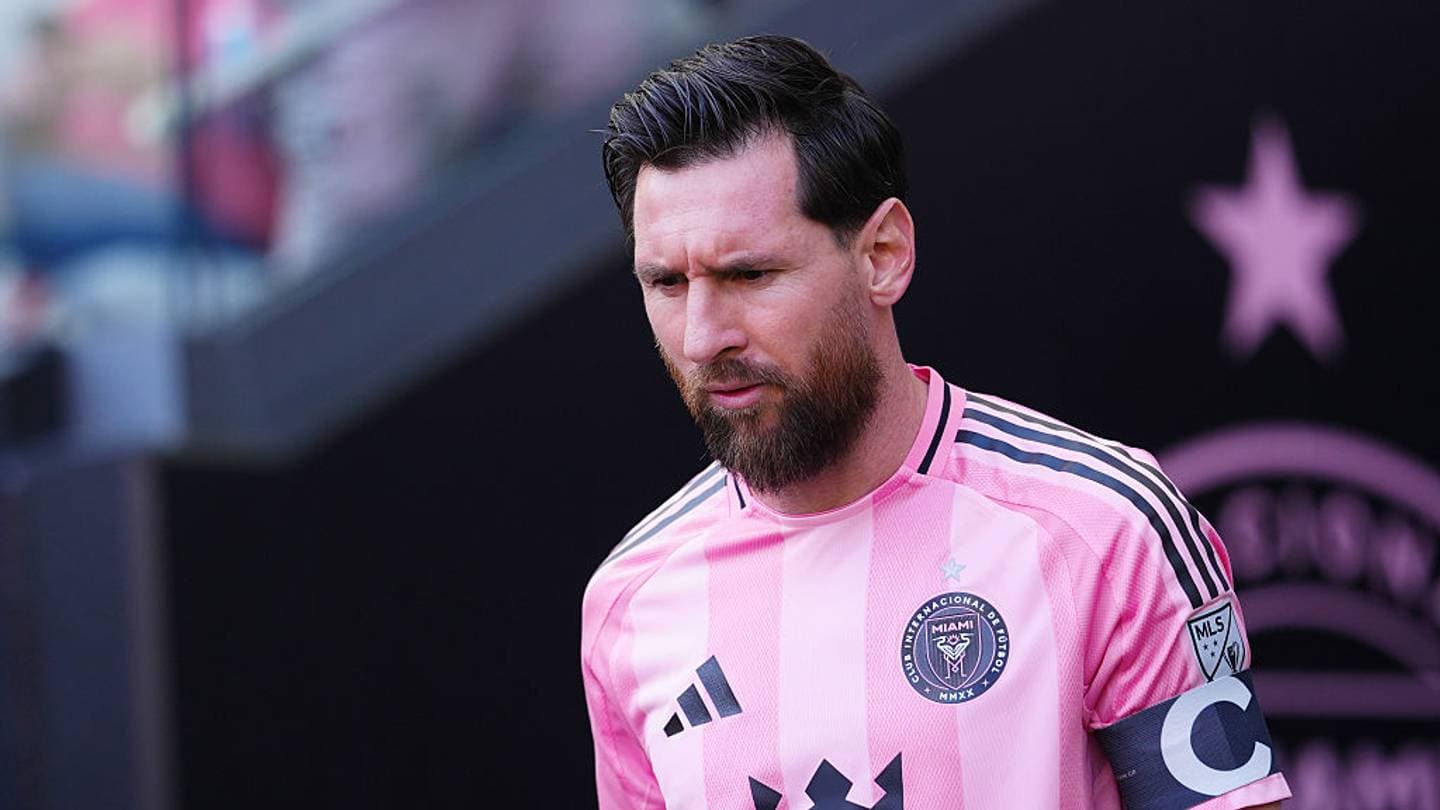
Some of that momentum comes from an unlikely place: Lionel Messi’s notebook.
In 2025, Messi named Gruda among the ten biggest talents in world football, alongside the likes of Como 1907’s Nico Paz. All ten, like Messi himself, are under contract with Adidas. The recognition was more than a pat on the head; it was a signal that the wider football world had started to pay attention.
The reward was tangible. Gruda received one of just 208 pairs of Messi’s “F50 Messi El Ultimo Tango” boots, the model the Argentine wore in his farewell match for Argentina against Benin in October – 208 pairs for 208 caps. Most players would frame them, lock them away, treat them as relics.
Gruda laced them up.
“The boots are simply a dream. Messi shaped my whole childhood,” he said when the package arrived. Instead of putting them on a shelf, he took them onto the pitch. His first outing in them came in the Champions League against PSV Eindhoven in mid-October. He scored his first goal in the competition that night.
From there, his game exploded. He has added five assists since and turned himself into one of Europe’s most dangerous one-on-one players.
The numbers back it up. Against FC Augsburg on Saturday, in a 5-2 Leipzig win, Gruda delivered two exquisite assists and completed ten of his eleven dribbles. No player has completed more dribbles in a single Bundesliga match this season. No Leipzig player has done it since detailed data collection began.
Across the campaign, he has completed 36 dribbles. Only three players in Europe’s top five leagues have more: FC Barcelona’s Lamine Yamal with 49, and the duo of Yan Diomande and Real Madrid’s Kylian Mbappé with 37 each. Gruda sits just behind them, shoulder to shoulder with the game’s most feared ball carriers.
Klopp’s street footballer
Klopp sees something raw, something instinctive in him.
“He’s something of a street footballer,” the Germany coach said. “Just a brilliant player who loves to take people on. He hasn’t yet fulfilled his potential, but he has shown a lot of positive signs.”
That is exactly what this Germany side lacks out wide: a winger who relishes the duel, who drags defenders into bad decisions, who changes the rhythm of a match with a single feint. Gruda does not just beat his man; he invites chaos in the final third.
The opportunity could hardly be clearer. With Schade and Adeyemi out, Gnabry injured, and no established star nailing down either flank, the next two games offer Gruda a runway. On one side, the more established Karl. On the other, the 22-year-old dribbling specialist with Messi’s boots on his feet and a point to prove.
Klopp has also called up 17-year-old Wael Mohya for the first time, another sign of how open the race on the wings remains. Nobody owns those positions yet. Every training session, every minute in Serbia and against the Netherlands, will tilt the balance.
Germany’s backbone is set. The shirt numbers in the middle of the pitch almost pick themselves. Out wide, though, the ink is still wet.
If Brajan Gruda brings his street football to the international stage the way he has to the Bundesliga, Klopp might finally find the winger his 4-3-3 has been waiting for.