Gianni Infantino Under Siege Amid World Cup Controversy
“Tell Mike it was just business. I always liked him.”
The line from The Godfather hangs over this story for a reason. Football’s most powerful man is discovering what it feels like when the room starts to empty and the protection peels away.
Gianni Infantino, already mired in controversy, is under siege again. For almost six weeks he has lived with the fallout from revelations of his covert plan to sell off football’s shared global property – the World Cup – in a deal that also promised him a vast personal payday. A grotesque scheme, critics say, from the man hired to guard the game’s crown jewel and pass it on intact.
There was early talk that this would finish him. That the scandal had turned him toxic, eroded his base, opened the door to a rival in next March’s presidential election. Yet entrenched power doesn’t fall easily. Infantino has already sold the world once. Then again. Most recently, to Donald Trump – in exchange for flattery, access and the trinkets of proximity to political power.
Give it a month, the thinking went. Let him stride back on stage, arms carving the air, delivering his familiar sermon on caring and sharing, égalité and fraternité, economic uplift and football for all. Stare into those oddly flat eyes behind the papier-mache mask of authority. You don’t buy me out. I buy you out.
This week, though, something shifted.
From gnats to heavy artillery
The sniping never worried him. Newspaper columns, moral outrage, the latest stern condemnation from – of all people – former Manchester United utility man Mikaël Silvestre. These are gnats around the ankles of a president who commands blocs of votes and levers of patronage.
Hard power is different. And it has finally walked into the room.
Two developments have followed Uefa’s threat of a lawsuit over the World Cup rights deal. Uefa, by most readings, does not expect a slam-dunk victory in court. That may not even be the point. This looks more like high-end chess: a zugzwang where the king must move, but every square is dangerous.
The first move came from Josh Kushner, the financier behind the Fifa Forward deal that sat at the heart of the controversy. By one of those remarkable coincidences of modern public life, the man Fifa turned to for finance and favours happens to be the brother of Jared Kushner, Trump’s son-in-law.
Named as a party to discovery in Florida, Kushner issued a careful statement. He said he “would not have gotten involved” in Fifa’s plans had he known the full picture, and called the situation regrettable. On the surface, mild. Between the lines, a clear attempt to create distance, to cut the cord to the apron that once offered protection.
Then came his second move: hiring Alex Spiro, the go-to “nuclear option” lawyer who has defended Elon Musk after he called a cave diver “a pedo” and Alec Baldwin after a fatal on-set shooting. You don’t bring in Spiro for a minor misunderstanding. You bring him in when you expect a war.
Fifa blinks at discovery
Fifa’s own response this week carried the same nervous energy. In its counterfiling, the organisation dismissed the entire affair as a “smear campaign”. Then it said the quiet part out loud.
Discovery.
Fifa spelled out its “very urgent intention” to resist it. That is the real battleground. No one in Infantino’s camp wants discovery – the legal process that forces the sharing of documents, internal memos, emails fired off from a smartphone on the golf course after lunch.
People in power always fear discovery. Infantino knows this. So does anyone who has moved in Trump’s orbit. Because you don’t just risk embarrassment. You risk becoming a problem for people who do not tolerate problems.
Behind the sabre-rattling, the mood feels different now. Thinner. As if the corridors around the office are suddenly quiet, the guards at the door distracted, the old man upstairs left a little too alone.
The Trump embrace cools
Even Trump’s support never looked entirely ironclad. In early August, the former president posted his backing for Infantino on Truth Social. It was warm, but hedged. If, “for any reason”, Fifa removed Infantino, Trump declared, this would be terrible. The wording left plenty of room to walk away.
Since then: silence.
The Gianni-Trump double act once made for surreal theatre. The Fifa president, gleaming and bald, basking in the glow of a US leader who speaks of “a very tall, very handsome man” while resembling, as ever, a giant unit of American fast food that has learned to move around in a baggy suit.
But Trump’s world is brittle. He will usher you in, boom your name, slap your back by the stairwell. When you fall, you fall alone. Loyalty is transactional because Trumpian politics has no real doctrine, no moral centre – just a relentless sorting of winners and losers.
And the losers? They tend to suffer. The Guardian once listed Trump’s enemies now facing charges, exile, lost security clearances, investigations into their finances. Some were once golden boys.
Michael Cohen, who vowed he would “take a bullet” for Trump, ended up imprisoned, disbarred, exiled from the inner circle. Jeff Sessions, the former US attorney general who hailed Trumpism as “a movement”, now sits on the scrapheap, mocked by Trump as weak, dumb, confused, “a disgrace” and worse. The pattern is clear. Enjoy the warmth, but don’t fly too close to the flames.
What’s really at stake
The coming court decision on discovery could define Infantino’s future. Uefa has accused Fifa and its president of “criminal mismanagement”, focusing on an alleged undervaluing of World Cup rights in the contested sale. Separate from that, and presented as standard industry practice, Infantino was set to receive a huge personal salary out of the structure.
Uefa’s strategy is obvious: open the box and see what’s inside. It wants discovery from Fifa, from Thrive Capital – Kushner’s firm – and from Trump donor and deal adviser Greg Maffei. All three are likely to have paper trails from the period when Infantino enjoyed intoxicating access to Trump’s circle and the machinery of US power.
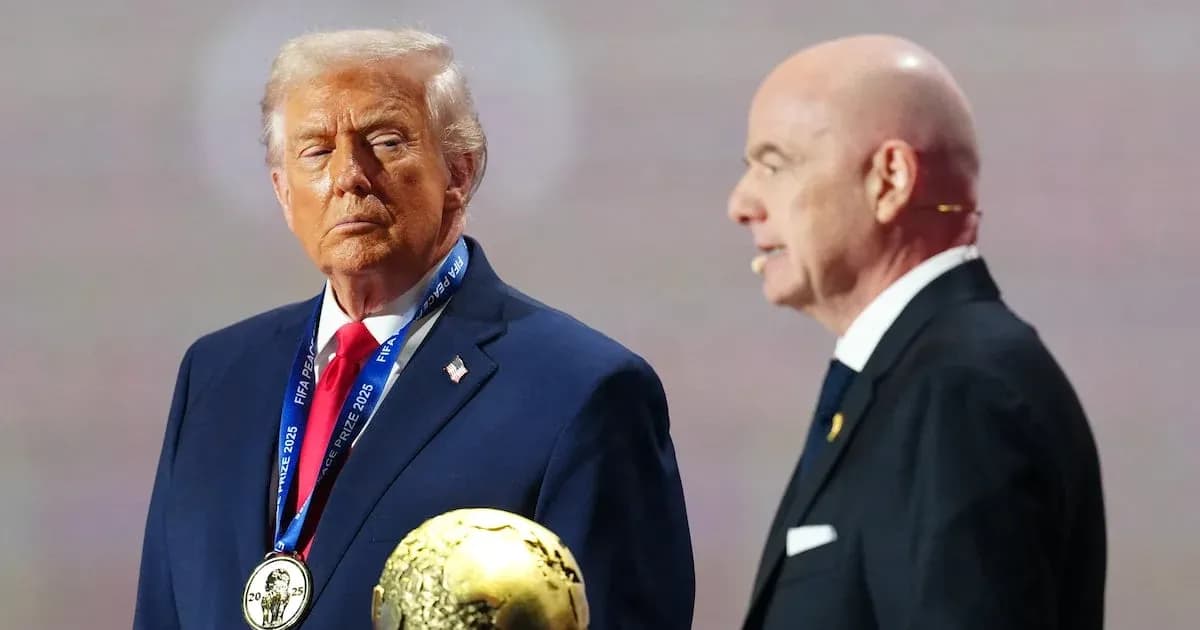
The image that comes to mind is the Club World Cup trophy – a strange, jagged object, all sharp edges and dark recesses, like something that might conceal a hidden drawer. Do you really want to know what’s in there? And if you look, can you ever look away again?
“Today I settle all family business”
“Please, Mike, don’t do this, don’t do this to me.”
“Today I settle all family business. So don’t tell me you’re innocent.”
The Godfather dialogue feels less like a flourish now and more like a mood. Infantino is doing what he can. He is on the road, working the outer provinces, shaking hands, reminding the smaller federations why they once saw him as their champion.
Saudi Arabia has offered support, but only with a telling qualifier: backing “at this time …”. Fifa’s congress in November looms. On paper, it is about votes and numbers and blocs. In reality, you wonder how much the ballot box matters if the real danger lies in a courtroom, in a judge’s order to open the files.
Sepp Blatter and Michel Platini both discovered how abruptly football’s power structure can turn. That single illegal payment allegation landed from nowhere and ended them. One day they ruled. The next, they were gone.
For now, the legal process simmers. Many such actions fizzle out. Uefa doesn’t need a crushing victory. It just needs to keep the heat on, to make clear that it will rake through the coals for as long as it takes.
Keep pushing, keep asking, keep demanding to see what’s in the box. At some point, something – or someone – usually falls out.
Mr President, you can have my answer now. Our offer is this: nothing.