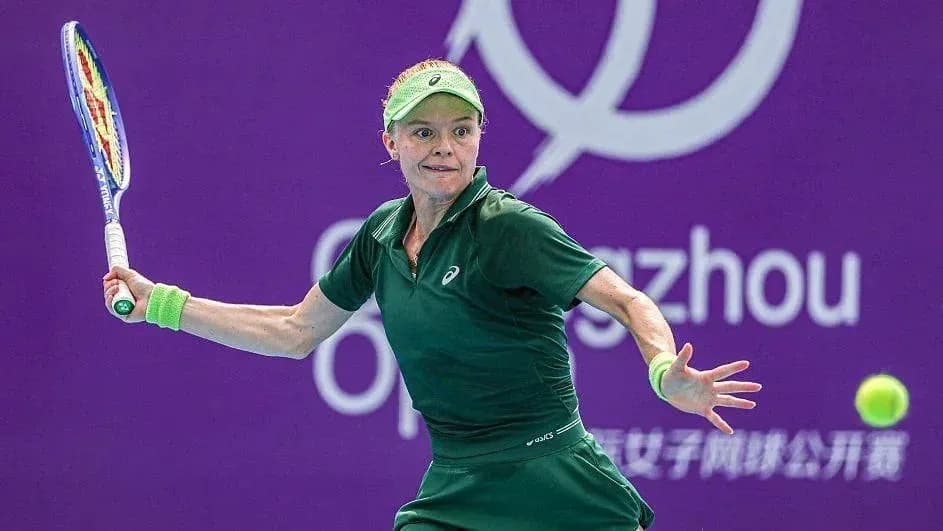
Harriet Dart Reaches First WTA Tour Final in Guangzhou
Harriet Dart wiped away tears in Guangzhou, finally standing where a decade of hard miles had been pointing her: a first WTA Tour singles final.
The 30-year-old Briton, a qualifier this week, dragged herself through a wild, nerve-shredding semi-final to beat 16-year-old Chinese wildcard Sun Xinran 5-7 7-6 (7-1) 6-0 at the Guangzhou Open, a match that swung violently before ending in a rout after just under two and a half hours.
“It’s been a really long journey. I’ve wanted it so much, so badly – sometimes too much. To finally be here means the world,” Dart said, her voice cracking as the reality sank in.
A brutal start, a brutal response
The match opened with Dart tight and Sun fearless. A double fault on break point in Dart’s first service game set the tone for a rocky start, and the British number five quickly trailed 3-0. The teenager, reigning US Open junior champion and backed by a partisan home crowd, looked at ease in the occasion. Dart did not.
Then the switch flicked.
Dart began to dictate from the baseline, stepping in, taking the ball early, and ripping through four straight games. From 0-3 down to 5-4 up, she looked every inch the seasoned pro against a prodigy still learning the tour’s demands. The chance to serve out the set felt like the natural conclusion to that surge.
Instead, the old demons bit back. Two more double faults at 5-4, the racquet clutched tighter, the shoulders tensing. The frustration was obvious. Sun pounced, broke again, and swept through the final two games to steal the opener 7-5, holding with authority and then breaking for a third time in the set.
Nerves, noise and a knife-edge tiebreak
Dart had been here before. This was only her second tour-level semi-final, after the 2024 Transylvania Open, and the weight of the moment showed. She admitted she was “really battling with myself,” and the second set became exactly that: a fight with her own expectations as much as with Sun.
Twice Dart broke early, in the first and fifth games, and twice Sun hit straight back. Every time Dart seemed to seize control, the teenager answered, matching her from the back of the court and leaning on that explosive first strike that has carried her so quickly through the junior ranks.
The tension spilled into the stands. Dart repeatedly complained to the chair umpire about the crowd, clearly irritated by the noise and movement between points. Each hold to stay in the match – twice she served with her back to the wall in the second set – felt like a small act of defiance against both her opponent and the atmosphere.
Then came the tiebreak, and with it a transformation.
Dart, who had been flinching on big points, suddenly played with clarity. She raced through it 7-1, stripping errors from her game, finding first serves, and silencing the arena that had roared for Sun all afternoon. The roar at the end of the breaker was hers.
“I found it tough out there. It was a rollercoaster,” she said. “Playing in this part of the competition, more nerves and more feelings come out. I was really battling with myself. I’m proud of the second set and was able to turn it quickly.”
One-way traffic in the decider
The momentum shift was brutal. Sun, just 16 and already carrying the burden of expectation as a home hope and junior Grand Slam champion, began to falter physically and emotionally. She took a medical timeout for treatment on her left leg, her movement clearly compromised as the third set unfolded.
Dart showed no mercy.
She tore through the decider 6-0, winning 28 of the 41 points, stripping the match of any remaining drama. The forehand dictated, the backhand held firm, and the serve – so fragile early on – became a platform rather than a liability. Each game slipped away from Sun a little faster, Dart reading the patterns, stepping inside the baseline, and finishing points with authority.
For a player who has spent years hovering on the fringes of the top 100, often stuck in qualifying draws and Challenger-level events, this was the kind of ruthless, composed close-out that has too often eluded her.
A long road, a big chance
Dart made her WTA Tour debut in Eastbourne back in 2015. Nine years on, she finally has a tour-level final to show for the grind. She has already climbed 14 places to 101st in the live rankings and knows that if she wins Sunday’s final against either fourth seed Lilli Tagger or Kaitlin Quevedo, she will punch her way back into the top 100.
This week in Guangzhou has already changed the shape of her season. One more win could change the shape of her career.