Iga Swiatek Reflects on a Challenging Season and Media Criticism
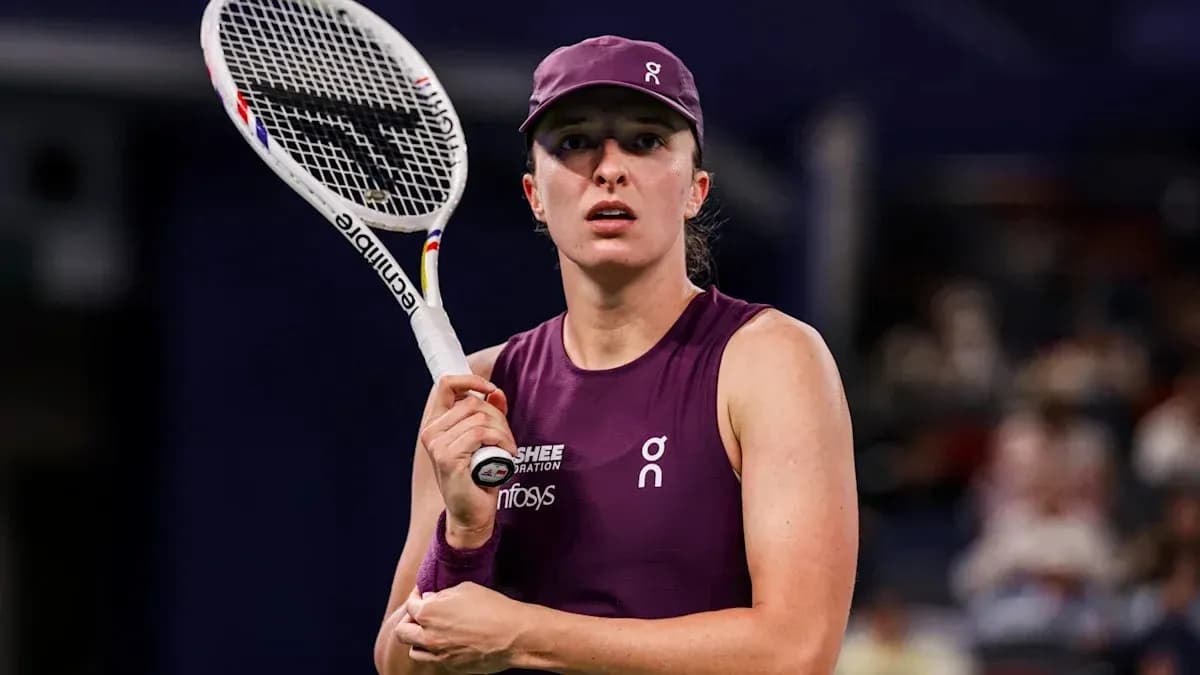
Iga Swiatek is used to closing seasons on the sport’s biggest stage. This year, she watched the WTA Finals from home.
For the first time in seven seasons, the former world No. 1 failed to qualify. The numbers alone tell you it was a step back: early exits at every Slam, a drop to No. 9 in the rankings, and a year that never quite settled into the relentless rhythm that once made her almost untouchable.
But the rankings table doesn’t show the part that has bothered her most: the noise around her.
Swiatek pushes back: “Mean and judgy” media
Swiatek has heard every theory about what went wrong in 2026. Some fans pointed at her coach Francisco Roig. Others questioned the influence of sports psychologist Daria Abramowicz. Many simply blamed Swiatek herself.
On the “What’s the Point” podcast, she chose to answer, not with anger, but with a very clear line in the sand.
“If I was a fan of someone, I would also be disappointed if they lost early and I did not have a chance to watch them,” she said. She understands the frustration. In fact, she knows she helped create it.
After years of dominance, fans started buying tickets with one assumption: Swiatek would still be standing on the final weekend. “People, after so many great tournaments that I had, started booking tickets only for the finals and semi-finals, and they are not quite aware that tennis is tough to be consistent,” she said.
She reminded everyone that what she did between 2022 and 2024 — stacking titles, surviving pressure, barely blinking from one event to the next — was the exception, not the rule. “I showed that I could be consistent maybe in 2022, 2023 and 2024, but it's not like every year that I would be able to do that.”
The expectations don’t bother her. The tone sometimes does.
Swiatek says she can live with most fan criticism. Social media, she knows, will always bring “super hateful” comments, and those cross a line. But the rest? She tries to flip it.
“If it's just being a bit judgy and them wanting to coach me, I can always just switch it around in my head and think that they care, so at least I had their support. Okay, maybe they don't understand everything, but it's okay.”
Then comes the part she doesn’t shrug off.
“The only thing that hurts me a bit more is when the journalists are being mean and judgy, and they are supposed to be experts, but they have never been on tour or been in a tennis tournament,” Swiatek said.
That, she admits, stings. Not because of the words themselves, but because of the reach.
“This is quite painful because I know they create opinions that are then read by fans, and the fans may believe it. I can totally understand the negative comments from the fans, but from people who are supposed to know something about the sport, if they do too many mean things, this is not right for me.”
In a season where her aura of inevitability cracked, Swiatek has been forced to confront not just opponents across the net, but the narratives written about her when she walks off court.
A tough year, a late surge
Strip the emotion away and the season still looks harsh on paper.
Quarter-final at the Australian Open.
Fourth round at Roland Garros and the US Open.
Third round at Wimbledon, where she arrived as defending champion.
For a player of her stature, those results carry weight. They cost her ranking points, cost her the WTA Finals, and opened the door to louder questions about her team, her schedule, her mental fatigue.
Yet the year did not drift into mediocrity. The second half, especially at WTA 1000 level, told a different story — one of a player quietly rebuilding.
Her 2026 WTA 1000 record charts that climb:
- Qatar Open – Quarter-final (lost to Maria Sakkari)
- Dubai Tennis Championships – Did not play
- Indian Wells – Quarter-final (lost to Elina Svitolina)
- Miami Open – Second round (lost to Magda Linette)
- Madrid Open – Third round (lost to Ann Li)
- Italian Open – Semi-final (lost to Elina Svitolina)
- Canadian Open – Champion
- Cincinnati Open – Semi-final (lost to Jessica Pegula)
- China Open – Quarter-final (lost to Elise Mertens)
- Wuhan Open – Semi-final (lost to Maja Chwalinska)
The turning point came in Canada. That title — against a deep field, in heavy conditions, under real pressure to prove something — shifted the feel of her season. From Rome onwards, she looked more like herself: deeper runs, sharper patterns, more control in the big moments.
She still finished only ninth in the world, a jarring number for a player who once made the top spot look like a private office. Yet that same ranking now comes with a warning for everyone above her: the engine is humming again.
New year, new start in Brisbane
Swiatek usually launches her campaign at the United Cup, a competition that suited both her patriotism and her rhythm. Poland lifted the trophy in 2026, another line on a glittering résumé.
This time, the script changes. In 2027 she is expected to head to the Brisbane International instead, with the event starting on January 3.
Different city, different build-up, same target.
She will walk into the new season without the cushion of being No. 1, without the guarantee of a WTA Finals ticket, and with critics — fans and journalists alike — still ready to dissect every misstep.
But she will also walk in as a recent WTA 1000 champion, with a strong second half of 2026 behind her and a point to prove, not about her ceiling, but about her staying power.
The question now is not whether Iga Swiatek can climb back into the top five. Her game, her mentality, and her track record already answered that.
The real question is how she chooses to carry the weight of expectation — and who gets to define her story as she starts again in Brisbane.