Iran’s World Cup Campaign Faces Chaos
Iran’s World Cup campaign was barely an hour old when the next blow landed.
Fresh from a draining, politically charged 2-2 draw with New Zealand in Los Angeles on Monday night, Amir Ghalenoei’s players expected ice baths, food, and sleep. Instead, they were told to pack up and get out of the country.
No recovery session. No night in California. Straight back to Mexico.
“We have to leave immediately,” the Iran coach said through an interpreter, still trying to process the order. The squad was instructed to board a plane for the short but gruelling 140-mile journey back to its training base in Tijuana, turning what should have been a standard post-match routine into another logistical ordeal in a World Cup cycle already defined by chaos.
“They didn’t even give us time to recover,” Ghalenoei said. “It’s very important for us to have time for recovery, (but) we are asked to get on a plane and return to our camp in Tijuana, and we are really troubled by that.”
He did not say who gave the order.
A World Cup under siege
Iran’s tournament has been shaped by events far from the pitch. Since the U.S. and Israel began a war against Iran on Feb. 28, every step of Team Melli’s preparation has been contested, delayed, or stripped back.
The federation asked FIFA to move its three group matches away from the U.S. FIFA said no. Iran chose to play on anyway.
The impact has been brutal. Captain Mehdi Taremi described a five-hour slog of travel and security checks on what is usually a short trip from Tijuana to the Los Angeles area on Sunday, the day before the opener.
“We don’t know why they are returning us, to be honest,” Ghalenoei said. “I think it’s very strange. It seems like others are doing the planning for us. The decision-making for us is being made elsewhere.”
The original plan was simple: arrive two nights before the game, stay in Los Angeles after the match, and head back to Mexico at lunchtime the next day. That schedule, Ghalenoei said, was torn up without explanation.
“I think our team is perhaps the most oppressed in the World Cup.”
The sense of isolation runs deeper than travel. Several key staff members, including the president of Iran’s football federation, coaching support staff, and media officers, were denied U.S. visas. The team has been operating with a skeleton off-field structure in a tournament that usually demands armies of specialists.
“We have to leave Los Angeles right now, and it’s not good for us,” Taremi said about an hour after full time. “I think FIFA have to help us more than this. ... Everything is like a disaster, actually, for us.”
Cramps, substitutions, and a draining night
On the pitch, Iran’s problems showed up in the legs.
The match at SoFi Stadium was played in mild conditions, but Iran’s players cramped repeatedly. Ghalenoei pointed directly to the travel and the disrupted schedule.
“Before the game, I said we haven’t had time to adjust because of the travel,” he said. “Many of our players, they had cramps, and that’s why we had to substitute them. So it wasn’t for technical reasons that we made substitutions. It was because of the injury and because of the cramp.”
The players will be examined by the staff on Tuesday, but the coach’s frustration is clear. Delayed arrivals. Forced early departure. No proper recovery window.
“They are making the situation more difficult,” he said.
The stakes only rise from here. Iran face Belgium in Inglewood on Sunday, then fly north to meet Egypt in Seattle next week. Both fixtures look tougher than New Zealand “on paper,” as Ghalenoei admitted, and all four teams in the group — Iran, Belgium, Egypt, and New Zealand — sit on one point after the opening round.
A fractured crowd, a fierce backing
Inside SoFi Stadium, the noise told a different story.
Los Angeles is home to the world’s largest population of Iranians outside Iran, and they turned the arena into a charged, conflicted, and ultimately compelling stage. The politics outside the stadium gates did not stay there.
Several hundred Iranian Americans gathered to protest the government before and during the match. Many in the stands jeered and turned their backs during the national anthem. Yet once the ball rolled, the players felt the full force of the diaspora behind them.
“It was an incredible atmosphere in the game, all 90 minutes,” Taremi said. “It was like at home for us.”
The tension between anger at the regime and affection for Team Melli has followed Iran to this World Cup. On Monday night, it produced a crackling edge: dissent during the anthem, roaring support for every attack.
A wild 2-2 that solved nothing
On the field, Iran’s performance was as messy as their circumstances.
Ranked 65 places above New Zealand in FIFA’s standings, Iran were expected to control the game. Instead, they trailed twice and had to claw their way back to a draw that felt both disappointing and strangely defiant.
Elijah Just struck early in each half for New Zealand, punishing lapses and silencing the Iranian fans — briefly. Each time, Iran responded with quality.
Ramin Rezaeian curled in a superb finish with the outside of his boot in the first half. Then, with the game slipping away, he delivered again, this time as creator. His cross in the 64th minute was inch-perfect, and Mohammad Mohebi met it with a thumping header to level the score at 2-2.
The celebration sparked as much debate as the goal. Mohebi appeared to mime the shooting of a gun, prompting criticism online. He followed it with the “ice in my veins” gesture popularised by Los Angeles Lakers guard D’Angelo Russell just a few miles from SoFi, then finished by holding up a heart to the fans.
“The Iranians who live in Los Angeles, they make a great atmosphere,” Mohebi said. “That celebration, it comes in the mind, and I did like this” — he motioned to his arm — “for all the fans. Just a celebration.”
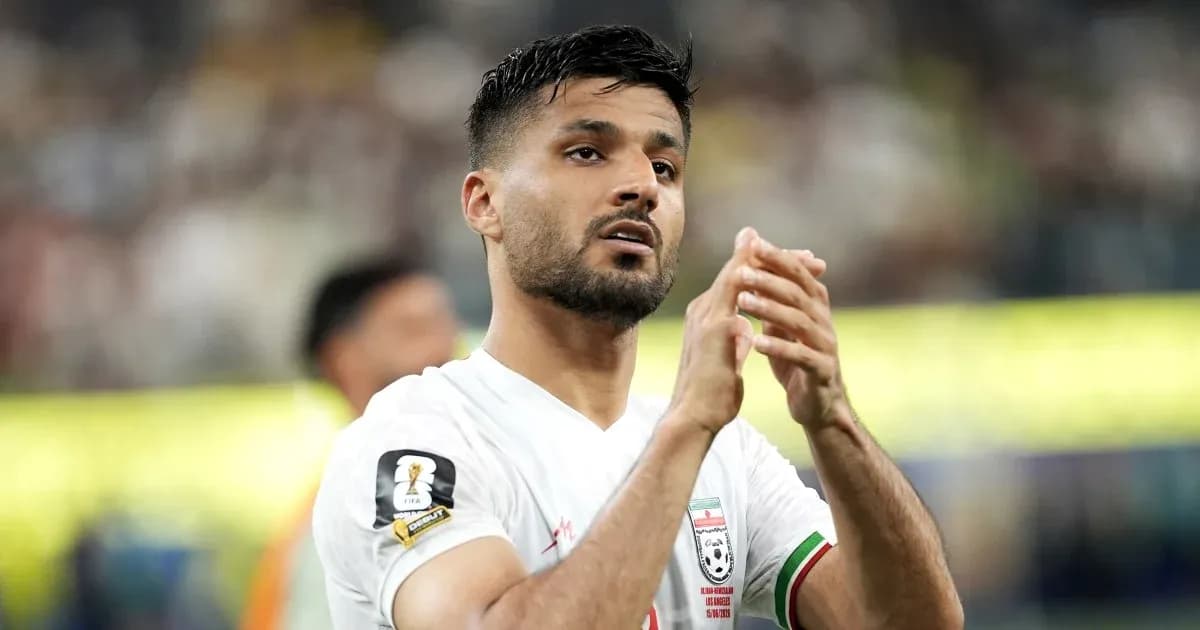
When the final whistle went, the hostility in the air gave way to respect on the grass. Players from both teams embraced and swapped shirts. Ghalenoei sat alone in the dugout, watching as his squad walked the perimeter of the pitch, applauding the thousands of flag-waving supporters who had stayed to salute them.
A group on a knife-edge
Iran’s path out of the group has never looked simple. Now it looks precarious.
Both of their remaining matches are against stronger opponents, at least by reputation. The physical strain is mounting. The political and logistical storm shows no sign of easing. Even the basic comforts of a World Cup — rest, rhythm, routine — seem out of reach.
“We’re facing more hurdles, but we’re not going to let that stop us from doing our best,” Ghalenoei said. “I think today was one of the best games in the World Cup so far, and I think the fans really enjoyed it inside the stadium and outside the stadium.”
The football, at times, matched the noise. The question now is whether this battered, travelling Iran side can keep playing at that level while the ground keeps shifting beneath its feet.