Iraola's Challenge at Liverpool: Balancing Klopp and Slot's Styles
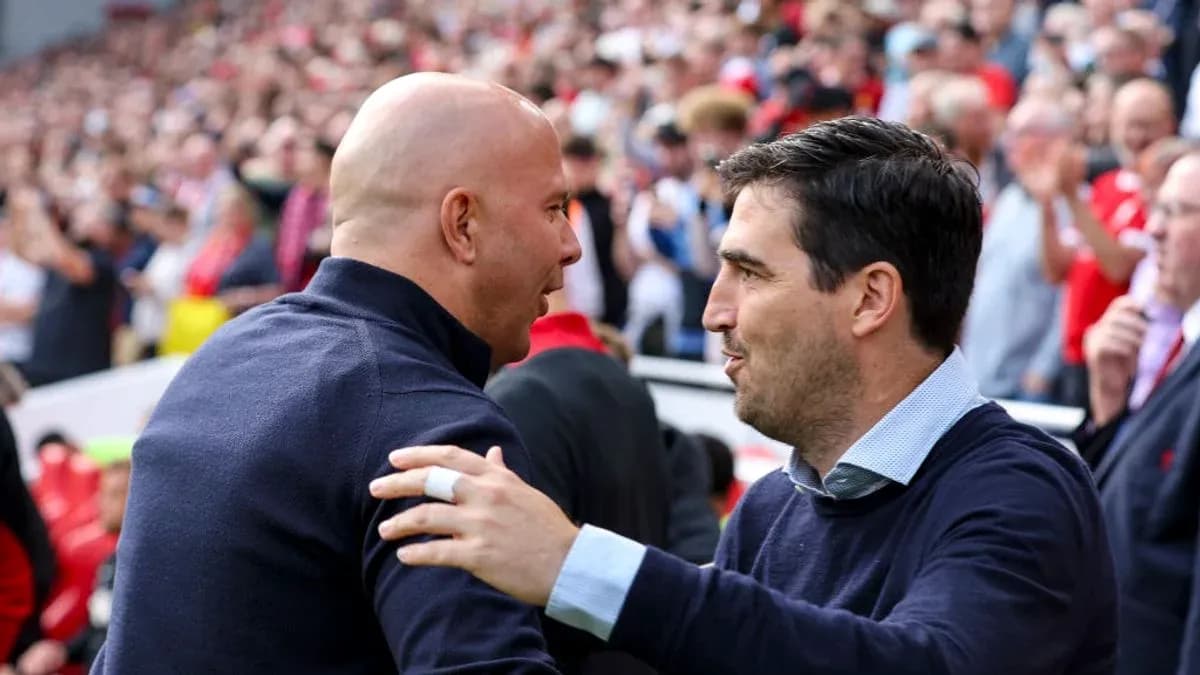
Andoni Iraola has never been afraid of a hard start. At Bournemouth, it took him 10 Premier League games to taste victory. At Liverpool, he will at least have to wait for matchday two.
His new era at Anfield opened with a chaotic 2-2 draw against Newcastle. Liverpool were outrun, ragged without the ball, and at times looked like a team still trying to remember which manager they actually play for.
Caught Between Klopp and Slot
The confusion was laid bare in an interview that should make Liverpool supporters sit up. Sitting down with Steven Gerrard for TNT Sports, Iraola was asked the inevitable question: is he closer to Jurgen Klopp or Arne Slot?
He didn’t hesitate for long.
“Probably closer to Jurgen, probably, I would say. But I loved a lot of the things that the team had with Arne also,” Iraola replied.
That answer matters. Klopp’s Liverpool lived on chaos, speed and verticality. Slot’s brief spell was built on control, structure and long spells of possession. Iraola wants something closer to Klopp’s storm than Slot’s chessboard, but the squad hasn’t fully left the old blueprint behind.
“There has to be a balance. Things are going to evolve differently because the first game we had 60, 61 percent of possession straight away,” he said of the Newcastle draw.
Then came the line that really told the story.
“Naturally, because the natural tendency of the players is towards that side, and I need to adapt also towards that side. ... But we also need to keep being vertical, keep attacking, keep taking sometimes some risks.”
That “natural tendency” is the red flag. It suggests a squad whose instincts still belong to Slot, not Iraola.
Possession Without Protection
You could see it in the way Liverpool attacked. Dominik Szoboszlai, Ryan Gravenberch, Jeremie Frimpong and Milos Kerkez frequently camped high up the pitch, happy to occupy advanced positions as Liverpool recycled the ball.
Under Slot, that was the whole idea: pin the opposition back, keep the ball, probe the low block, wait for gaps. Under Iraola, that same shape becomes a trap.
He wants speed. He wants direct runs. He wants a team that can go from back to front in seconds. But if too many players stand high and wide waiting for the next pass, every turnover becomes a sprint race the wrong way.
That’s a problem when your last line is a 35-year-old Virgil van Dijk and a novice Jeremy Jacquet, both being asked to defend huge spaces in transition. Newcastle exploited it. Twice. Both goals exposed Liverpool’s vulnerability when attacks broke down and the rest defence simply wasn’t there.
The numbers underline the identity clash. Over 60 percent possession in Iraola’s first league game sounds like control. It didn’t look like it. It looked like a team trying to play one style with players whose muscle memory is wired for another.
Energy Shortfall
None of this arrives out of the blue. Iraola had already raised concerns during preseason in the United States, pointing the finger at fitness and intensity levels that weren’t where he wanted them.
After a preseason match against Leeds in early August, his assessment was blunt.
“I think we played really good [in the] first half, especially the first 30 minutes, but right now probably we don't have much more in terms of the level required to play like this,” he said. “Then they were much better in the second half.
“The problem is right now probably they don't have the energy for 90 minutes and they start to get tired. It will take time with them, we need more training with them.”
That was weeks ago. The Newcastle game suggested the issue hasn’t disappeared. Liverpool began with the ball, but not with the bite Iraola’s style demands. When the tempo dipped, the gaps appeared. When the legs faded, so did the structure.
Two Problems, One Direction
Iraola inherits a squad schooled in Slot’s possession-first approach, still physically short of the intensity he demands, and mentally torn between two identities. He has to fix both.
First, he must reshape those “natural tendencies” in possession. The midfield and full-backs cannot all live on the edge of the final third while the rest defence hangs by a thread. Vertical football only works if the team is ready for what happens when the ball is lost.
Second, he needs time on the training ground to drag the fitness levels up to his standard. His own words make it clear: Liverpool, as currently conditioned, cannot yet play his football for 90 minutes.
None of this means the project is doomed. It does mean the turbulence is logical. A coach closer in spirit to Klopp than Slot is trying to bend a Slot-influenced squad into something more aggressive, more direct, more exposed.
That doesn’t happen in one summer, or in one wild 2-2 on opening day. The real question is not whether Iraola has work to do. It’s how patient Liverpool can afford to be while he does it.