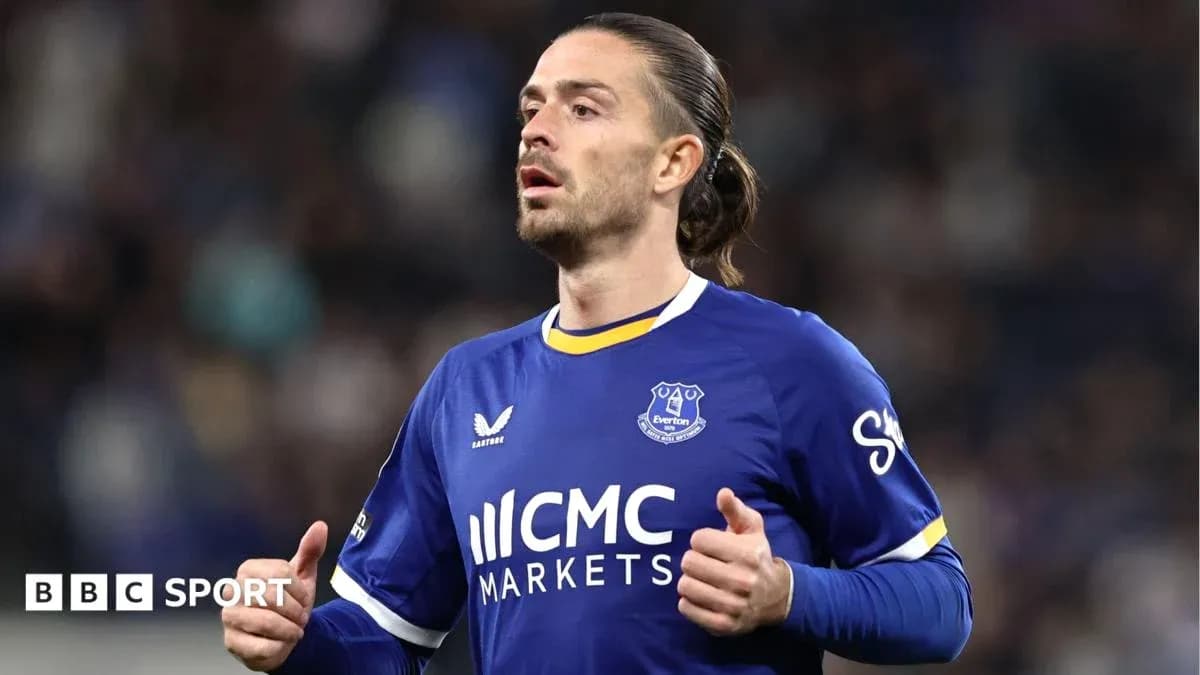
Jack Grealish Faces Critical Moment at Everton After Disciplinary Breach
When Jack Grealish rolled back into Finch Farm on deadline day, white Lamborghini purring, he felt like a returning hero. Supporters clustered around the gates, phones in the air, and the 31-year-old soaked in every second. After a joyless summer in the transfer market, Everton finally had something – and someone – to believe in.
His first loan from Manchester City had ended with a serious foot injury, but not before he had given Goodison Park flashes of the old swagger. Enough to make this second coming feel like more than a short-term fix. It felt like a bond rekindled. By the time he left in the early hours, deal signed, every autograph scribbled, every selfie taken, Grealish looked and sounded like a man who had found his place again.
Now that sense of homecoming is under threat.
A breach, and a line crossed
Everton did not hide behind vague phrases when Grealish disappeared from the squad for the Carabao Cup tie against Newcastle United. His absence was put down bluntly to “a breach of club discipline”. The issue was clear: he had failed to turn up for training on Monday.
For a player who once carried the weight of being Britain’s first £100m footballer, it was a jarring misstep. For a footballer already living on the margins at Manchester City, exiled in the final year of his contract, it felt like a self-inflicted wound.
Everton chose to go public before kick-off. That alone told its own story. This was not a minor internal ticking-off. This was a marker laid down.
Inside the club, it is not being dressed up as the final straw. David Moyes simply does not have the numbers to discard a player of Grealish’s talent. The manager has only 18 senior professionals to work with after a botched window and cautious owners. He cannot afford luxury outcasts.
But the pressure has shifted. Sharply.
This now looks and feels like Grealish’s “now or never” moment at the top of the Premier League. If it unravels at Everton, it is hard to see who at the elite level takes the next gamble.
Moyes’ values, George’s impact
The punishment was agreed high up at Everton, with Moyes’ full backing. It left Grealish watching from the outside as his team-mates delivered arguably their best performance of the season, beating Newcastle 3-1 to book a quarter-final trip to League Two Fleetwood Town, the side who had already knocked out champions Arsenal.
Crucially, the left flank – Grealish’s territory – belonged to 20-year-old Tyrique George. He brought pace, energy and direct running, the kind of tempo Moyes demands and has not always seen from Grealish this season. It was exactly the sort of display that makes a missing senior player feel suddenly less indispensable.
Moyes chose his words carefully afterwards, but his message was unmistakable.
“You probably know I'm not going to give any details. It's a club decision and I support it. It's something I don't want to speak too much about,” he said.
Then came the line that will echo around Finch Farm.
“The one thing about Everton is that they have got real good values. All the players stand behind it and accept the values, on the pitch and off the pitch, and I think the players did a good job.
“It is a small squad, but we are doing our best to keep challenging. We are not accepting any excuses for anything and I think the players are doing a great job. There was a humility about us.”
He never named Grealish. He did not need to. For a strict disciplinarian like Moyes, a no-show for training is a direct challenge to the culture he is trying to protect.
A bond tested
The sting will be sharper because of the relationship the two men built almost from day one of Grealish’s first spell in August 2025. The forward spoke then of how a single conversation convinced him Everton was the only destination he wanted. Moyes, in turn, trusted him in big moments.
Grealish arrived on Merseyside as a Treble winner with Manchester City, a key figure in the 2023 Premier League, FA Cup and Champions League triumphs. At Everton, he was beginning to look like a player reborn until that foot fracture in a 1-0 win at Aston Villa cut him down in January.
He could have gone back to City for his rehabilitation. Instead, he stayed at Finch Farm, working with Everton’s medical staff, living inside the club’s routines and rhythms. It was a decision that spoke of comfort and loyalty on both sides.
So when Everton weighed up a second loan, they did so with clear eyes. The injury record, the cost, and yes, the character, all went into the equation. Moyes still pushed to bring him back, convinced that Merseyside was where Grealish wanted – and needed – to be.
The context makes this latest misjudgement harder to swallow.
Underwhelming form, shrinking margins
On the pitch, the numbers have not helped his case. Across eight appearances this season – two for City, six for Everton – Grealish has not scored and has not registered an assist. His habit of slowing attacks, of taking an extra touch, jars with the quick, vertical football Moyes prefers.
He also missed the weekend defeat at Arsenal, officially through “illness”. For a manager dealing with a thin squad, that absence, followed by a failure to report for training, will have felt like a pattern he can ill afford.
Inside the dressing room, the picture is different. Grealish is hugely popular. Staff around the club speak warmly of him. “A lad with a heart of gold, kind and charming, who actually loves being here,” is how he has been described.
The evidence for that softer side is not hard to find. Recently, he donated £10,000 to a GoFundMe page for Everton fan Leon Skapars, a 36-year-old father of three diagnosed with cancer. Skapars’ wife, Crystal, spoke of the impact: “In that moment, Jack gave our whole family something we desperately needed, hope. What he has done for our family is something we will never forget. It makes us feel incredibly emotional.”
Grealish has fronted awards at the Daily Mirror’s ‘Pride Of Britain’ event, telling the audience: “Footballers are classed as heroes – but these are the real heroes.” In April, he extended his role as principal ambassador to Special Olympics Great Britain for another three years, having first taken it on in 2022.
He marked that extension by inviting five of the 10 Special Olympics GB athletes who completed the London Marathon to Everton’s Hill Dickinson Stadium, giving them a VIP experience, a tour and time on the pitch. At Finch Farm, he is often one of the first to step into community work, spending time with the Everton in the Community Down Syndrome team and drawing inspiration from his sister Hollie, who has cerebral palsy.
These are not token gestures. They are consistent threads in his life.
The other side of the story
Yet Grealish’s career has always been a tug-of-war between the generous, engaging figure off the pitch and the headlines that follow him away from it.
In April, he was pictured asleep at a Manchester rooftop bar, drinks scattered around him. Nothing illegal, nothing extraordinary in isolation, but hardly ideal optics for a player rehabbing from injury in an era of camera phones and instant judgement.
Back in March 2020, he was fined by Aston Villa and forced into a public apology after breaking lockdown guidelines during the pandemic by leaving his home to visit a friend. Later that year, in November, he admitted two counts of careless driving after incidents involving a Citroen van and a Mercedes.
These moments sit awkwardly alongside the glowing personal references. They do not erase them, but they complicate the story. They make this latest disciplinary breach at Everton feel less like an isolated lapse and more like another step on a familiar tightrope.
Crossroads at Goodison
Inside the club, Grealish has already held talks with senior figures. The message, under Moyes, will have been blunt: no repeats. Not in this squad. Not with this manager.
BBC Sport understands there have been occasional issues with time-keeping in the past, though never on this scale, and never from a player regarded as a hard trainer who usually looks after himself. That is part of what makes this so jarring. This is not a serial shirker. This is a player who has, more often than not, put the work in.
But football at the top level does not deal in endless second chances. Not for long. Not when a 20-year-old like Tyrique George can step into your position and change the rhythm of a game.
Grealish remains adored by many at Everton. His character, his generosity, his willingness to engage with supporters and community projects have earned him deep affection. That is why this hurts people inside the club as much as it angers them.
The punishment has been handed down. The public explanation has been given. The squad has shown it can win, and win well, without him. Wembley has crept into view in the Carabao Cup. The stakes, for club and player, have risen.
For Jack Grealish, this is no longer about the car he drives through the gates or the selfies he signs on the way out. It is about whether, at 31, he can finally align the talent, the personality and the professionalism that so many people believe he has.
Because at Everton, and at this level, he is running out of chances to prove they are right.