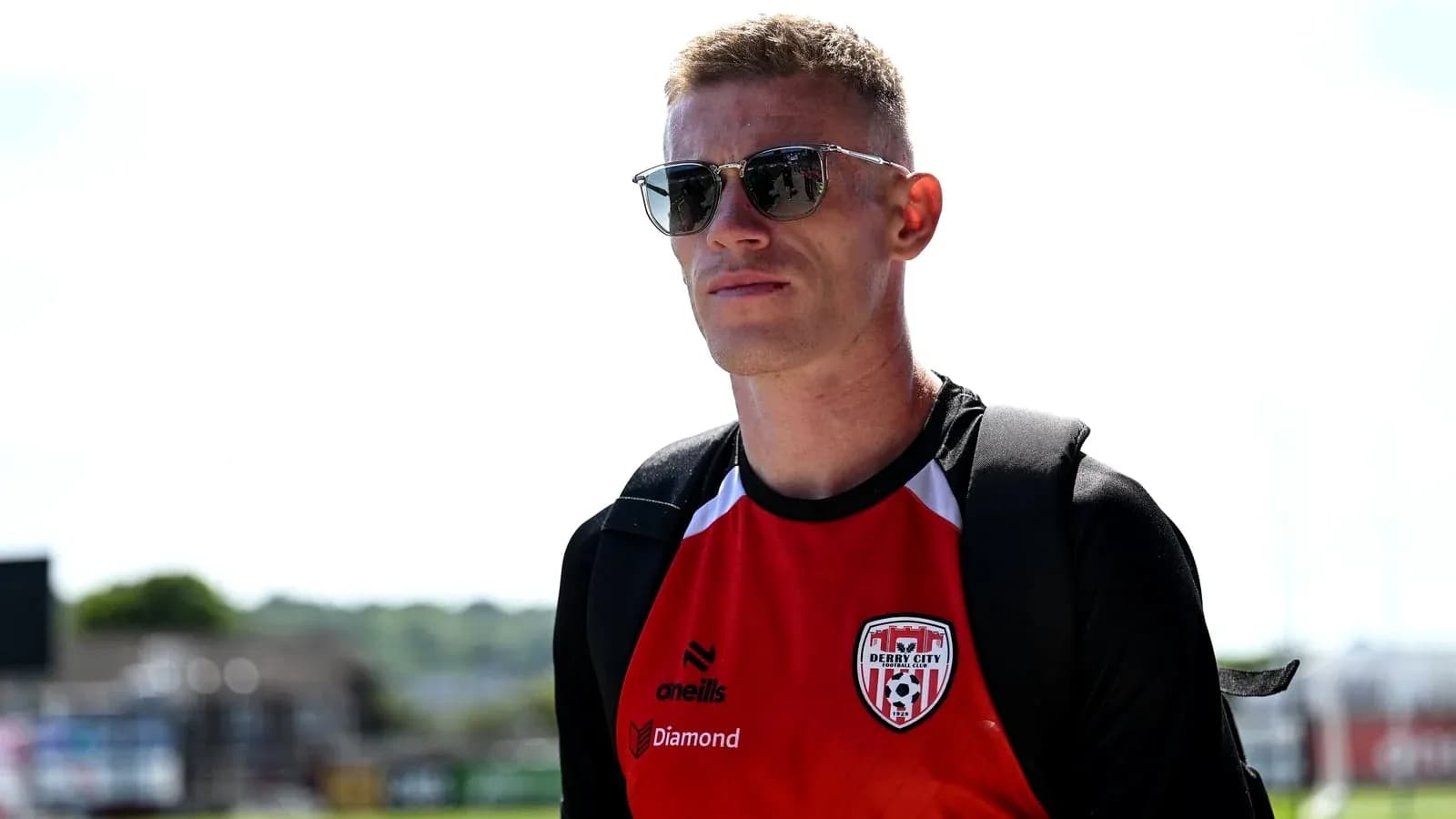
James McClean: A Troubled Return to Derry City
James McClean came back to Derry to finish where it all began. Instead, he finds himself on the outside, watching the club he loves move on without him.
The 37-year-old, who returned to his hometown side from Wrexham in January, has not been named in a matchday squad since early July. What should have been a sentimental homecoming has curdled into a stand-off, a public fallout and a player who admits, bluntly, that he is “struggling”.
A Homecoming Gone Sour
McClean’s return to Derry City was supposed to be the romantic final act: the local hero, 103 caps for the Republic of Ireland, coming back to the Brandywell to close the circle.
Instead, he claims the club made an “incomprehensible” attempt to terminate his contract. The dispute spilled into the open, his frustration boiling over in sharp criticism of the Candystripes. He later apologised for some of the language he used, but the damage was done.
He has not featured since, and not at all under interim manager Mark Connolly. Derry City, for their part, have distanced themselves from his comments, stressing they “do not reflect” the club’s core values or beliefs. The relationship sits at an impasse, cold and unresolved.
For McClean, that professional freeze-out cuts deep.
“I’m struggling in my current situation,” he admitted on RTÉ Radio 1’s The Brendan O’Connor Show. “You go home expecting and being told one thing, and for that not to work out, and then to be cast aside and then made to feel like a leper in a place where you thought they would never do that to you…for that to happen is very tough.
“The one thing I have always loved doing, and all I have known, is playing football. For a power to take that away from me wrongly, and unfairly, has been difficult.”
The Book, the Backlash and the Word “Weakness”
At the same time as his club career has stalled, McClean has stepped into another arena. His new book, The Walls, charts the closing stages of his football life and a growing fascination with boxing. It also pulls back the curtain on a childhood that still shadows him.
In the book, he reveals he only learned who his biological father was around the age of 10. He describes a man with alcohol problems whom he met just once. That unresolved past, he says, lingers in ways he hasn’t always wanted to confront.
The promotional tour for the book opened up a new front of criticism. In an interview with the Sunday Independent, McClean explained why he would never seek therapy.
“As a man, I see that as weakness. I don’t need to open up,” he said. “I see it as a weakness that I’d have to speak to someone about my feelings; my emotions.”
Those lines, lifted and shared widely, drew fierce reaction. Mental health advocates, supporters and commentators lined up to challenge the message. McClean suddenly found himself at the centre of a storm he insists misrepresented his true stance.
“That (the comment about seeking counselling as a weakness) was a screengrab, it was put out there and people jumped on it,” he said on RTÉ. “My own club (Derry City) put out a statement that didn’t help in the slightest, but not one person reached out to me to say, ‘James, can you clarify what you meant?’
“I’m pretty sure nobody actually read the context of the article. If they had, they would have seen that I was solely speaking on my own personal experience.”
He stresses he has never looked down on anyone who chooses therapy.
“Any man or woman that needs to go to therapy to help themselves, I couldn’t commend them any higher,” he said. “That’s not to say me going to the gym is wrong either because that works for me. I was solely speaking about me.
“Me saying the word weakness, was probably my weakness in saying that, but I’m not going to apologise that I’m in a place where I feel I don’t need to go to therapy. That’s in a way what I’m getting bashed for.”
Public Figure, Private Weight
The backlash has clearly rattled him. Asked whether he had been reluctant to revisit painful parts of his life while writing the book with ghostwriter Dan McDonnell, McClean didn’t hide.
“Maybe more so now after the backlash of the last few days,” he said. “It has probably made me more reluctant to do so going forward because I opened up on stuff that I never really spoke about privately, never mind publicly.
“What has happened over the last few days has made it really tough.”
His wife, Erin, has watched the toll this year has taken. She described her husband as “struggling” and said life had become “a daily battle”. McClean did not argue.
Asked directly if he agreed with her, he replied: “I am struggling.”
He spoke of the contrast between the image he projects and the turmoil underneath, particularly in the way he reacts online.
“My biggest problem has always been social media. In the moment, when I feel attacked, it’s almost like auto-pilot, I go on the offensive to show nothing bothers me.”
Erin, he says, believes therapy could help him process trauma from his childhood, especially around his biological father. He still isn’t ready to take that step, choosing instead to lean on fitness and gym work as his outlet. For him, that is how he copes, even if the language he used around therapy has come back to haunt him.
A Career on Hold, a Future in Question
This is not how a 103-cap international expects the final chapters to read. No farewell ovation. No last roar in front of the home crowd. Just silence from the team sheet and a sense of exile in his own city.
McClean’s football future remains uncertain. Derry City and their most decorated modern son are locked in a stand-off that shows no sign of thawing. The club has drawn a line under his recent remarks. The player feels abandoned by the institution he thought would always have his back.
For now, he is left with his book, his boxing, his gym sessions and his memories of a career that took him from Derry to the Premier League and back again. The one thing missing is the ball at his feet.
If this is the closing stretch of James McClean’s playing days, it is unfolding not under the floodlights, but in the shadows of a club he still calls home.