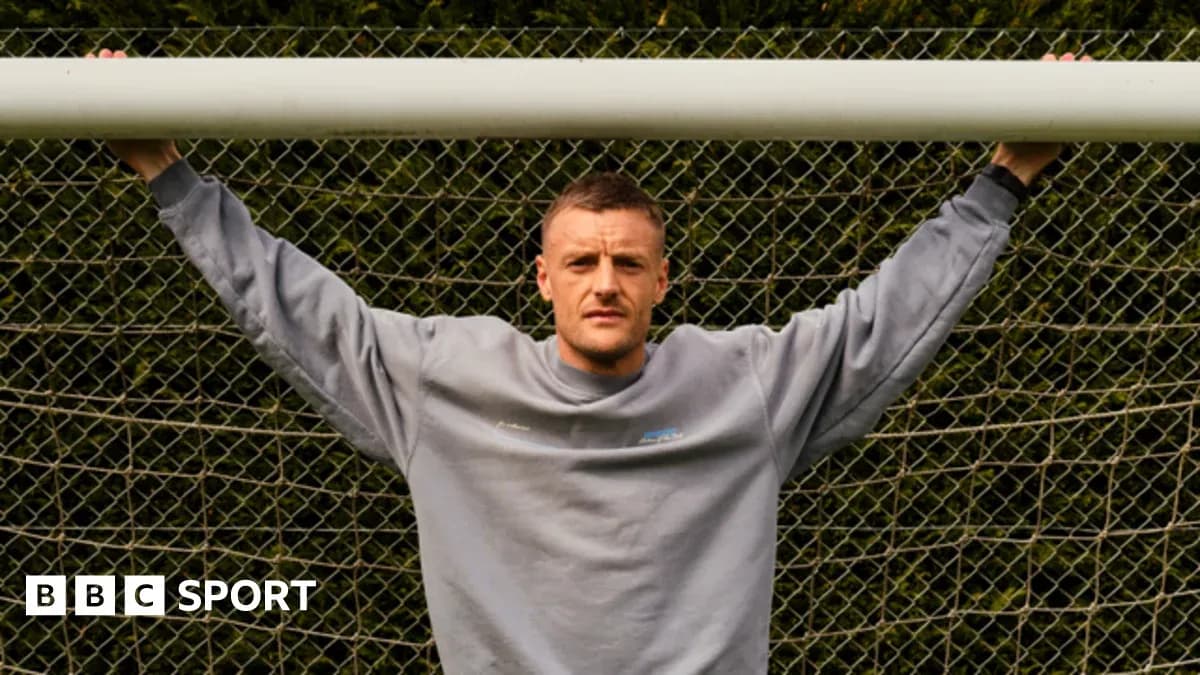
Jamie Vardy: From Underdog to Premier League Champion
The first line hits like a two‑footed tackle.
“A raw, caged animal, drinking, partying and fighting.”
That is how a new Netflix film chooses to introduce Jamie Vardy. At 39, now grinding away in Serie A with Cremonense, Vardy goes even harder on himself in the documentary, using a harsher expletive to sum up the man he once was.
Yet the figure sitting in front of a small group of journalists at Netflix’s London headquarters is not the feral forward English football first met. He is still blunt, still barbed, but this is an older Vardy, an underdog-turned-Premier League champion trying – not entirely comfortably – to look back.
“I don't have time to reflect, to be honest,” he says after the first screening of his Untold UK film. Wife Rebekah sits a few rows back in a plush mini‑cinema room, mostly silent, occasionally bristling or smiling at questions and answers.
“At the minute, it's playing, the season finishes and I just want to forget about football. I need to mentally forget everything and get back to a normal place.”
The grind in Italy, the scars from England
Vardy knew what he was signing up for last summer. Cremonense, not Feyenoord. A relegation fight, not a title push. They are still stuck in the drop zone with three games left, and the years are written in his voice as much as in his legs.
“Physically and mentally, football is a killer,” he says. “It's such a grind on your body and your mind, so I just want to completely forget about it.”
It is not a moan. He quickly straightens that out.
“Of course I love it. If I didn't still love it, I wouldn't still be playing.”
Then comes the line that stops the room.
If he could do it all again – the slog from the eighth tier to the Premier League title, the England caps, the medals, the headlines – would he?
“If you asked me to go and do it all again, I wouldn't.”
From factory floor to fairy tale
The film rewinds to the beginning: Stocksbridge Park Steels in the eighth tier, the boy Sheffield Wednesday released for being too small. There is grainy footage of a skinny forward terrorising part‑time defences, scoring for fun, then clocking in at a factory making medical splints.
The goals look easy. The life did not.
By 2007, the first of a string of problems hit. Vardy admits in the documentary he had “no stability” in his life. Convicted of assault after a night out, he served six months with an ankle tag and a 6pm curfew. He was leaving matches early not because of an injury, but because the law said so.
Halifax Town came next, where he met agent John Morris, who would steer him through the chaos. Fleetwood Town followed. Then the £1m leap to Leicester City, still a Championship club but a different universe from non-league.
Threaded through the story is a small, tight group of mates from Sheffield – “The Inbetweeners”, as they call themselves – who function as his unofficial welfare unit.
“If one of us is having a problem, then get it in the group,” Vardy says. “Might get abused for a bit but at least it's us lot keeping an eye on each other.”
Skittles vodka and a culture shock
Leicester did not embrace him instantly. Or rather, he did not know how to live in that world.
Former midfielder Andy King calls it a “culture shock”. Vardy admits he felt not good enough. The pressure of the transfer fee and the step up collided with old habits. Physiotherapist Dave Rennie backs up the accounts of heavy drinking, including the now‑infamous detail of him “manufacturing his own Skittles vodka at home”.
He would turn up to training hungover. On one occasion, he was unreachable while Rebekah – Becky, as he affectionately calls her – was pregnant and trying to contact him.
Inside the club, there was a genuine fear he would throw it all away.
What pulled him back? A “good psychologist”, he says. Nigel Pearson’s patience. And the jolt of responsibility that came with the birth of his daughter Ella. The man who once needed a tag to get home on time started to grow up.
Fame, though, brought its own mess.
In 2015, The Sun on Sunday published a video of Vardy using a racial slur towards a Japanese man in a casino. He would later call it “a massive, massive learning curve”, saying he had never been taught which terms were unacceptable. It was a public shaming, and one of several moments in the film where the story swerves sharply away from the neat fairy tale.
Another comes with a tabloid call that changed his life again. On a team‑bonding trip to Helsinki, Vardy was told a paper was about to publish a story about his secret biological father – a man he had never known existed. He flew home to deal with it, one of “the harder things” he says he has had to face.
From title icon to England fatigue
On the pitch, the arc is more familiar. Leicester’s 2015‑16 miracle season, Vardy as the poster boy and top scorer. The record‑breaking run of goals. The Premier League trophy in Claudio Ranieri’s hands. An FA Cup win to follow. And Morris’ bold prediction from the Halifax days – that Vardy would play for England – coming true.
Could he have done more for his country if he had not stepped away in 2018?
“Possibly. We'll never know,” he replies.
He talks about England camps with a mix of pride and fatigue.
“I'll be honest, going away with England is unbelievable – you want to play for your country – but the mental side of it was tough. That changed when Gareth [Southgate] came in, but before that you were stuck in your room all day.
“You trained and then you were just back in your hotel room, pulling your hair out. There's only so much time you can spend on a PlayStation or speaking to the kids on video calls. You've already not seen them and now you're getting pulled away for another two weeks. It's tough.
“At the time, after the World Cup, I just wanted to protect [my legs] as much as possible, prolong my club career, and as I'm still going now, it was obviously the right decision.”
He still watches England, still watches Leicester. The latter hurts.
“I watch as many games as I physically can and it's not nice to see,” he says, having been back at the King Power last month before their relegation to League One was confirmed.
Rebekah, home life and the future he won’t plan
What comes next for Jamie Vardy?
“Management? No. I've not really thought about it,” he shrugs. “I've not looked that far down the line.”
From the back of the room, Rebekah’s verdict on that lack of planning is one word: “Infuriating.”
The documentary does not directly touch the infamous ‘Wagatha Christie’ legal saga between her and Coleen Rooney, but she features heavily throughout. This is not just Vardy’s coming‑of‑age story; it is also a portrait of a marriage that has had to withstand fame, scandal and scrutiny.
After the screening, Rebekah lingers, asking journalists what they genuinely thought of the film. On screen, Vardy appears hands‑on as a father, a man determined his children will have a different kind of grounding.
“We bring them up as normally as possible,” he says. “They need to have a home life, be kids and enjoy it, but also do what I didn't and work hard at school.”
That day‑to‑day mentality – wake up, train, go again – is what he believes can drag him through another season in Italy and carry him into his 40s at the top level.
“I wake up in the morning, train and go again – the same on matchdays,” he says. “I give as much as I can. I still love football or I wouldn't be doing what I'm doing.”
Then comes the final question. Could another non‑league player really follow his path, from Stocksbridge to the Scudetto chase, from an ankle tag to the Premier League title?
“I think, luckily, I was just a bit of a freak,” he says. “I don't think it will probably happen again, no, but it happened for me and it was hard work.
“It really was tough, but all worth it.”
The raw, caged animal is still there in the story. The difference now is that Vardy is the one holding the key.