Just Fontaine: The Unmatched World Cup Legend
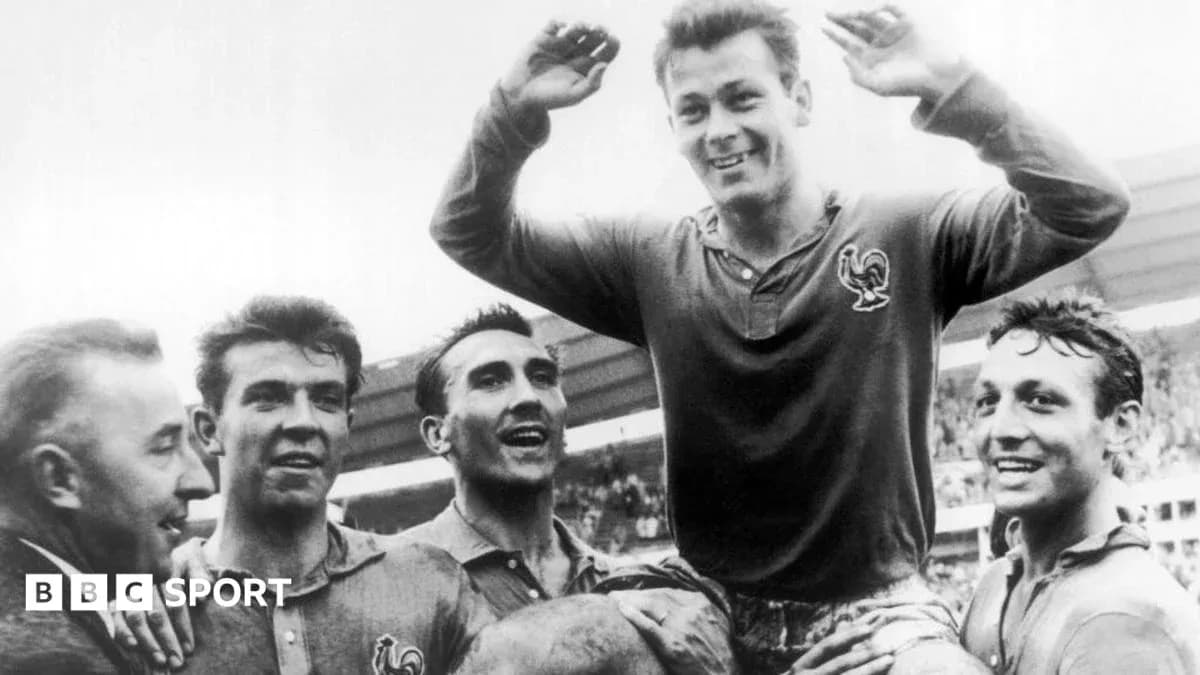
Just Fontaine’s name drifts back into the conversation every four years, like an old song you suddenly remember the words to. Thirteen goals at a single World Cup. On its own, that sounds outrageous. Then you learn he did it in six games. In borrowed boots. As a late replacement who wasn’t even meant to start.
It stops being a statistic and starts to feel like a fable.
A record under siege
Here in 2026, the giants of the modern game are charging at his mark with all the force of a new era. Lionel Messi, Kylian Mbappe, Erling Haaland, Harry Kane, Jude Bellingham – names that dominate billboards, social media feeds and sponsor campaigns – are locked in a race for the Golden Boot.
- Mbappe has eight already.
- Messi and Haaland stand on seven.
- Kane and Bellingham lurk one back.
They have advantages Fontaine never knew. A 48-team World Cup, an extra round, the prospect of eight matches if they reach the semi-finals. More minutes, more chances, more penalties, more everything.
And yet, even with that cushion, they are still staring up at a man from 1958 who needed only six games and a pair of someone else’s boots.
The “Just Fontaine derby”
To many younger fans, Fontaine is a line in a quiz, a curiosity that sits alongside grainy footage and black-and-white photographs. He doesn’t live in the same cultural space as Pele or Messi. He lives in the margins.
But his story runs straight through one of this tournament’s defining fixtures. France v Morocco in the quarter-finals was billed as the Just Fontaine derby for a reason.
Fontaine was born in Marrakesh in August 1933, when Morocco was still a French protectorate. By the time Morocco gained independence in 1956, he was already established in French football and in the France national team. The choice had effectively been made for him: he would wear the blue of France, not the red and green of his birthplace.
It is a sliding-doors detail that feels even more striking now, as the two nations collide on the biggest stage.
The last-minute starter with borrowed boots
The myth often starts with the number 13. The reality begins with a twist of fate.
As sports journalist and historian Philip Barker told BBC Sport, Fontaine was not supposed to be France’s spearhead in Sweden. Rene Bliard, a team-mate, was ahead of him in the pecking order. Then came a warm-up injury. Plans changed. Suddenly, Fontaine was in.
The call came so late he didn’t even have boots that fit. He had to borrow a pair from team-mate Stephane Bruey for the opening game.
Imagine it now. In an age of bespoke studs, personalised designs and multi-million boot deals, the World Cup’s greatest goalscoring campaign began with a rummage through a team-mate’s kit bag.
Fontaine was not arriving in perfect condition either. He had undergone surgery on his meniscus during the season and, for a while, his place at the tournament looked uncertain. That doubt turned into a strange kind of blessing. While others dragged heavy legs from a long, bruising campaign, Fontaine arrived relatively fresh.
He had just five caps when coach Albert Batteux pushed him into the starting XI. Five caps, and a reputation. At club level he was no mystery.
A striker already on fire
Fontaine was the ruthless finisher for Reims, the dominant force in French football. In 1957-58 they completed the league and cup double, one of four Ligue 1 titles he would win – one with Nice, three with Reims.
The year after his World Cup explosion, he would help drive Reims all the way to the European Cup final, losing to Real Madrid but finishing as the competition’s top scorer in 1958-59 with 10 goals. At international level he shared a room with Raymond Kopa, the French star who dazzled for Real Madrid and would win the 1958 Ballon d’Or, with Fontaine finishing third.
This was not some unknown chancer plucked from obscurity. This was a striker already feared across France, stepping into the brightest of spotlights.
Speaking to the BBC in 2002, Fontaine recalled a very different World Cup atmosphere.
“In those days there was not so much pressure on us,” he said. Only two journalists followed the team. The hierarchy were so convinced France would not go deep in the tournament that they handed players just three shirts each. No grand expectations. No wall-to-wall coverage. No endless talk shows.
“My mind was not on the goals record at all,” he said. He even refused a penalty in the third-place play-off.
The greatest goalscoring campaign in World Cup history, and its architect turned down a free shot from 12 yards.
Lighting the fuse
Once the tournament began, the quiet build-up vanished in a blur.
Fontaine’s hat-trick in a wild 7-3 win over Paraguay in France’s opening match ignited everything. It was not simply the volume of goals but the manner of them: late runs into the box, sharp movement to spring the offside trap, finishes drilled into the corners.
He looked, even on flickering black-and-white footage, like a striker dropped in from the future.
“Fontaine looks like a modern striker, he has so much pace,” Barker said. L’Equipe called him a leader of the attack in the English style – courageous, combative, stubborn. A centre-forward who led the line with aggression and intelligence.
Score a hat-trick in your first game and the World Cup suddenly feels like your personal stage. Fontaine never stepped off it. He scored in every match France played.
They rode that wave all the way to the semi-finals, where they ran into the irresistible force of Brazil, powered by a 17-year-old Pele. Brazil won 5-2. Even then, Fontaine found the net.
Four more in borrowed boots
The third-place play-off against West Germany gave Fontaine one final outing in Sweden. He didn’t drift through it. He tore it apart.
France won 6-3. Fontaine scored four.
His third against the Germans stands out even now: collecting the ball near halfway, accelerating beyond defenders and sliding his finish into the far corner. It calls to mind Michael Owen’s famous run for England against Argentina in 1998, only this came four decades earlier on a heavier pitch with a heavier ball.
By the end of the tournament, Fontaine had 13 goals. France, with their free-flowing attack built around Fontaine and Kopa, had scored 23 – the highest tally of any side at that World Cup. The competition itself was a festival of attacking football: 126 goals, the second-most in a 16-team tournament behind 1954.
“The 1958 tournament was the last real goal-fest,” Barker said. With Brazil emerging and France in full flow, it produced a level of attacking play that can stand alongside any era.
He argues that the 1958 France team deserves to be mentioned in the same breath as the 1998 and 2018 world champions. The front five scored 22 goals between them. Fontaine was not only finishing chances; he was creating them for Kopa in a side that moved the ball with a speed and clarity that would trouble any modern defence.
Yes, the back lines were slower. But the standards at the top end were real, and brutal. France were only stopped by one of the greatest international teams ever assembled: Brazil 1958.
The World Cup that never came again
Fontaine never played at another World Cup. His record remains frozen in that single, extraordinary tournament.
You can’t help wondering what France might have done in 1962 or 1966 with that same ruthless finisher leading the line. Football history is full of such questions. This one is sharper than most.
Away from the pitch, Fontaine refused to drift into the background. He helped found the French players’ union, the UNFP, becoming its first president in 1961. He moved into coaching, taking charge of France for two games in 1967 before spells with PSG and Toulouse, and later returning to his birthplace to coach Morocco for two years.
He ran sports shops. He stayed around the game. And from time to time, when someone asked who held the World Cup goals record, he could still enjoy the flicker of recognition.
Barker recalls Fontaine joking that if he came back in 200 years, his record would still be intact. L’Equipe called it “unbeatable”. It sounded like hyperbole at the time. It sounds less so when generation after generation falls short.
Fontaine died on 1 March 2023, aged 89. He lived long enough to watch France lift the World Cup twice and to see Mbappe rise as the new face of Les Bleus, the man most likely to come after his crown.
“How appropriate it would be if Mbappe beats him?” Barker said.
Maybe it happens in this expanded World Cup, with more games and more chances. Maybe it doesn’t. Either way, the number sits there: 13 in six matches, in borrowed boots, from a striker who was never meant to start.
For all the noise around today’s stars, that is the standard they are still chasing – the mark set by football’s greatest unsung hero.