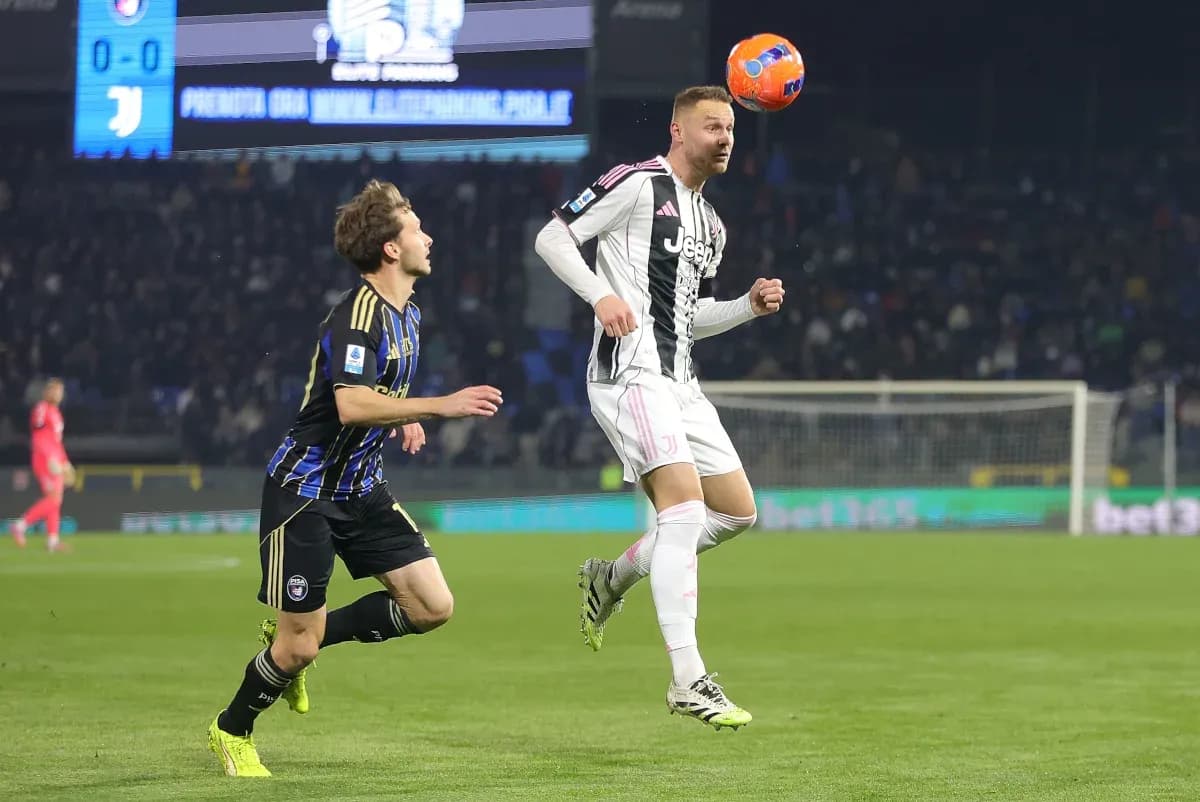
Juventus Overwhelms Pisa 4–0 with Tactical Superiority
Juventus 4–0 Pisa at Allianz Stadium: how a 3–4–2–1 overwhelmed a 3–5–2 mid‑block
The battle: controlled territory, controlled risk
Juventus’s 60 percent possession was not sterile circulation but a platform to lock Pisa in and repeatedly access the box. With 550 passes at 87 percent accuracy versus Pisa’s 364 at 80 percent, Juventus built a stable three‑at‑the‑back structure (Bremer, Federico Gatti, Pierre Kalulu) behind a four‑man midfield line. Manuel Locatelli anchored, allowing Weston McKennie and Khéphren Thuram to step into advanced half‑spaces while Andrea Cambiaso held width on the left.
Pisa’s 3–5–2 aimed to crowd central zones, but their 40 percent possession was mostly reactive. They struggled to progress beyond the first line, generating only 7 shots in total and 0.45 xG, indicating that their ball recoveries rarely turned into high‑value attacks.
Offensive mechanics: volume, territory, and overperformance
Juventus produced 25 shots to Pisa’s 7, with 19 of those Juventus attempts coming inside the box. Their scoring threat of 2.89 xG converted into 4 goals, a slight overperformance but fully explained by the sheer volume and proximity of chances. Juventus had 9 shots blocked by Pisa, underlining how often they managed to work shooting positions in crowded central areas and force last‑ditch interventions.
The 3–4–2–1 allowed Kenan Yıldız and Francisco Conceição to receive between Pisa’s midfield and defensive lines, pulling the outer centre‑backs into uncomfortable zones. This created lanes for Jonathan David’s runs and Cambiaso’s underlaps. The breakthrough at 54 minutes from Cambiaso, assisted by Yıldız, exemplified that pattern: overload on the left, inside‑channel combination, late wing‑back arrival into the box.
Thuram’s goal at 65 minutes reflected Juventus’s ability to attack second phases around the area, with Pisa’s midfield line collapsing too deep after repeated box entries. Yıldız’s strike at 75 minutes, assisted by Conceição, came from the same structural dominance: dual tens receiving on the half‑turn against a retreating block. Jeremie Boga’s 90‑minute goal, assisted by Locatelli, underlined that Juventus’s attacking mechanisms remained coherent even with rotated personnel.
Defensive intensity: clean structure, controlled aggression
Juventus conceded only 2 shots on target, and Mattia Perin needed just 2 saves. With Pisa’s scoring threat at 0.45, Juventus’s performance under the bar was largely about maintaining concentration rather than high‑difficulty stops. Pisa had 4 shots blocked by Juventus, showing how the back three plus collapsing midfielders protected the central lane.
Both sides committed 7 fouls, but Pisa’s defensive strain showed in their disciplinary record: three yellow cards, all for fouls, to Marius Marin at 39 minutes, Mehdi Léris at 48 minutes, and Antonio Caracciolo at 70 minutes. Juventus received a single yellow, to Bremer at 72 minutes, consistent with a team defending higher up and less often under emergency pressure.
Substitution phases: from structural tweak to game management
The 46‑minute double change for Juventus was decisive. Lloyd Kelly for Gatti and Jeremie Boga for David slightly rebalanced the back line and added a more direct, dribbling threat in the left half‑space. This coincided with Juventus’s most productive phase, as Pisa’s block had to respect Boga’s ball‑carrying, freeing Cambiaso and Thuram.
Pisa’s triple substitution at 60 minutes (Juan Cuadrado for Léris, Felipe Loyola for Marin, Gabriele Piccinini for Malthe Højholt) was an aggressive attempt to add ball progression and wide threat. However, it immediately preceded Juventus’s second goal at 65 minutes, exposing the instability of a reshuffled midfield still adjusting to new reference points.
The 75–82 minute window was pure game management from Juventus. At 77 minutes, Teun Koopmeiners replaced Thuram and Fabio Miretti came on for Conceição, adding fresh legs and better control in central areas to protect the lead while still threatening from deep. At 82 minutes, Filip Kostić for Yıldız injected direct wing play to exploit Pisa’s stretched shape in transition, culminating in Boga’s late goal.
Pisa’s 76‑minute double change, with Samuel Iling Junior for Rafiu Durosinmi and Filip Stojilković for Arturo Calabresi, aimed to add verticality and a more attacking profile, but by then their 3–5–2 had lost compactness, and they could not contest midfield control.
Conclusion
Juventus’s 4–0 home win was the product of structural superiority: a stable three‑at‑the‑back base, dual tens between lines, and relentless box occupation. The numbers align with the eye of the tactics board: clear territorial dominance, high‑volume chance creation, and minimal concession of quality shots. Pisa’s adjustments never solved the fundamental problem of central overloads and were repeatedly punished as Juventus refreshed and refined their pressing and possession structure through well‑timed substitutions.