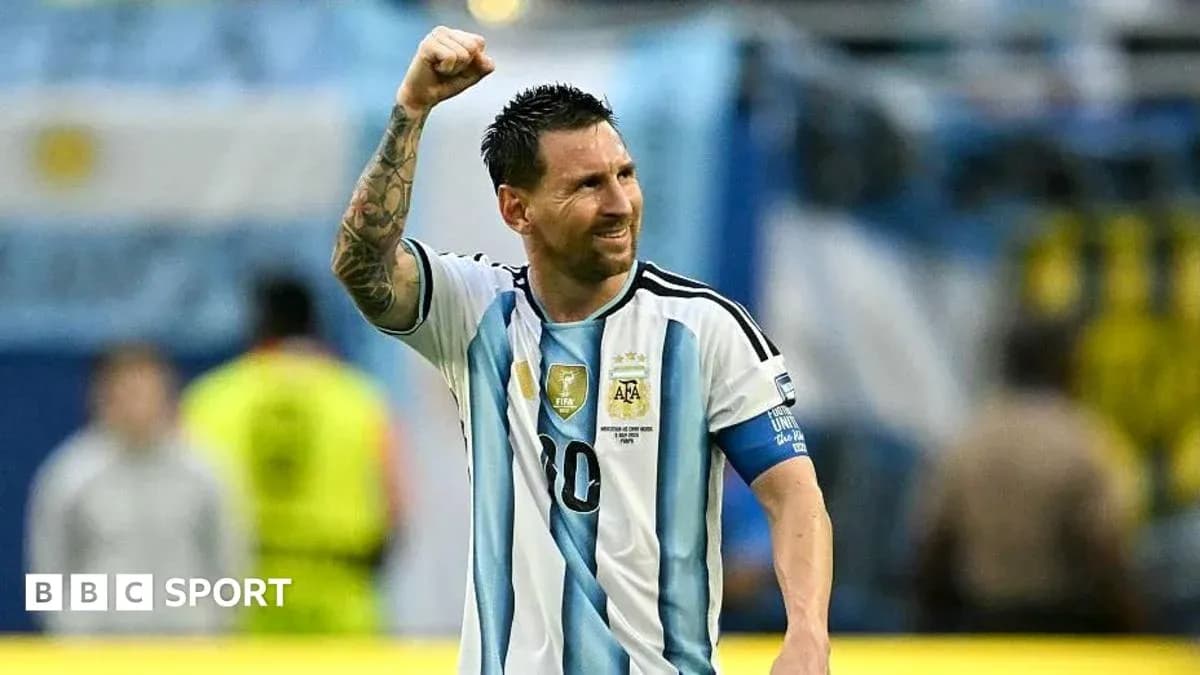
Lionel Messi Shines in Argentina's Wild Win Over Cape Verde
Lionel Messi walked out into the Miami heat with the air of a man who has done all this before and yet still finds new ways to make it matter.
Three against Algeria. Two against Austria. One against Jordan. Now another, this time in a wild, breathless 3-2 win over Cape Verde that pushed Argentina into the World Cup last 32 and pushed Messi into yet another corner of footballing history.
His opener, swept in with the kind of casual brilliance that only arrives after a lifetime of repetition, was his 20th goal at World Cup finals. No one – man or woman – has ever reached that number before. It was his seventh of this tournament alone.
A city painted in sky blue and white
The story began long before kick-off.
Miami’s streets turned into a travelling tribute to Argentina’s number 10. Sky blue and white shirts spilled out of bars, flags hung from balconies, drums echoed around the blocks. Supporters posed beneath enormous Argentina banners, phones raised, voices hoarse long before a ball was kicked.
Inside the stadium, it felt like a home game. Blue and white dominated every angle, Messi’s number 10 stamped on shirts, flags, hats, even painted on faces. One banner cut through the noise: Messi and Diego Maradona side by side, depicted like saints, a visual hymn to the two men who have come to define Argentine footballing faith.
“He’s our hero. He’s like our God,” said one fan outside, almost shrugging at how obvious it sounded.
“He has aged like fine wine,” another added. “The older he gets, the better he gets.”
They talked about the Golden Boot as if it were a formality. If Argentina reached the final, they were certain Messi would be in the running again. Many insisted he didn’t need it. “We’ve already had so much from him,” one supporter said. “If he wins it, fantastic, but everything he’s already done for Argentina is enough. He is incredible.”
Cape Verde refuse to play the part
The match refused to follow the script.
Cape Verde, ranked outside the world’s top 60, were meant to be a footnote. They never looked like one. They pressed, they passed, they held their nerve. For long stretches they frustrated Argentina, snapping into duels, keeping their shape, showing none of the deference that the rankings might suggest.
By Messi’s outrageous standards, he was not the constant conductor. He drifted, he watched, he waited. Argentina toiled. Cape Verde refused to fade.
Then the moment came.
Lisandro Martínez stepped in with a pass that split the backline. Messi had already seen it. He timed his run to slip beyond the defence, took the ball in stride with a velvet first touch and, with a tiny lift of his left foot, scooped it over the goalkeeper.
One touch to control. One to finish. That was enough.
On BBC Radio 5 Live, former Scotland forward James McFadden could barely contain his admiration. The finish, he said, was “just incredible”.
“The run he makes is beyond the backline and the timing is excellent,” McFadden said. “The weight of the pass into him is outstanding and his first touch is exquisite.”
On ITV, Ally McCoist watched the same moment and reached for the same superlatives, calling it “genius at work”.
“It’s just one record after another,” he said. “It’s amazing.”
Records that barely seem real
The numbers now feel almost surreal.
Twenty World Cup goals. More than anyone in the history of the competition, in either the men’s or women’s game.
Eight consecutive World Cup appearances with a goal – another mark that belongs to him alone.
Seven or more goals at two separate World Cups, after also hitting that figure in 2022. No one else has done that either.
His tally of seven at this tournament would have been enough to win the Golden Boot in all but two of the 13 World Cups since 1978. In five of the last six, it would have stood alone at the top.
The records keep falling, not because he runs more than everyone else, but because he thinks quicker.
While others chase, Messi studies. He walks, scans, files away information. At 39, he has no interest in a sprint he cannot win. Instead he waits, preserves his energy, and then, when the angle opens or the defender’s weight shifts, he pounces.
McFadden has watched that evolution for years. “Throughout the years, Messi has walked at times in games to assess what is happening,” he noted. This tournament, though, has shown another layer. Messi is not only calculating; he is also working. Dropping in to help win the ball back. Stepping forward to start the press. Not a furious, high-octane charge, but a lead from the front that his teammates can follow.
Miami’s adopted king
If Messi mania has a capital outside Buenos Aires, it is Miami.
Since his move to Inter Miami in 2023, the city has wrapped itself around him. His face is splashed across murals, his shirt in shop windows, his name stitched into endless pieces of memorabilia. On the beaches, children play barefoot in the sand wearing Argentina’s number 10, trying to imitate a man who makes the impossible look routine.
Even the food scene has bent towards him. Argentine restaurants proudly plate up milanesa – breaded beef or chicken, one of his favourites – with some naming the dish in his honour. You can eat what he eats, wear what he wears, chant his name hours before he appears.
Around stadiums, his presence is felt long before he steps onto the grass. Chants of “Messi, Messi” roll down from the stands during the warm-up. Camera phones follow his every stretch, every smile, every glance towards the ball.
Then comes the media crush.
In the mixed zone after games, the atmosphere changes the second he appears. Conversations stop. Journalists bunch together, microphones shoot into the air, camera operators lean over shoulders and barriers, desperate for a line, a look, a moment. He rarely lingers, slipping down the corridor in seconds, but those few seconds are treated like gold.
Across the world, digital platforms track his every move. Entire channels and feeds exist just to document him – training clips, celebrations, statistics, slow-motion replays of yet another goal that bends logic.
More than one nation’s dream
This World Cup, for Argentina, is about defending a crown and chasing another star above the badge. For everyone else, it often feels like something else entirely.
It is another chapter in the story of a player who has spent two decades redefining greatness. Another chance to watch him bend a match to his will with one run, one touch, one finish.
In Miami, on a hot night heavy with noise and colour, Cape Verde nearly stole the show. Messi did what Messi always seems to do.
He took it back. And he kept the story moving.