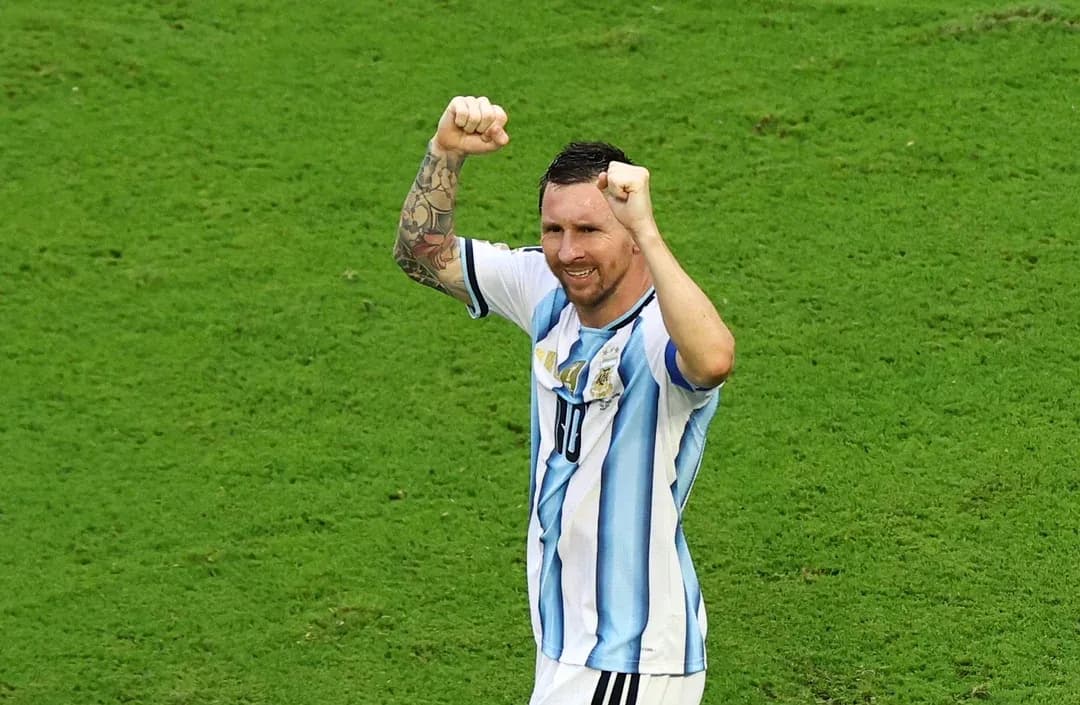
Lionel Messi Makes World Cup History Again with Stunning Goal
Lionel Messi didn’t just score in Miami. He left another mark on World Cup history.
Under the lights at Miami Stadium, in a Round of 32 tie that felt like a home game for Argentina, the 2026 FIFA World Cup produced a familiar scene: No space, no time, and still, somehow, Messi found both.
Cape Verde’s charismatic goalkeeper Vozinha, one of the breakout personalities of this tournament and known across the stands as “El Abuelo,” had been relishing the stage. Then came the 29th minute.
Lisandro Martínez looked up and split the game open with a superb switch of play, a pass that sliced through Cape Verde’s shape and shifted the entire Argentine attack in an instant. Messi, starting wide on the right, drifted infield with that measured glide that has fooled defenders for nearly two decades. He took the ball inside the box, shaped his body, and everything slowed.
Left foot. One touch to set, another to decide.
Messi drilled his shot with that same left foot, ripping it high into the near top corner on the goalkeeper’s left. Vozinha went full stretch, but the ball was already past him, thundering into the net and sending the stadium into a roar that felt as much like gratitude as celebration.
It was a goal that carried numbers as heavy as its aesthetics. This strike was Messi’s seventh of the tournament, a landmark that pushes him into yet another exclusive club of one: the first player ever to score seven or more goals at two different World Cups, after doing the same at Qatar 2022.
The records kept tumbling in the background as he jogged back to halfway.
While Cristiano Ronaldo has finally broken his own World Cup knockout drought in this edition, Messi continues to operate on a different plane when the stakes rise. He remains the only player to have scored in five separate knockout stages, and he has done it in five consecutive World Cups. The list of victims reads like a timeline of modern football: from earlier tournaments to Qatar, where he struck against Australia in the Round of 16, the Netherlands in the quarterfinal, Croatia in the semifinal, and France in that unforgettable final.
New Milestone
Now there is a new line in that catalogue: his first goal in the newly introduced Round of 32.
A new stage, same story. At 2026’s expanded World Cup, as formats shift and generations turn over, one constant endures: when elimination football arrives and the margins narrow, Lionel Messi still finds a way to shape the tournament in his image.