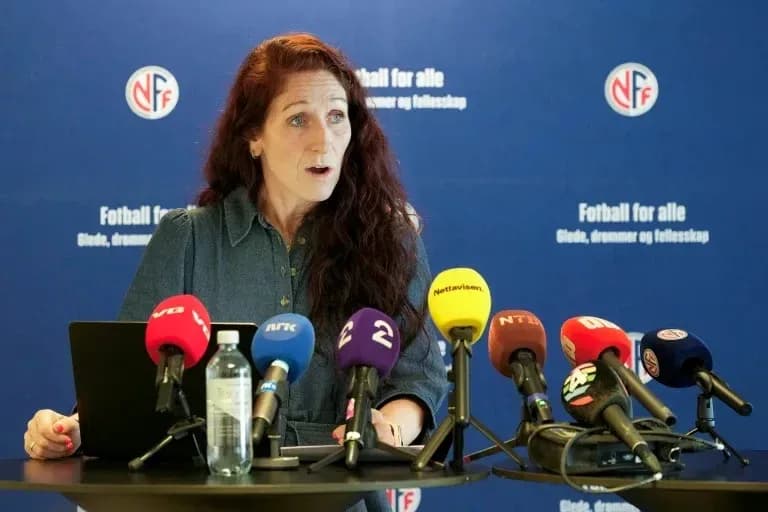
Lise Klaveness: The Reluctant Challenger to Infantino at FIFA
In a sport still dominated by men in dark suits and closed rooms, Lise Klaveness has made a career of walking straight into the room and saying what others only whisper in the corridors.
The president of the Norwegian Football Federation, a 45-year-old lawyer and former international with 73 caps, has spent the past few years doing something few at the top of the game dare to do: taking direct aim at FIFA and its leader, Gianni Infantino.
Now, with Infantino’s presidency under sustained fire and his latest grand plan collapsing, voices across the game are asking the same question: is Klaveness the one who should replace him?
From reform hopes to open revolt
When Infantino swept into power in 2016, he did so under the banner of reform. He promised good governance, transparency, a break from the murky era that had brought down Sepp Blatter.
Klaveness remembers that moment clearly. Speaking to AFP, she recalled that he was elected “on a reform programme focused on good governance.” That optimism, in her eyes, did not last.
“Then things quickly deteriorated,” she said. Distance from political power gave way to proximity. Safeguards blurred. The independence from heads of state and powerful figures – especially from World Cup host nations – eroded. The old habits of football politics crept back in.
She did not keep those thoughts to herself.
Barely settled into her role as head of the Norwegian federation in 2022, she chose the most sensitive stage in world football to fire her first major shot: the World Cup in Qatar. Standing in Doha, in a tournament already dogged by controversy, she lamented that “human rights, equality, democracy, the core interests of football, were not in the starting 11.”
It was a line that cut through the noise. A direct challenge, in FIFA’s own showcase, to the way the organisation did its business.
Norway then refused to back Infantino in his re-election bid the following year. That was not a symbolic gesture from a small federation on the fringes; it was a public statement that the trust once placed in the president had snapped.
Mina Finsted Berg, a sports commentator for Norwegian channel TV2, summed up Klaveness’s role in the global debate. She was, Berg said, “in a way the first standard-bearer for much of this criticism that many others now share when it comes to the way Infantino runs FIFA.”
Klaveness, she added, is “very committed to ensuring that rules and decisions are respected.” In a landscape where compromise and quiet deals often rule, that commitment makes her stand out – and, in some quarters, makes her a problem.
Trump, Balogun and the breaking point
The tension between Klaveness and Infantino has only sharpened in recent months.
The list of grievances is striking. FIFA’s decision to award a “Peace Prize” to US President Donald Trump, with whom Infantino has cultivated a conspicuously close relationship. The lifting of US player Folarin Balogun’s suspension at the 2026 World Cup after an intervention by Trump. And the explosive, swiftly rejected plan to open FIFA competitions, including the World Cup, to private investors.
Each episode chipped away at the image of an independent, rules-based governing body. For Klaveness, they formed a pattern she could not ignore.
Norway’s federation has now taken the step of bringing all three issues before FIFA’s Ethics Committee. It is a direct institutional challenge to the sitting president, not just a media skirmish.
Then came the moment that pushed her from critic to open opponent. After Infantino’s investor plan was shot down last week, she went further than ever before. On Friday, she called for him to resign.
The pressure on Infantino, already intense, suddenly had a clear and credible alternative voice attached to it.
A rare voice, gaining volume
Klaveness speaks from a position that is still painfully rare in football: a woman at the top of a national federation, operating in the upper tiers of the global game.
Her words carry extra weight now that Norway’s national team has re-emerged on the big stage. Long absent from the latter rounds of major tournaments, the Norwegians put together a strong run at this year’s World Cup, reaching the quarter-finals before falling to England. Success on the pitch has amplified her standing off it.
Internationally, commentators have praised her “strong moral compass” and see her as a serious candidate to replace Infantino if he steps down. She is no longer just the noisy outsider from Scandinavia; she is being discussed as a potential president of FIFA.
Even Sepp Blatter, the former FIFA head whose own tenure ended in disgrace after a corruption scandal, has weighed in from the sidelines. On X, he wrote that she “was the only one who always took a clear stand and did not go along with the mainstream. And at FIFA, the time is right for a woman to take the lead.”
Coming from Blatter, the endorsement is as loaded as it is telling. The old guard, watching from a distance, can see that the ground is shifting.
Infantino, for now, remains firmly in place. He is standing for a fourth and final term next March and is currently the only declared candidate. The machine is still behind him. The ballots, as ever, will be counted far from public view.
Not a “Game of Thrones” – but a fight for power all the same
Klaveness, for her part, has tried to keep the focus on principles, not personalities.
She has pushed back against the idea that this is just another power struggle at the top of FIFA, another season of an endless “Game of Thrones.” She has instead argued for a renewed focus on good governance, on structures that outlast any single president.
“For us, it has never been a personal issue against Gianni Infantino,” she told AFP. “The problems go beyond the person of the president.”
She knows her name is in circulation as a possible successor. She admitted she has “registered” the speculation, but brushed aside questions about whether she is a candidate. “We’re not there yet,” she said.
Those four words speak to both realism and strategy. She understands the size of the task. She also understands the politics.
Because for all the talk of her candidacy, the obstacles are formidable.
The ballot box reality
Klaveness is admired in many corners of Europe, but admiration does not always translate into votes. Even inside UEFA, where she might expect the greatest support, the path has been anything but smooth.
In 2023, she failed to win election to the UEFA Executive Committee. She only joined in 2025, and then only as the sole candidate for the seat reserved for women. The symbolism is hard to miss: even in the continent that talks most loudly about equality and reform, her route to influence has been narrow and hard-fought.
Beyond Europe, the picture is even more complex.
“In addition to being seen as extremely radical in many places, especially outside Europe, she is a woman. That is also likely to count against her in many regions of the world,” noted Mina Finsted Berg.
The word “radical” hangs in the air. In some federations, calling for transparency, independence from political leaders, and strict adherence to rules is still seen not as basic governance, but as a threat to entrenched power.
Erik Thorstvedt, former Norway goalkeeper turned commentator, posed the blunt question many inside the game are asking. If Klaveness already struggles to win elections in Europe, “how could she convince Africans and South Americans?”
That is the hard arithmetic of FIFA politics. One member, one vote. Many of those members operate in environments where the very things Klaveness champions are seen as disruptive, even dangerous.
A test of what football really wants
So the sport stands at a crossroads.
On one side, a sitting president, unchallenged on the ballot so far, backed by a system that has long rewarded loyalty and patronage. On the other, a federation chief from Norway, a former international who has made herself the face of resistance to that system, whether she likes the label or not.
Klaveness insists the story should not be reduced to personalities. Yet football has always told its own history through its central figures – the presidents, the rebels, the reformers, the ones who dared to say no.
Right now, she is that figure.
Infantino will go to the polls next March seeking a final term, his record and controversies laid bare. The question is whether the rest of the world’s federations are ready to back someone who has spent years challenging that record from the inside – or whether they will decide that the cost of change is still too high.
If the game truly wants a different kind of leadership, it may soon have to prove it where it matters most: at the ballot box.