Liverpool vs Galatasaray: UEFA Champions League Showdown
Anfield awaits another European rescue mission as Liverpool host Galatasaray on 18 March 2026 in a UEFA Champions League 1/8 final second leg, with a place in the Quarter-finals on the line and a 1-0 deficit to overturn.
This is exactly the kind of night the stadium lives for: Liverpool, one of the league phase’s heavyweights, ranked 3rd with 18 points and a +12 goal difference, chasing a tie that has slipped away twice in Istanbul. Galatasaray arrive with the scoreboard, if not the status, on their side – 20th in the league phase table with 10 points and a -2 goal difference, but holding a precious 1-0 aggregate lead from the first leg.
The state of the tie: Galatasaray’s edge, Liverpool’s obligation
The first leg at Rams Park finished 1-0 to Galatasaray. No away goal rule, no cushion beyond a single strike – just a fragile 1-goal advantage to protect at one of Europe’s most intimidating arenas.
For Liverpool, the equation is clear: they must win the night at Anfield. A 1-goal victory would at least force extra time, anything more swings the 1/8 final in their favour inside 90 minutes. Galatasaray, by contrast, can afford to be pragmatic. A draw is enough, and even a narrow defeat can still drag the tie into an extra 30 minutes of nerve and noise.
Form and identity: Liverpool’s power vs Galatasaray’s edge
In the league phase, Liverpool looked like a side built for deep Champions League runs. Six wins from eight, no draws, and only two defeats underline a high-risk, high-reward profile. They scored 20 and conceded 8 in the league phase, averaging 2.5 points per game and attacking with a relentlessness that shows in their home numbers: 11 goals scored and 6 conceded in 4 Anfield matches.
Across all phases, the profile barely changes. Liverpool have played 9 Champions League fixtures, winning 6 and losing 3, with 20 goals for and only 9 against. They average 2.2 goals per game and concede just 1.0. At home, they are even more explosive: 11 goals in 4 matches at 2.8 per game, but that attacking ambition leaves them a little open, with 1.5 goals conceded on average at Anfield.
Galatasaray’s path has been more turbulent but no less compelling. In the league phase they finished with 3 wins, 1 draw and 4 defeats, scoring 9 and conceding 11. Their away form was fragile: 1 win and 3 defeats, with 4 goals scored and 8 conceded. Yet their broader Champions League campaign tells a story of a side that can punch above its weight in bursts. Across all phases they have 11 matches: 5 wins, 1 draw, 5 defeats, 17 goals scored and 16 conceded.
The split is stark: at home they are strong – 11 goals for, 5 against – but away they concede heavily, 11 goals shipped in 5 games at an average of 2.2 per match. That defensive vulnerability on the road is exactly what Liverpool will try to rip open.
Tactical battle: Liverpool’s front-foot vs Galatasaray’s pragmatism
Liverpool’s most-used shape across all phases is a 4-2-3-1, deployed in 6 matches. It suits the intensity of Anfield: a double pivot to control transitions, a central creator behind a lone striker, and wide players pushing high to pin full-backs. With 4 clean sheets and only 2 home matches without scoring, they are built to dominate territory and volume of chances.
Expect Liverpool to press high, compress the game into Galatasaray’s half and lean on their depth between the lines. The fact they have never failed to score at home in this Champions League run is a warning sign for the visitors. They also own some of the competition’s biggest wins across all phases – 6-0 at home and 1-5 away – proof of their capacity to blow ties open in short, brutal spells.
Galatasaray, on the other hand, are likely to lean into their 4-2-3-1 as well, a system they have used 9 times. But their version will be more reactive: compact lines, disciplined double pivot, and rapid counter-attacks aimed at exploiting Liverpool’s high defensive line. Their goal distributions show they are dangerous early and just after half-time, with strong scoring clusters in the 0-15 and 46-60 minute ranges. That suits a game plan where they soak pressure and then spring forward when Liverpool overcommit.
Defensively, the concern for Galatasaray is the timing of their collapses. Across all phases, 31.25% of their goals conceded arrive between 61-75 minutes, exactly the period when Liverpool’s Anfield wave tends to crest. If the visitors are still under siege around the hour mark, this could become a question of survival.
Osimhen vs Anfield: the superstar who can flip the script
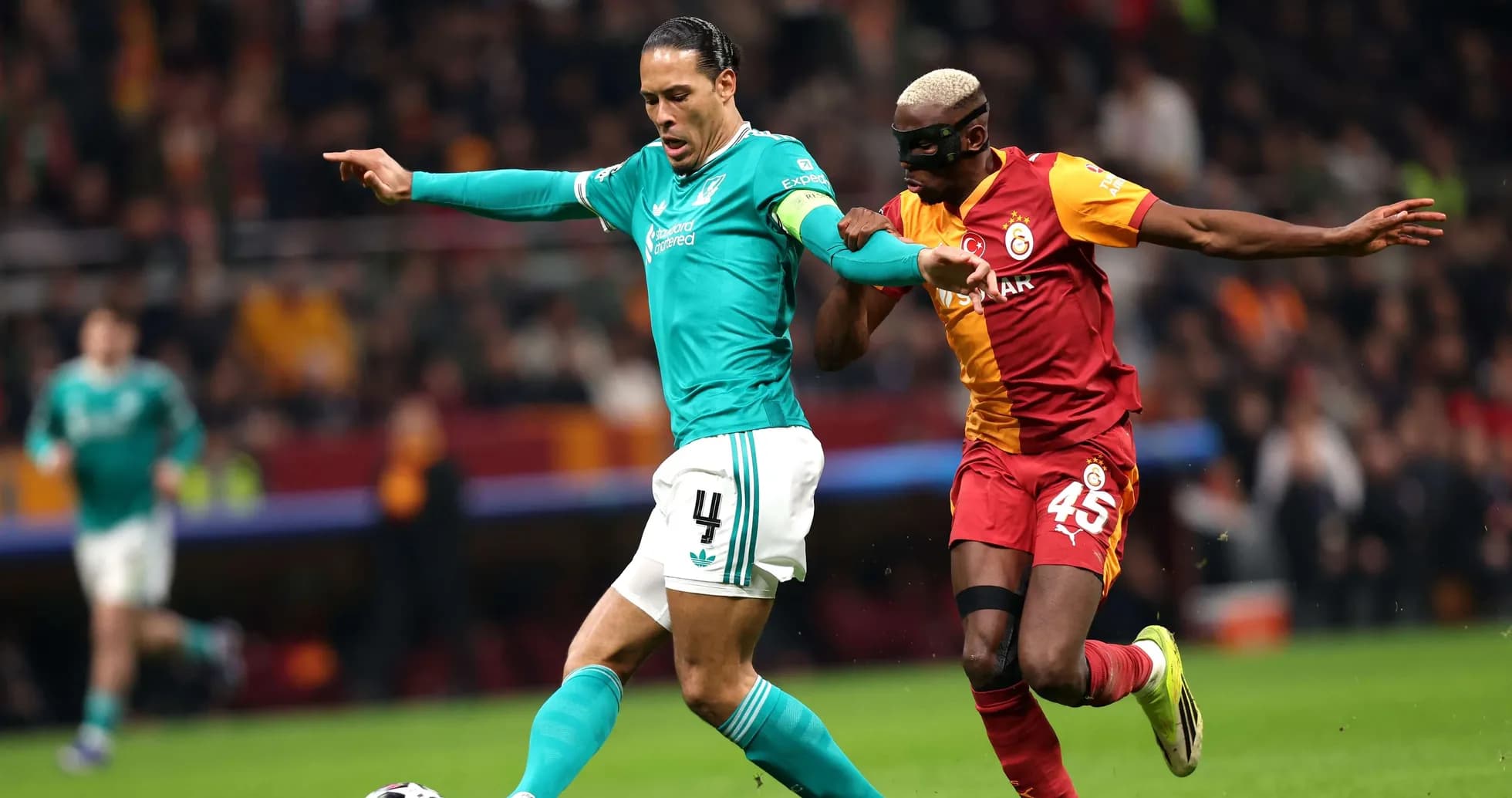
Galatasaray’s trump card is clear: Victor Osimhen. With 7 goals and 2 assists in 9 Champions League appearances, he is one of the competition’s standout forwards. He averages almost a goal every game, with 35 shots, 25 on target, and a relentless duel output – 93 duels contested, 50 won. He has also been flawless from the spot, scoring 3 penalties from 3.
If Galatasaray are to survive Anfield, Osimhen’s hold-up play and penalty-box presence will be crucial. He gives them an outlet when they are under pressure and a real threat on the break. One moment, one run across a centre-back, one precise cross – and Liverpool’s task can double in difficulty instantly.
Team news and depth: who is missing matters
Liverpool are hit by a cluster of absences. S. Bajcetic (hamstring), C. Bradley (knee), H. Davies (inactive), W. Endo (foot injury), A. Isak (broken leg), G. Leoni (knee) and R. Williams (inactive) are all listed as missing. The loss of W. Endo in particular could impact the balance of that double pivot, forcing Liverpool to adjust their midfield protection in a game where transitions will be critical.
Galatasaray’s list is shorter but not insignificant. M. Baltaci is suspended, C. Guner, G. Gurpuz and R. Nhaga are inactive, while D. Sanchez is out through yellow card accumulation and A. Unyay is injured. The suspension of D. Sanchez strips them of a key defensive option, a serious blow when facing a side that thrives on aerial bombardment and chaos in the box.
Psychological edge and head-to-head narrative
The recent head-to-head record gives Galatasaray quiet confidence. They have beaten Liverpool twice at Rams Park in this Champions League cycle, both by 1-0 scorelines – once in the league phase and once in the first leg of this 1/8 final. Those games proved they can frustrate and edge Liverpool in tight, tactical contests.
But this is Anfield, and that changes the dynamic. Liverpool’s home goal difference across all phases in this competition is +5 (11 scored, 6 conceded), and the atmosphere is likely to push them into the kind of relentless, wave-after-wave assault that Galatasaray have not yet had to withstand in Istanbul.
Verdict: chaos likely, Liverpool favoured – but Osimhen keeps it alive
On paper and in the metrics, Liverpool are favourites to win the second leg. Their attacking numbers at home, their overall defensive record (only 9 conceded across all phases), and Galatasaray’s away fragility all point towards a home victory.
But this is not a straightforward procession. Galatasaray have already proved twice that they can keep Liverpool to 0 in Istanbul, and with Victor Osimhen in this kind of form, they have a forward who can turn a half-chance into a tie-defining moment.
Expect Liverpool to dominate the ball, create more chances and likely score at least once. The question is whether they can keep Osimhen quiet and avoid the kind of transitional punch that would force them to chase multiple goals.
Logical prediction: Liverpool to win the night and force a knife-edge finish. The balance of probabilities leans towards Liverpool overturning the 1-goal deficit and reaching the Quarter-finals, but not without suffering – and not without Galatasaray, and Osimhen in particular, threatening to rip up the script.