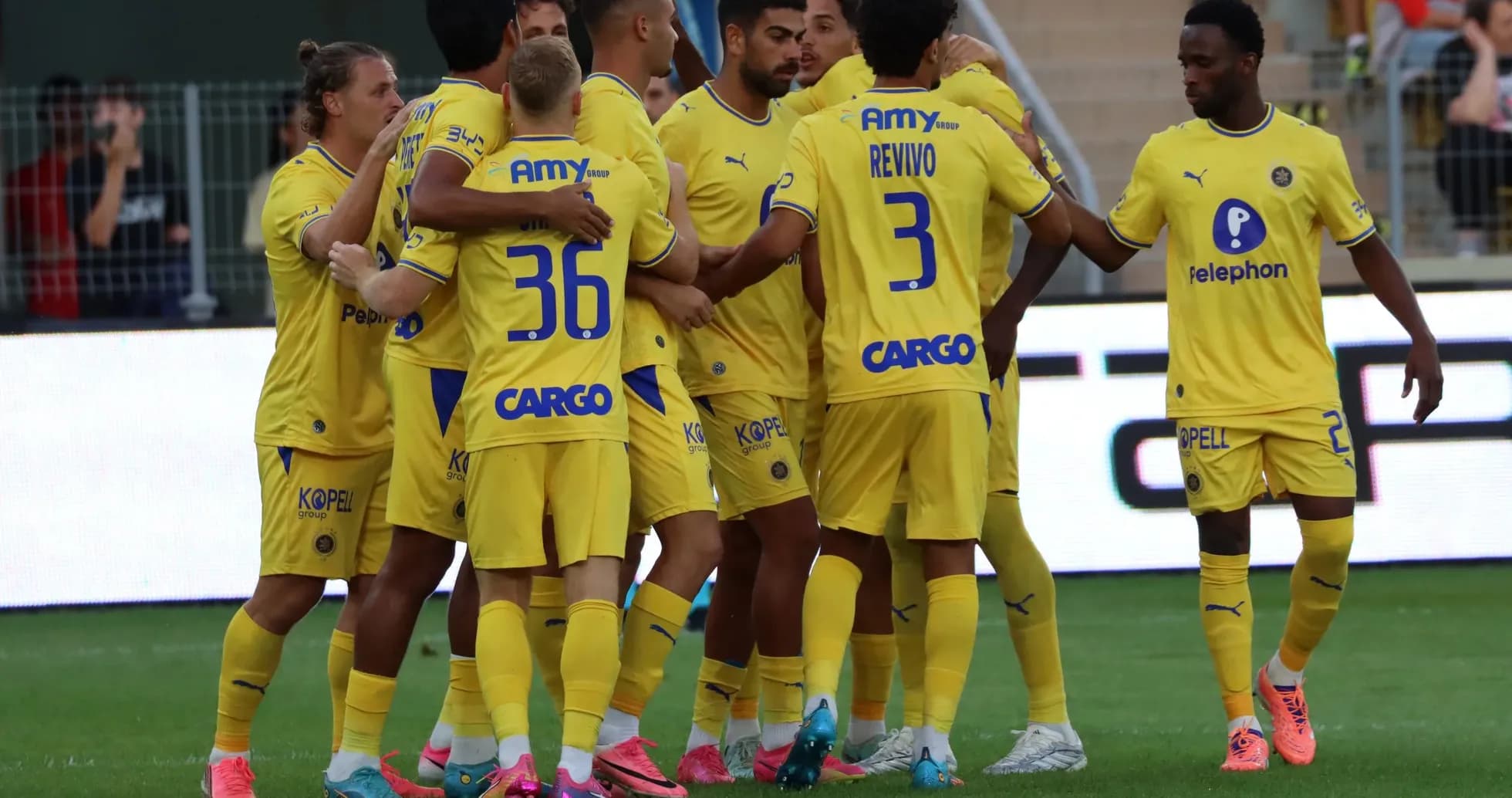
Maccabi Tel Aviv Dominates Sheriff Tiraspol 5-0 in UEFA Qualifiers
Maccabi Tel Aviv’s 5-0 win at Sheriff Stadium was the product of a clear structural superiority in and out of possession, built from a mirrored 3-5-2 shape that they executed with far greater cohesion and tempo than Sheriff Tiraspol. With 69% of the ball, 19 total shots and 12 on goal, Ronny Deila’s side controlled territory, rhythm and transitions, turning their back three and flexible wing-backs into constant launchpads against an increasingly stretched home block.
Both teams lined up in a 3-5-2, but the interpretations were radically different. Sheriff’s back three of B. Ciss, S. Magassouba and Rai sat deep and narrow, with Mota and D. Forov nominally as wide midfielders but often pinned back into a back five. Ahead of them, A. Pergjoni and D. Klas tried to connect with Sapata and L. Jaures-Ulrich underneath J. Asprilla Moreno, yet Sheriff’s 31% possession figure underlines how rarely they could establish any stable passing sequences. Their 10 total shots and 6 on goal came more from sporadic breaks and direct balls than from constructed attacks.
Maccabi Tel Aviv, by contrast, used their 3-5-2 as an aggressive, front-foot structure. The back three of I. Ben Hamo, M. Camara and R. Shlomo stepped high, compressing the pitch behind an assertive midfield of I. Shahar, I. Sissokho and I. Noy. On the flanks, R. Revivo and Sagiv Jehezkel started as nominal defenders but effectively played as wing-backs, constantly pushing onto Sheriff’s last line. That dynamic was visible early: at 5', S. Abu Farkhi finished from an I. Shahar assist, a move that reflected Maccabi’s ability to find pockets between Sheriff’s midfield and defence before the hosts could settle into their shape.
Goals
The second goal on 29', scored by D. Peretz from a cross by R. Revivo, highlighted the structural mismatch on the flanks. With Sheriff’s wing-backs locked deep, Revivo repeatedly found room to advance and deliver from wide areas, exploiting the space outside Sheriff’s narrow back three. Sheriff’s response at half-time – introducing V. Fratea for Sapata and B. Fomba for B. Ciss at 46' – was an attempt to refresh legs and add more physicality and energy, but it did not fundamentally change their ability to contest the wide zones or control the ball.
Maccabi’s third goal at 53', scored by S. Jehezkel from another R. Revivo assist, was almost a tactical copy: overloads on the left, quick circulation, then a wing-back arriving in an advanced position to finish. That pattern underlines how Maccabi’s 3-5-2 morphed into a 3-3-4 in possession, with both wing-backs joining the front line and one of the central midfielders, often Sissokho or Peretz, attacking the half-spaces. Sheriff’s back line, already under siege, was forced ever deeper, leaving huge gaps between their midfield and attack and isolating J. Asprilla Moreno.
The card pattern further illustrates Sheriff’s defensive strain. Yellow cards to Baye Assane Ciss (17'), Miguel Mota (60'), Soumaila Magassouba (73'), Mamoutou Ouedraogo (76') and Danila Forov (77') all came as Maccabi continued to probe and force last-ditch interventions. Sheriff’s five bookings to Maccabi’s single yellow for Sagiv Jehezkel at 48' reflect a home side constantly reacting rather than anticipating. The timing of the cards – clustered from the hour mark onwards – coincides with Maccabi’s push to turn dominance into a rout.
From 64' onward, Deila rotated intelligently without losing control. K. Belic replaced I. Shahar, H. Varela came on for S. Jehezkel, and O. Davida entered for I. Noy, all at 64', refreshing the midfield and wide roles while preserving the same attacking structure. Later, D. Glazer entered at 72' and T. Asante at 80', with the back three and double pivot still functioning as a stable platform. This depth allowed Maccabi to maintain intensity, culminating in three further second-half goals: a penalty converted by S. Abu Farkhi at 74' to make it 4-0, and a driven finish from I. Sissokho at 78' for 5-0.
On the Sheriff bench, Victor Mihailov’s changes were more reactive and fragmented. After the early double change at 46', he introduced M. Ouedraogo for Mota and S. Kone for A. Pergjoni at 66', then J. Modelo for L. Jaures-Ulrich at 80'. These moves shuffled personnel but did not alter the basic 3-5-2 structure or solve the core issues: a midfield outnumbered and outpassed, wing-backs unable to push Maccabi’s wide players back, and forwards starved of service.
The defensive collapse is also visible in the penalty incident and the late goals. With Sheriff defending ever deeper and accumulating cards, their timing and distances in the box deteriorated, leading to the 74' penalty that S. Abu Farkhi converted. Four minutes later, Sissokho stepped into the space in front of the back line to add the fifth, emblematic of how Maccabi’s central midfielders were able to step into shooting positions unopposed as Sheriff’s block lost compactness.
While individual goalkeeper statistics are not provided, the shot profile tells its own story. Sheriff allowed 19 shots and 12 on goal, a volume that would test any goalkeeper and points to systemic rather than individual failure. Offensively, Sheriff’s 10 shots and 6 on target suggest that when they did reach the final third, they were capable of testing O. Melika, but their lack of sustained possession (31%) meant these moments were isolated and never built into pressure phases.
Set pieces and territorial control further underline Maccabi’s grip. They earned 5 corners to Sheriff’s 4, a modest edge but consistent with their territorial dominance. With both sides listed with 0 free kicks in the data, the focus shifts even more sharply to open-play structure, where Maccabi’s superior spacing, rotations between midfield and wing-backs, and aggressive rest defence behind the ball suffocated Sheriff’s attempts to transition.
In statistical terms, Maccabi Tel Aviv married volume with efficiency: 19 total shots, 12 on goal, and five goals away from home in a UEFA Europa League 2nd Qualifying Round tie. Sheriff, despite managing 6 shots on goal from 10 attempts, were simply overwhelmed by the imbalance in possession and field position. The 5-0 scoreline aligns closely with the underlying shot and possession numbers: Maccabi imposed their model for 90 minutes, while Sheriff’s 3-5-2 remained a reactive, low-block variant that never translated into a coherent counter-attacking threat.