Maldini's Role in Italy's Football Rebuild as Conte Awaits World Cup
Italian football stands at a crossroads again, and the solution, as so often, has a familiar face. Paolo Maldini, the symbol of an era at Milan and one of the most respected figures in the game, has emerged as the man Italy want to place at the heart of their rebuild.
This is not a ceremonial role. The plan on the table would hand Maldini sweeping authority over both the technical structure and the youth sectors, a kind of sporting compass for an Azzurri system that has lost its bearings too often in recent years. The message is clear: if he accepts, he becomes the reference point from Coverciano down.
Alongside that structural revolution sits the other pillar of the project: Antonio Conte. A four-year proposal has been laid out, a contract designed to carry Italy all the way to the next World Cup. Conte would bring the intensity, the edge, the tactical certainty. Maldini, the long-term vision and credibility. It is an ambitious pairing, one that speaks to a federation finally tired of half-measures.
World Stage: Vinicius Lifts Brazil, Morocco and Switzerland March On
While Italy wrestles with its future, the World Cup keeps moving without them. Brazil, unsurprisingly, are not waiting for anyone.
Vinicius Jr lit up the night as Brazil swept aside Scotland, a performance that underlined why Carlo Ancelotti has built so much of his attacking structure around him. Two goals from the Real Madrid star, another from Matheus Cunha, and the Brazilians cruised. Neymar stepped off the bench, a reminder that this squad still has layers of talent to peel back as the tournament deepens.
The result leaves Brazil top of their group. No drama, just authority.
Behind them, the picture is more nuanced. Morocco did their job and beat Haiti, but it was not enough for first place. They finish second, dangerous and awkward, but with a tougher path ahead. Switzerland, meanwhile, delivered the decisive blow in their group by getting the better of Canada. The Swiss take top spot; Canada, with four points, squeeze through and live to fight again.
On the sidelines of it all, Jürgen Klopp captured the contradiction of the modern game in a few sharp lines. Too many matches, he argued, but what a spectacle. Norway and Japan, in his eyes, stand out as the tournament’s true surprises, nations that have ripped up expectations and forced the established powers to pay attention.
Inter, Como and the Madrid Axis
Back home, the transfer market hums with its own tension. Inter’s pursuit of defensive reinforcements has taken a decisive turn, and the focus has shifted to Madrid.
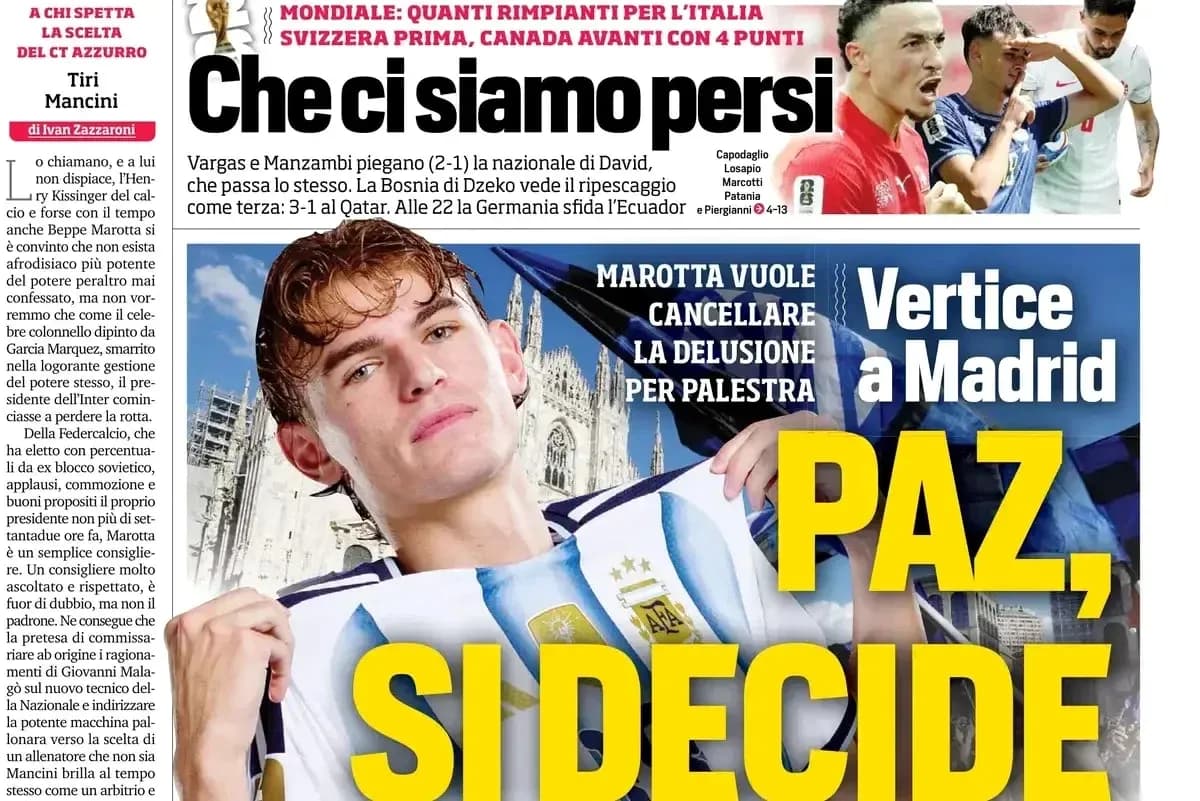
A key decision looms on Paz. Inter chief executive Giuseppe Marotta, still stung by the disappointment around the failed move involving Palestra, wants to make amends. A meeting in Madrid is on the agenda, and from that summit a great deal of Inter’s summer strategy will flow.
Oaktree, now holding the keys at Inter, had set aside 50 million for a move for Atalanta’s full-back. That plan has been shelved. The same funds are being redirected towards Nico, another Real Madrid asset. The problem is the price: Florentino Pérez is asking for 60 million. Inter push, Real hold firm.
Into this scenario steps Como. Their sporting director, Carlalberto Ludi, is also due in Madrid today. The newly ambitious club are chasing a fresh loan deal, with Cesc Fàbregas watching closely and hoping the negotiations fall their way. One city, one club, two Italian suitors with very different histories and budgets, both trying to carve out a piece of Madrid’s talent.
Italy’s Regrets as World Cup Rolls On
For Italy, the World Cup plays out like a highlight reel of missed opportunities. Switzerland top their group, Canada advance with four points, and every result seems to underline what the Azzurri left on the table. The narrative is cruelly familiar: others seize the stage while Italy watch and wonder how it slipped away again.
Juve’s Market Battles: Dibu, Kolo Muani and a New Napoli
At Juventus, the transfer window is a tug of war on several fronts. The club are locked in a battle over Emiliano “Dibu” Martínez, Aston Villa’s World Cup-winning goalkeeper. His name sits alongside that of Randal Kolo Muani on the list of major targets under discussion.
In this swirl, Giovanni Carnevali’s influence grows. The Sassuolo executive continues to act as a key broker in the Italian market, pushing and pulling pieces that could define Juve’s next cycle.
Down south, Aurelio De Laurentiis has returned from the United States with a new Napoli to design. The club wait for the official announcement on Massimiliano Allegri, who is expected to take charge, while work continues on several fronts: Gila, Khalali, and a lingering hope of landing Guglielmo Vicario. The Scudetto glow has faded; the rebuild must be sharp, not sentimental.
Milan’s Route to Jackson
Milan, too, see an opening. Nicolas Jackson is on their radar, and the path looks cleaner than most summer sagas. Chelsea are ready to part ways, and Bayern will not redeem the Senegalese centre-forward. The chain reaction works in Milan’s favour. If the numbers align, this is a deal that can move quickly, without the usual transfer theatre.
Roma Hold Their Nerve on Svilar and Wesley
In Rome, the stance is defiant. Two Premier League offers have landed for goalkeeper Mile Svilar and wing-back Wesley. Both have been rejected. Roma know they must bring in 50 million before June 30, but they are not prepared to sell at any price.
That financial pressure is exactly why Svilar has caught the eye of Juventus as a serious alternative to Martínez. The Giallorossi’s need to cash in, set against Juve’s need for a goalkeeper, creates a tension that could define the final weeks of June. For now, though, Roma hold.
There is also a twist in the Paulo Dybala story. What once looked like a relationship drifting towards an ending now seems to be turning back towards commitment. A renewal is close, a significant shift for a club that cannot afford to lose its brightest creative light for anything less than a statement fee.
Juve, meanwhile, sit down with Luciano Spalletti for a transfer summit. On the table is the possibility of reviving a Cambiaso–Frattesi swap, while the Bianconeri also weigh up a move that would put them in direct competition with Inter for Liverpool’s Curtis Jones. One complication: the so-called surplus players in the Juve squad show little desire to leave, a reminder that moving pieces out can be harder than bringing new ones in.
Modric’s 200th, Adjetey’s Rise and a Swiss Strike
Beyond the transfer noise, international football continues to write its own stories.
In Croatia, it is Luka Modric’s time again. His 200th appearance for the national team comes with a victory, a milestone wrapped in a win. Ante Budimir, long familiar to Italian fans, delivers the decisive blow to Panama, but the night belongs to Modric. He stands alone as the record holder for his country, an icon whose influence has stretched far beyond club colours.
In Germany, a different kind of tale is unfolding. Adjetey, the Ghanaian defender at Wolfsburg, has produced the kind of performance that changes careers. He shut down Harry Kane, left England’s star striker in his wake, and in doing so painted his own future in bolder strokes. Nicknamed “the painter” for the way he reads and shapes the game, he now dreams openly of a move to Serie A. On this evidence, Italian scouts will not ignore him for long.
Switzerland, already mentioned for their work at the World Cup, add another scalp with a blow to Canada that reinforces their status as one of Europe’s most reliable tournament sides. Bosnia, too, keep their hopes alive with a crucial victory that extends their campaign and keeps their ambitions intact.
From Maldini’s possible return to the heart of Italian football to Modric’s 200th cap and Adjetey’s emergence, the picture is clear: leadership, identity and courage on the ball still define this sport. The question is simple: who in Italy is truly ready to seize that standard and carry it into the next era?