Manchester United's Missed Opportunities in 2-2 Draw Against Everton
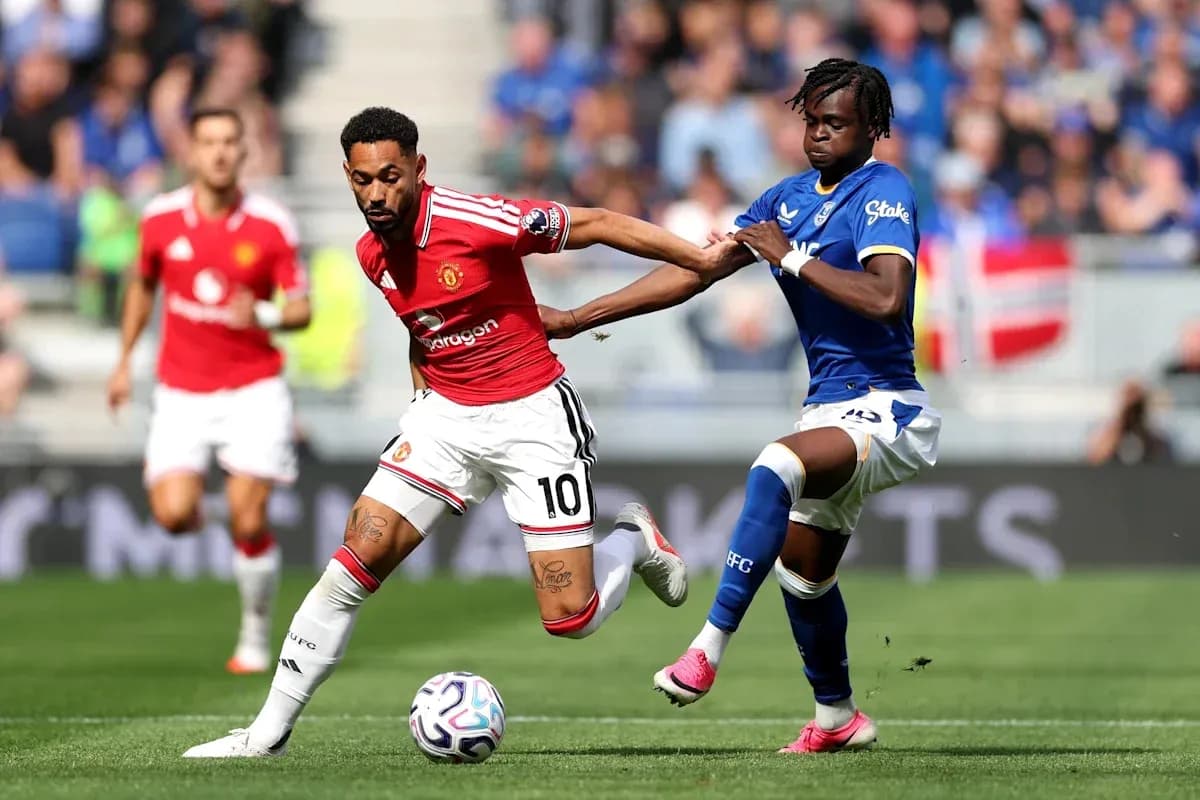
Manchester United walked out of Goodison Park with a point. It felt like a defeat.
They led twice. They scored late. They still couldn’t close the door. Again.
This was a performance full of intent and invention, but short on the two things that decide tight Premier League games: ruthlessness in the box and control under pressure.
Bright ideas, blunt edge
United actually played some good football. The first half brought a string of promising moves, clever rotations from the front three and enough territory to suggest this should have been a routine away win. Twice they struck after restarts to tilt the game their way.
But every time they built something, the final act deserted them.
There was no consistent presence in the penalty area, no one repeatedly making the ugly, decisive runs between centre-backs. The creativity from the forwards helped mask it for spells, yet the absence of a true penalty-box focal point kept resurfacing.
Benjamin Sesko’s return to fitness offers one obvious answer. Bryan Mbeumo stepping back into a central striking role is another potential fix. The right flank, though, still feels unresolved. Amad’s absence from his usual right-wing berth is being felt, and there is little indication that Matheus Cunha will be used there. Shea Lacey is highly regarded, but throwing him in as a solution right now would be a significant gamble.
United did enough to win this game. They just didn’t finish it — in either box.
A back four that won’t settle
The bigger alarm, though, sits at the other end of the pitch.
Three games into the season, three times United have conceded twice. Six goals shipped to Hull City, Ipswich Town and now an Everton side that has laboured in attack. For a team with Champions League ambitions, that is a flashing warning light.
Luke Shaw, at least, showed signs of life. After two poor outings at left-back, he produced a much stronger display: key blocks, overlapping runs with Marcus Rashford, and a quality cross that Sesko buried in the 88th minute and looked, for a brief moment, like the winner.
But even Shaw’s improved performance came with a sting. For Tyrique George’s first equaliser on 83 minutes, Shaw drifted too far inside, leaving George free to unleash a vicious strike into the near-post top corner. Arne Lammens got a hand to it and might feel he could have done better, but the ball still found the net.
Shaw wasn’t alone in his struggles. Harry Maguire, Lisandro Martinez and Diogo Dalot all had shaky moments. As a unit, they allowed Everton far too many looks.
Maguire was fortunate when Thierno Barry headed over in the 42nd minute from a position that should have produced an Everton goal. In first-half stoppage time, Dalot’s attempted clearance fell straight to Jarrad Branthwaite, who could only fire directly at Lammens. Later, a misplaced Dalot cross in midfield left Shaw and Martinez scrambling to recover against Brennan Johnson, eventually managing to deflect his effort over the bar.
These aren’t isolated slips. They’re a pattern.
Sitting deep, inviting trouble
United held a 1-0 lead for most of the second half. Instead of squeezing the game and suffocating Everton, they retreated.
Everton took control of the ball, wave after wave, while United dropped off and absorbed. The more they sat back, the more inevitable the long-range strikes began to feel. Those “screamers” only happen if the opposition is allowed to camp around your box.
After George’s equaliser, Michael Carrick turned to his bench. Noussair Mazraoui came on at left-back, Leny Yoro on the right. The changes backfired.
On 90 minutes, Mazraoui lost George again and allowed him another crack at the near post. Lammens saved this time, and the move was ruled offside, but the warning was clear. United didn’t heed it.
Deep into stoppage time, with Everton chasing one last chance, Hayden Hackney drifted past Yoro far too easily and slipped the ball into the area. Mazraoui’s attempted clearance fell straight to Ainsley Maitland-Niles, who produced a stunning, Puskas-level strike to rip away United’s victory.
Carrick’s full-back substitutions didn’t work. The uncomfortable question is whether keeping Dalot and Shaw on would have changed anything. Right now, whoever plays, United look incapable of closing games out.
Structural fault, not just bad days
The concern isn’t just individual errors. It’s structural.
Shaw can still offer quality, but he no longer has the recovery speed to consistently bail himself out when United push high. Dalot faces the same problem on the opposite flank. When both full-backs are caught ahead of the ball, the centre-backs are left exposed, forced to defend huge spaces against runners with pace.
Better teams will target this relentlessly. They’ll drag the full-backs forward, then attack the channels, turning every transition into a foot race United look ill-equipped to win.
The club spent the summer reshaping the midfield and adding more creativity. That part of the puzzle looks promising. The attack, even without a fully settled centre-forward, has enough quality to score plenty.
But the balance of the squad still feels off. The defence — especially the full-back positions — was not addressed with the same urgency, and it shows.
Matthijs de Ligt is edging towards his first appearance since November 2025 and could soon offer a different profile at centre-back. Ayden Heaven is another name who may deserve more minutes if this continues. Yet the deeper issue is clear: no matter who lines up in defence, United are too easy to score against.
The Champions League starts this week. With this back line, how many leads can they realistically trust themselves to keep?