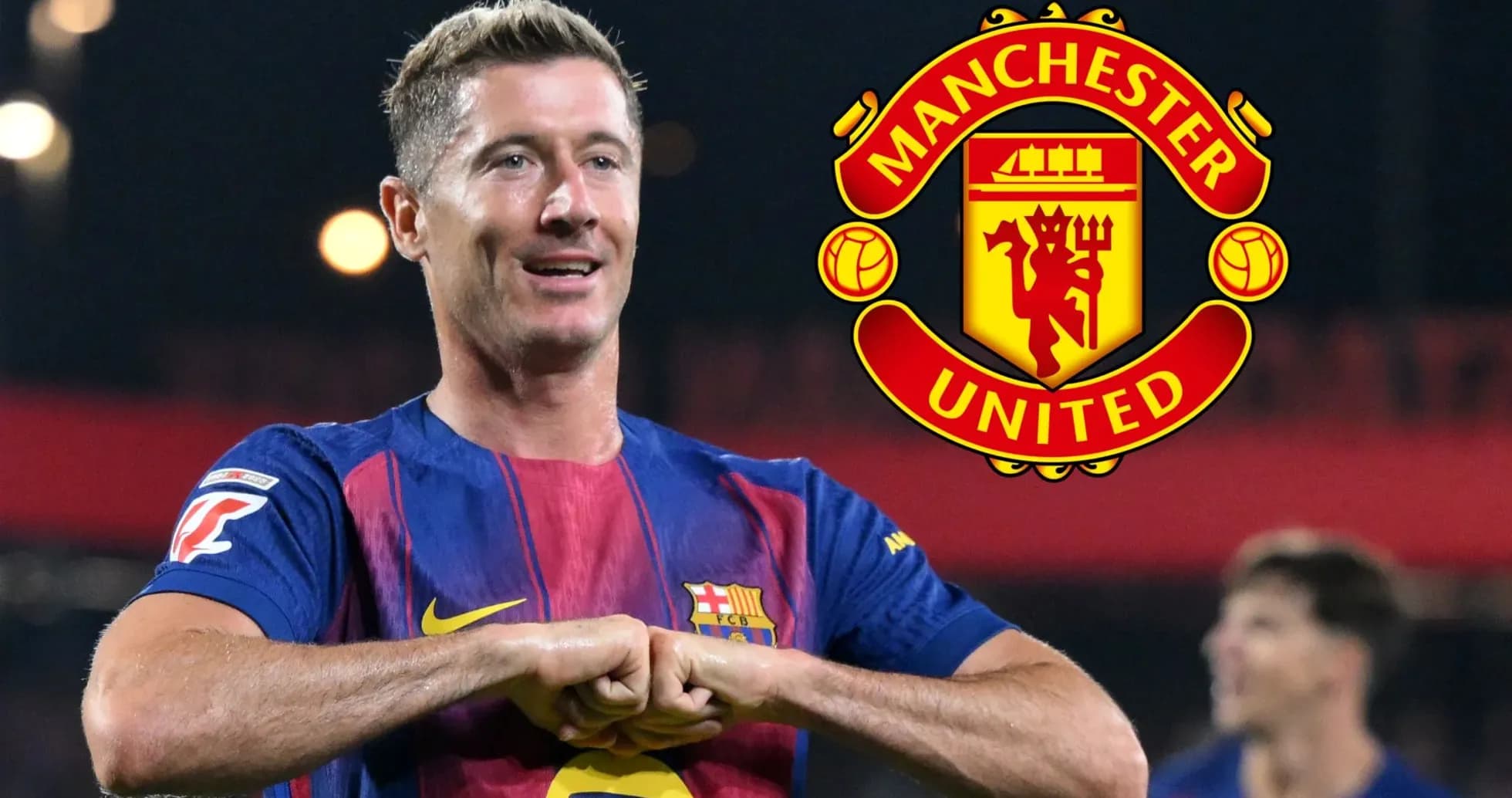
Manchester United's Striker Dilemma: Sesko and Lewandowski
At Old Trafford, the scars of expensive attacking misfires still run deep. Big cheques, bigger promises, not nearly enough goals. But the summer of 2025 felt different. At last, the money started to look well spent.
Matheus Cunha and Bryan Mbeumo injected purpose and productivity into a forward line that had too often looked confused. With Michael Carrick stepping in after Ruben Amorim’s departure, United found something they had been missing for years: a coherent attacking plan that actually hurt opponents. The reward was a charge towards Champions League qualification that didn’t rely on nostalgia or spin, but on numbers and nerve.
At the heart of it, by the time 2026 rolled around, stood Benjamin Sesko.
The Slovenian arrived from RB Leipzig for £74 million, a fee that carries its own pressure at Old Trafford. He responded with 12 goals, 10 of them crammed into just 16 appearances in 2026. That is not the profile of a stop-gap. That is a centre-forward beginning to understand his own power.
United believe there is much more to come from the 22-year-old. They also know what history at this club screams: one striker is never enough when Europe’s elite loom back into view.
Lewandowski on a free: statement or step back?
Enter the name that always stirs a reaction: Robert Lewandowski. One of the great modern No.9s, 109 Champions League goals, and, crucially for United’s accountants, no transfer fee.
On paper, it looks like the sort of opportunistic move that smart clubs make. For Carrick, it could be a shortcut to the kind of know-how that can’t be coached on a training pitch in Carrington. But Old Trafford has never just been about numbers. It’s about fit, about image, about the sense that the next big move is part of a larger plan rather than a short-term grab.
Louis Saha knows that pressure well. The former United striker, speaking to GOAL in association with CasinoNews, didn’t dismiss the idea. He leaned into it.
“I would think about it. He is the type of player who has enormous experience in the Champions League. He will definitely help,” Saha said, pointing to the immediate impact Lewandowski could have in Europe and at home.
For Sesko, Saha sees potential relief as well as rivalry. “In the league, he will enjoy partnering with Sesko, sharing that burden. It will help him a lot. I do think that it will provide leadership as well, high standards. So why not?” he added.
Then came the caveat that every director of football must weigh when looking at a 37-year-old striker.
“His age, I still think that you need to consider this. I think he will definitely provide 15 to 20 goals in some way or another. But for the future, saying that you want to build a team around him, this is where my consideration goes.”
The parallel is obvious and Saha didn’t dodge it. Zlatan Ibrahimovic walked through the same doors in 2016 as a free agent and bulldozed his way to 28 goals, dragging United to the Community Shield, League Cup and Europa League under Jose Mourinho. He was a short-term signing who left a long-term mark.
“With Ibrahimovic when he came, it always was, ‘he will leave in two years’,” Saha recalled. The same logic would shadow Lewandowski from day one. “If you want to manage your first way back in the Champions League, he is a type of name that will impress, and will provide a kind of statement in some way.”
A statement, yes. A cornerstone, no.
Can Sesko and Lewandowski really coexist?
Strip away the romance and the marketing, and one tactical question sits at the centre of this debate: can Sesko and Lewandowski play together, or are United buying a direct rival for their £74m investment?
For Saha, that is where the hesitation creeps in.
“The problem I see is just because Lewandowski still has the same style as Sesko,” he said. Two penalty-box strikers, two focal points, one central lane. That can work in theory, but not without compromise.
“I would love to have a player who could play with him, a bit of a 4-4-2 style, where I don’t see Sesko and Lewandowski playing together. So it will be about sharing the spot a bit more.”
Sharing minutes between a rising star and a modern legend sounds neat. In reality, it can destabilise both. Carrick would face a weekly balancing act between development and delivery, between the future and the now.
“So, that’s why I think I would have preferred someone else in some way,” Saha admitted. Yet he didn’t close the door entirely. For a club stepping back into the Champions League, the blend of youth and experience still has its pull. “Definitely going into that campaign in the Champions League, you need experience, you need that kind of youth and experience as well. So, it is something that could work.”
Something that could work. Not something that must.
The profile United really need
Saha’s mind drifts to a different template when he imagines the ideal forward to stand alongside Sesko. Not another pure No.9, but a runner, a roamer, a destroyer of space.
“I would prefer someone like, I don’t know if I’m saying something crazy, but Kylian Mbappe, or someone that style,” he said. Not Mbappe the name, Mbappe the profile. Devastating pace, movement off the shoulder, the ability to orbit a more traditional striker.
He referenced Olivier Giroud’s partnership with Mbappe for France: the target man who occupies defenders, the star who explodes into the gaps. United, in Saha’s eyes, have always thrived with that kind of dynamic.
“This type of player, this is where Manchester United have always been dangerous,” he explained. “You have Dwight Yorke, who ran around Andy Cole, someone around Ruud van Nistelrooy, and this always worked. Whatever formation, whatever era, this formula works.”
The pattern is clear. One striker pins, the other prowls. One finishes, the other creates chaos. Sesko can be the anchor. United, Saha argues, should be looking for the storm around him, not a mirror image.
Free talent, big decisions
United will not walk into this summer window empty-handed. There is money to spend when the market opens on June 15, and they are not backed into a corner where a free transfer becomes a necessity rather than a choice.
That is what makes Lewandowski such a fascinating test of the club’s new decision-making. Signing him for nothing would free up funds for other problem areas, especially in midfield, where reinforcements are still needed. He would also arrive as a live, breathing masterclass for Sesko, a chance for United to let their young striker learn daily from one of the greats instead of paying again for a “ready-made” No.9 in two years’ time.
The question is not whether Lewandowski can still score. Saha is convinced he can. The question is sharper than that: in a squad finally starting to look like it has a direction, does United’s next iconic striker need to be a mentor, or a partner who unlocks Sesko’s prime?
The answer will say as much about United’s long-term vision as any goal scored next season.