Manchester United Women: Defying the Odds Amid Challenges
“Defy the odds.”
It was designed as a rallying cry. A neat line on a wall, a slogan for a club stepping into Europe for the first time, a message to a Manchester United Women squad trying to elbow their way into the established order of Arsenal, Chelsea and Manchester City.
Instead, it has become an awkward mirror.
Because inside the dressing room and around it, the question has lingered all season: whose odds are they actually defying?
A slogan that cuts both ways
The phrase came from high up in the club’s hierarchy before the 2025-26 campaign, meant to frame a pivotal year. United were in the Champions League at last. They were chasing trophies on multiple fronts. They were supposed to be announcing themselves as permanent members of the elite.
Yet, according to multiple people inside and close to the women’s team, the motto has required a kind of collective double-think. The players are being told to break through barriers that, in part, are erected by their own club — by the way the team is funded, staffed and prioritised.
A familiar refrain has echoed around the set-up this season: “the players deserve better”.
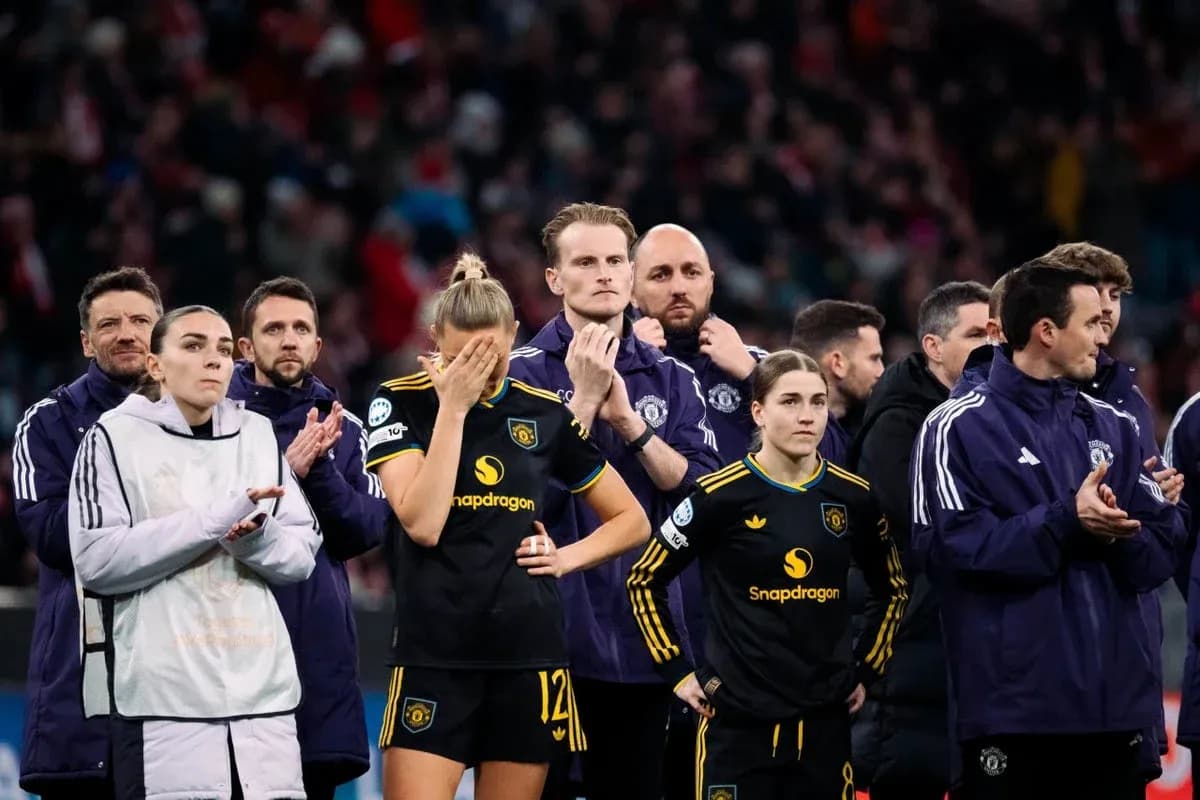
They have been overachieving for years, punching above a budget that trails the division’s heavyweights. That underdog spirit has forged a tight-knit group. It almost carried them to something extraordinary in Munich on Wednesday night.
Melvine Malard’s early strike dragged the Champions League quarter-final back to 3-3 on aggregate with 79 minutes left, against a Bayern Munich side accustomed to this stage. For a spell, United played with the conviction of a team who had finally arrived.
Then the reality of their season caught up with them.
The tank runs dry in Munich
United came out for the second half with a deeper midfield, a bench stripped bare by injuries and fatigue, and just four outfield substitutes. One of them, 18-year-old Jess Anderson, had only just made her Women’s Super League debut at the weekend.
Bayern emerged with fresh legs and intent.
The numbers told the story. United, who had managed six shots and four on target in the first half, mustered only one effort after the break. Their expected goals in that period: 0. Their share of the ball: 24 per cent. Bayern racked up nine shots and an xG of 1.45, pinning United back.
The dam held for most of the night. It finally burst under the most predictable pressure.
Bayern’s 12th and 13th corners of the match brought two late goals and a 5-3 aggregate defeat, exposing a season-long weakness at set pieces that everyone in the league has seen coming. United’s resistance had been heroic. It was also unsustainable.
There is only so long you can hold the line. There is even less time you can keep defying it.
Out of cups, out of Europe – and out of excuses?
The exit in Munich leaves United’s season stripped back to three WSL games and a scrap for a return ticket to Europe. They are out of the Champions League, out of the FA Cup, beaten by Chelsea in the League Cup final. To qualify again, they will likely need to beat Chelsea on the final day and take care of Tottenham Hotspur and Brighton & Hove Albion.
Inside the club, the questions have grown louder. What is the plan to make sure this is not a one-off adventure in Europe? How do United become a team that belongs in these games, rather than one constantly told to defy the odds just to be there?
Senior figures in the women’s set-up and across the executive team have wrestled with those issues all season, according to multiple sources familiar with the discussions.
United did act in the summer. Jess Park, Fridolina Rolfo and Julia Zigiotti Olme arrived. Two other targets slipped away after United were outbid. That shortfall helped trigger internal debate about how to increase investment, including the possibility of external backing.
The need has only grown since INEOS bought a minority stake in December 2024. The new regime has recognised the women’s team requires more resource, but the pace of change has been slow. Sir Jim Ratcliffe admitted last year that the men’s operation had dominated his attention, leaving the women’s project short of his full focus.
This season’s fixture pile-up, on a tight squad, has underlined the cost of that delay.
Investment talks – and closed doors
A March meeting was marked out as a key moment. Senior figures from the women’s side and the wider executive were scheduled to sit down with decision-makers to explore options, including selling a stake in the women’s team to an outside investor.
Club sources say that idea was quickly shut down. No firm proposal emerged. Yet, people close to the talks insist internal conversations have not stopped, and that final recommendations still need to go to the board and the owners.
A subtle rebrand of the women’s team has even been floated in those meetings, though senior leadership are not planning to pursue it.
United are not alone in testing the market. Chelsea Women sold around 10 per cent to Alexis Ohanian for £20million last May, valuing their team at more than £200m. Everton Women brought in Canadian-based GED Investments as minority backers in December. Sunderland Women, as reported in March, are in advanced talks to sell a majority stake to U.S. firm Sixth Street through its Bay Collective platform.
This is the new landscape. United are in it whether they like it or not.
People around the women’s team argue that United have struggled to keep pace with rising wages and transfer fees, hemmed in by budget constraints. Those on the club side counter that this is simply what sustainable investment looks like.
The friction is real. At least two signings completed in January were deals United had originally targeted for the previous summer. One planned addition for this coming window still cannot be finalised because no one has yet signed off the recruitment budget.
Behind the scenes, staff have sent pointed reminders to senior figures, including a screenshot of a matchday bench decimated by injuries against a WSL rival.
A squad stretched to breaking point
The human cost of those numbers is visible on the treatment table.
Dominique Janssen, Ellen Wangerheim, Anna Sandberg, Leah Galton, Elisabeth Terland and Ella Toone have all been sidelined. Against Bayern, midfielder Simi Awujo limped off with what looked like a hamstring problem.
Training has been stripped back to tactical walkthroughs, video work and recovery. Coaches are wary of pushing players any harder in case the injury list grows again.
It would be wrong to say United have not invested at all. Since Marc Skinner took over five years ago, the club have made 37 signings. The women’s operating budget has more than doubled, from just under £5m in 2021-22 to £10.7m in 2024-25.
Those figures can be presented as a model of measured growth. Inside and outside the dressing room, though, some voices draw a sharp line between investing sustainably and investing enough to win.
The gap to the top is stark. Last season, United spent £5.88m on wages. Arsenal spent £11.3m. Manchester City, who finished fourth, reported operating expenses of £14m, £4m more than United’s entire budget. Chelsea’s latest accounts are not yet public, but their previous season — when they won a fifth straight WSL title and reached the FA Cup and Champions League semi-finals — showed an operating budget north of £20m, roughly double United’s.
United are trying to live in the same neighbourhood on half the mortgage.
Skinner’s record under the microscope
On the pitch, Skinner’s tenure is not a failure story. Far from it. In five seasons, United have finished fourth, second, fifth and third in the league. They have reached four major finals and lifted the FA Cup in 2023-24 with a 4-0 win over Tottenham.
But the ceiling is clear. The other three finals all ended in defeat to Chelsea, by a combined score of 6-0. Across the past two campaigns, Skinner has three wins in 17 matches in all competitions against Chelsea, Arsenal and City. Against Chelsea alone, United have one win in their last 19 attempts — that FA Cup semi-final in 2023-24. Skinner’s personal record against the west London club reads one win, one draw and 13 defeats in 15 games.
He signed a new two-year contract last summer and retains the club’s backing. The debate around him, though, has sharpened.
Some people close to the squad question his willingness, or ability, to develop young talent. They argue he prefers established players with significant senior experience. The numbers support that concern. Before 16-year-old Layla Drury made her WSL debut on February 15, United had given players under 21 just 90 league minutes all season — all of them to Wales goalkeeper Safia Middleton-Patel in a 3-0 defeat to Manchester City when Phallon Tullis-Joyce was out with a fractured eye socket.
There are also doubts about what players receive from the touchline. Several sources say attacking patterns are often left to the players to improvise, with limited in-game coaching. Skinner rarely leads technical sessions himself, instead delegating to his staff while he handles broader responsibilities.
In some sessions, coaches have stepped in to play or referee to make up numbers, rather than focus solely on instruction. That is partly a function of the thin squad. It also speaks to a structure stretched to its limit.
Other voices inside the camp paint a different picture. They praise Skinner’s readiness to absorb public criticism, his calm communication and his tactical work, especially in organising the team defensively under constraints. Players who thrive on freedom enjoy the licence he gives them.
But against Europe’s streetwise sides, and the best in England, that looseness has sometimes left United exposed. The second half in Munich was a case study: no attacking outlet, no escape route, just wave after wave of Bayern pressure.
Set-piece scars and tactical gambles
Set pieces have become a running sore. Long-time goalkeeping coach Ian Willcock, who also oversaw defensive set plays and helped United set a WSL clean-sheet record in 2022-23, left last summer as part of a wider staff turnover. He was replaced by Joe Potts, formerly of Liverpool Women.
Since then, the numbers have turned. United went out of the FA Cup with a 2-1 defeat to Chelsea after conceding from a corner in extra time. Bayern’s late brace from corners added another painful chapter.
“We were knocked out in all our games from a set piece, in the FA Cup and now here,” captain Maya Le Tissier told Disney after the Bayern loss. “It’s something we need to work on.”
Skinner’s tactical calls have not escaped scrutiny either. Using striker Elisabeth Terland as a No 10 in the League Cup final against Chelsea raised eyebrows. So did deploying Wangerheim, signed from Hammarby in January as a centre-forward, on the wing.
Wangerheim said in February that she had been told during talks she would be playing as a No 9. The later arrival of Lea Schuller from Bayern complicated that picture, and a club source insists Wangerheim knew she would sometimes be used wide. She admitted she needed “some training sessions and games” to adjust to the flank. The congested schedule has offered little space for either new forward to bed in outside competitive matches.
These are fine margins at the top level. United are trying to manage them while juggling injuries, budget questions and the expectation that comes with their badge.
The chase from below
The end of their first Champions League journey hurts. It also exposes a bigger truth: United are still eight years old as a women’s team, trying to grow into a giant’s shirt.
They will finish this season as they began it, leaning on that mantra on the wall. Three league games to play. A likely need to beat Chelsea for only the second time in 20 attempts to secure another crack at Europe. Victories required over Tottenham and Brighton. No margin for error.
How long can that hold?
Senior figures at three clubs currently below United in the WSL have already identified them as the target to catch next season. They point to United’s financial limits in the market and to what they see as a lack of surrounding infrastructure. The gap between the brand and the backing has not gone unnoticed.
After Bayern, Skinner stood in front of the cameras and framed the reality as he sees it.
“I’m incredibly proud of what my players are doing on resources we have,” he said. “Because we wear Manchester United’s badge, everybody expects us to be the very best team in the world. We have that expectation too. Yet we’ve got to grow because we’re eight years old.
“You (can) give me all the flack. That’s no problem, that’s my job. But if we want to compete at this latter stage, we’ve seen what we’ve got to do, as a club. And then it’s our choice now, isn’t it?”
The slogan on the wall won’t change that. The choice, and the odds, will be set in the boardroom long before the next ball is kicked.