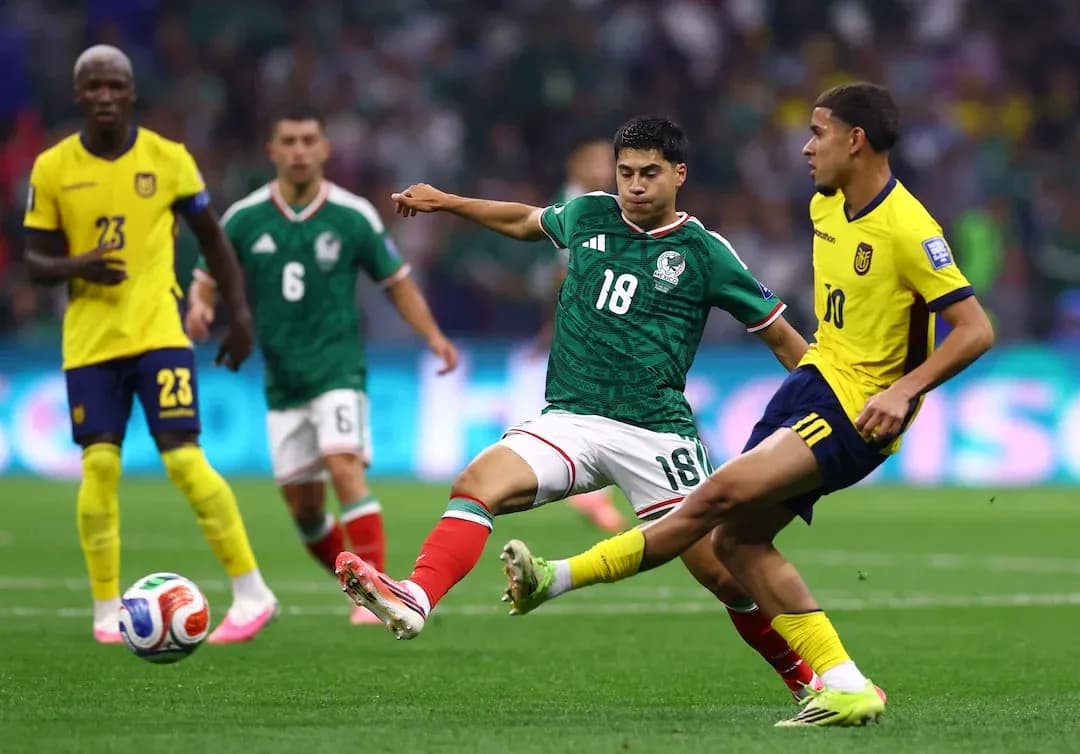
Mexico Outplays Ecuador 2-0 in World Cup Round of 32
Mexico’s 2-0 win over Ecuador at Estadio Banorte in this World Cup Round of 32 tie was a classic example of a team using structure and verticality to out-punch a more ball-dominant opponent. Javier Aguirre’s 4-3-3 accepted a territorial and possession deficit (43% vs 57%) but translated its attacks into cleaner chances and a decisive first-half surge, while Sebastian Beccacece’s 4-4-2 struggled to convert control into threat.
I. Executive Summary
Mexico’s game plan revolved around a compact mid-block, aggressive full-backs, and rapid front-three combinations. Ecuador built more patiently through midfield, completing 407 passes at 84% to Mexico’s 319 at 78%, but finished with only seven total shots and a single effort on target. The match was effectively decided before the interval, with Mexico converting two of their three shots on goal, then managing the second half through structure, substitutions, and game-state control.
II. Scoring Sequence & Disciplinary Log
The breakthrough came on 22 minutes: Julián Quiñones finished for Mexico, assisted by Roberto Alvarado, capping an early pattern of direct, vertical attacks into the channels behind Ecuador’s full-backs. On 31 minutes, the roles reversed in a different combination: Raúl Jiménez struck Mexico’s second, set up by Quiñones, exploiting the space between Ecuador’s centre-backs as the 4-4-2 line was stretched by wide movements.
Discipline tilted heavily against Ecuador and reflected their increasing frustration. At 45+1', Alan Franco received a yellow card for “Tripping”, a first warning sign of Mexico’s forwards provoking late challenges when receiving between the lines. Deep into stoppage time, with Ecuador chasing the game, Kendry Páez was booked at 90+3' for “Tripping”. Two further incidents underlined the emotional unraveling: at 90+5', Piero Hincapié was shown a red card for “Unsportsmanlike conduct”, and at 90+9' Moisés Caicedo was cautioned for “Tripping”. Mexico finished without a single card, underscoring both their control of duels and disciplined game management.
III. Tactical Breakdown & Personnel
Aguirre’s 4-3-3 was built on clear roles. Raúl Rangel (Mexico) in goal faced only one shot on target and made one save, protected by a back four of Jorge Sánchez, César Montes, Johan Vásquez, and Jesús Gallardo. The defensive line held a relatively conservative depth, prioritizing compactness between centre-backs and shielding the half-spaces where Ecuador’s narrow front two, Enner Valencia and Gonzalo Plata, like to receive.
In midfield, Gilberto Mora, Erik Lira, and Luis Romo formed a hard-working trio. Their task was less about long passing sequences and more about screening and triggering transitions. Mexico’s 319 passes were not high-volume, but with 249 accurate at 78%, they were efficient in connecting first and second passes after regains. The xG of 1.02 aligns with the two clean first-half chances they created; the front three consistently received in advantageous positions rather than speculative shooting zones.
The front line of Alvarado, Jiménez, and Quiñones was the tactical heart of Mexico’s plan. Quiñones in particular functioned as a hybrid wide forward and second striker, alternating between pinning Ecuador’s full-backs and darting into the inside channels. His goal and assist capture how Mexico manipulated Ecuador’s back four: Alvarado’s movement from wide into the right half-space for the first goal, and Quiñones’ own central positioning to feed Jiménez for the second, both exploited the gaps between full-back and centre-back.
Substitutions were used by Mexico to stabilize and refresh the structure rather than to chase further goals. At 58', Brian Gutiérrez (IN) came on for Gilberto Mora (OUT), adding fresh legs in midfield. On 73', Obed Vargas (IN) replaced Luis Romo (OUT), maintaining the three-man balance. In attack, Santiago Giménez (IN) came on for Jiménez (OUT) at 74', offering depth running to stretch Ecuador’s high line. Later, at 80', Orbelín Pineda (IN) for Quiñones (OUT) and Israel Reyes (IN) for Alvarado (OUT) signaled a tilt toward control and defensive security, with Reyes allowing a shift toward a more conservative shape to defend the flanks and aerial balls.
Ecuador’s 4-4-2 was more possession-oriented but lacked incision. Hernán Galíndez (Ecuador) made one save, matching Mexico’s three shots on goal but conceding twice, with a goals prevented figure of -0.57 reflecting underperformance relative to the quality faced. The back four of Alan Franco, Joel Ordóñez, Willian Pacho, and Piero Hincapié had to defend wide spaces due to the advanced positioning of wingers John Yeboah and Nilson Angulo. This structural stretch opened corridors that Mexico repeatedly attacked.
In midfield, Moisés Caicedo and Pedro Vite were tasked with progression and control; Ecuador’s 407 passes at 84% show they achieved circulation but not penetration. Their xG of 0.73 and just one shot on target underline how Mexico’s block forced Ecuador into less dangerous areas, often wide and in front of the defensive line.
Beccacece’s second-half substitutions aimed to add dynamism and width. At 46', Yaimar Medina (IN) came on for Franco (OUT) and Ángelo Preciado (IN) for Ordóñez (OUT), seeking more thrust from the right side. On 59', Kevin Rodriguez (IN) replaced Enner Valencia (OUT), adding fresh movement in the channels. At 79', Jordy Caicedo (IN) came on for Yeboah (OUT) and Kendry Páez (IN) for Angulo (OUT), effectively shifting toward a more aggressive, attack-heavy setup. However, with Mexico compact and content to defend deeper, these changes produced more possession than real threat and coincided with the late disciplinary collapse.
IV. The Statistical Verdict
The numbers validate Mexico’s tactical choice to prioritize chance quality over volume. With 15 total shots to Ecuador’s 7 and 10 of those inside the box, Mexico consistently accessed high-value zones. Ecuador, despite superior possession and passing accuracy, produced fewer shots and only one on target, illustrating how sterile their control became against Mexico’s structure.
Defensively, Mexico committed 10 fouls to Ecuador’s 14 and conceded eight corners to their own three, but they defended their box with discipline, reflected in the clean sheet and low xG conceded. The fact that Mexico incurred no cards while Ecuador collected three yellows and one red encapsulates the contrast in emotional and structural control. In a knockout setting, Mexico’s blend of compact defending, efficient transitions, and disciplined game management proved decisively superior to Ecuador’s more expansive but less incisive approach.