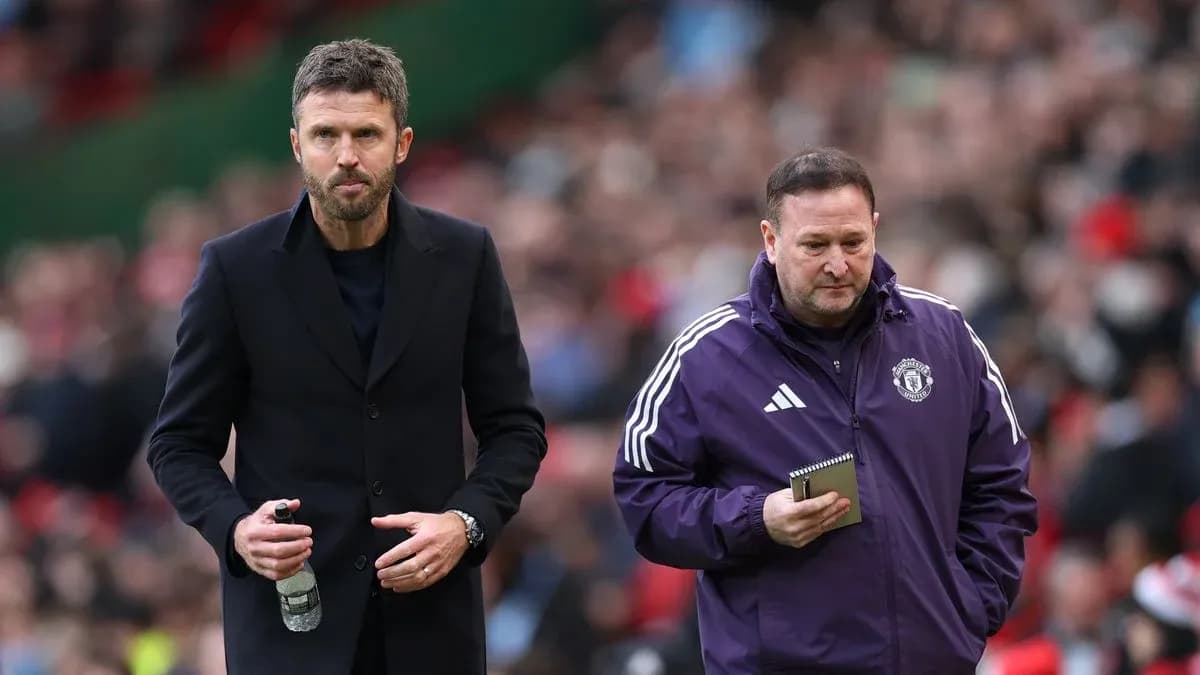
Michael Carrick's Candidacy for Manchester United Head Coach
Michael Carrick insists it was nothing more than a cup of tea and a chat. The rest of football knows better.
The 44-year-old is in pole position to become Manchester United’s permanent head coach this summer, and last week he sat down with co-owner Sir Jim Ratcliffe at Carrington. No contracts. No formal offer. Just a meeting that, in the current climate, carries far more weight than Carrick is willing to admit publicly.
“He came in. We had a chat. We had a cup of tea. Casual chat, to be honest, it was nice to see him showing his support, obviously,” Carrick said. “That was it. It was quite informal, but it was nice to see him.”
On the surface, it sounds routine. Ratcliffe, 73, has become a semi-regular presence at the training ground since taking charge of football operations, and this was framed as another drop-in. Yet the backdrop is impossible to ignore: eight wins and two draws from Carrick’s 12 games, United pushing hard for a return to the Champions League, and a market in which several of the biggest managerial names are unavailable or unwilling.
In that context, a “casual chat” starts to look like something closer to a temperature check on the man already in the hot seat.
A dressing room won over
Carrick’s candidacy is not being built on PR or nostalgia. It is being built on the training pitch.
Players have spoken privately of their admiration for the clarity of his ideas and the intensity of the sessions, remarkable given the way his staff was pieced together at short notice in January. What could easily have felt like a stopgap has instead looked like a structure.
He brought Jonathan Woodgate with him from his Middlesbrough spell, leaned on his long-standing relationship with Jonny Evans from their playing days at Old Trafford, and accepted the experience of Steve Holland as his No. 2 despite never having worked with him before. Travis Binnion, promoted from the academy, completed a coaching group that might have looked improvised on paper.
On the grass and in the cramped coaches’ office, it has clicked.
“Even though we came together specifically for the role here, we're all very clear in terms of what it looks like,” Carrick explained. “It's not something that we need to overly discuss, to be honest. I think we're all on the same page.
“We know it. It's pretty obvious, you know. I keep saying the same things in some ways every week, but it is what is. We're right, we're fine with that, and the coaches are fine with that.”
This is where Carrick’s approach is clearest. Not in slogans, but in how he talks about people.
“Sometimes you connect with people and you get on and you work together and you work well. For me, it is all about people, whether that's players or staff or supporters, family, whatever it is. I think connecting with people is really important to try and get the best out of each other.
“I have to say the staff have been absolutely top-class in different ways, different personalities, different roles. To come together in a coaching office that's not much bigger than the desk, to be around the desk day in day out when it's new and it's fresh takes a lot of effort, but credit to everyone, it's been all positive since we came together in January.”
That last line matters. If Ratcliffe and his football executives decide Carrick is the man to lead the project long term, the head coach wants this group around him. Continuity of ideas, continuity of faces. United have had too little of both in the last decade.
A club trying to feel connected again
Carrick talks repeatedly about connection. It is not a throwaway line.
“I think as a football club we're hugely connected all the way through,” he said. “I think it's a big part and I’m really conscious of that's how it should be, and I am trying to do my part with that, as well as is everybody else. So, I've felt that since I've been here since January for sure.”
United, under their new structure, are desperate to rebuild that sense of alignment: ownership, football department, staff, players, supporters. Carrick, a former club captain in all but name, understands the nuances of that better than most. His calm authority and understated presence sit in sharp contrast to some of the chaos that has engulfed the club in recent years.
The results have given him a platform. The dressing room has given him its backing. The coaching staff, assembled in a hurry, has given him a framework that works.
All that remains is the decision from upstairs.
Ratcliffe and his team will continue to survey the landscape, but with the elite managerial market tight and United’s form surging under a man who already feels at home in the dugout, the picture is becoming clearer by the week.
The meeting may have been over “just” a cup of tea. The next one might define Manchester United’s future.