Morocco Dominates Canada 3-0 to Reach Quarterfinals
HOUSTON — Morocco no longer knocks on the door of football’s elite. It walks straight through it.
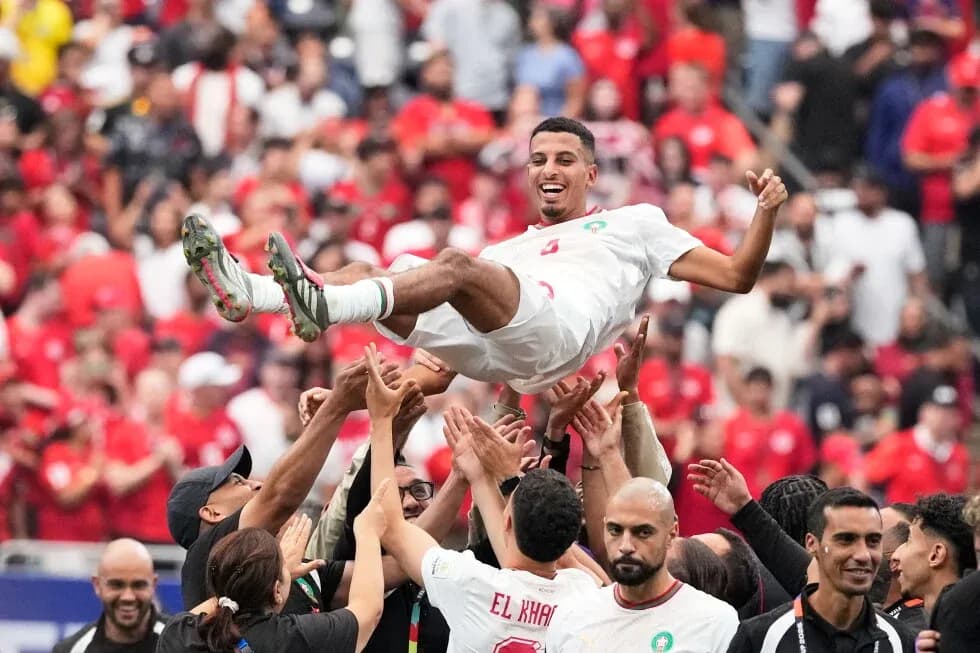
Azzedine Ounahi struck twice in the second half and Soufiane Rahimi added a late flourish as Morocco overpowered Canada 3-0 in the World Cup round of 16 on Saturday, booking a second consecutive trip to the quarterfinals and tightening its grip on history.
This is no one-off. No fairy tale. Not anymore.
“We are no longer a surprise,” coach Mohamed Ouahbi said through a translator. “Now when people talk about Morocco we’re a major contender and it’s a great source of pride. I think it’s only the beginning and I hope we continue to have runs like this.”
They have already gone where no African nation has gone before — a semifinal in 2022. Now they are the first African team to reach the quarterfinals more than once. The pattern is no accident, and Ouahbi knows it.
“We want to keep going,” he said. “We don’t want to stop.”
Ounahi breaks it open
For 45 minutes, Canada refused to yield. The co-hosts pressed high, snapped into challenges and, for long stretches, dictated the rhythm. Morocco absorbed it, waited, and trusted its quality.
The breakthrough came five minutes after the restart.
Achraf Hakimi stood over a free kick and clipped it short into a crowded area. The ball rolled to Ounahi, who took aim from outside the box and drilled a right-footed shot low through traffic into the bottom-right corner. One touch. One clean strike. One ruthless reminder of the gap in pedigree.
Canada wobbled but did not immediately collapse. Jesse Marsch’s side kept pushing, kept the ball, and kept believing. The chances finally came.
In the 78th minute, Jonathan David stood over a free kick from outside the box with a sliver of hope. His effort, though, sailed over the bar. Moments later, Tajon Buchanan tried from distance, hammering a drive from about 30 yards. Yassine Bounou, born in Canada to Moroccan parents, flung himself to his right and clawed it away.
That was Canada’s moment. Bounou shut it down.
The goalkeeper finished with three saves and another statement performance on a stage he has grown used to owning.
“We are so proud to represent Africa because it’s a continent with a lot of talent and Africa deserves to be in the best level in football,” Bounou said.
Clinical where it counts
While Canada chased, Morocco killed.
In the 82nd minute, Brahim Díaz slipped a ball into the heart of the area. Ounahi arrived, unmarked and unhurried, and swept a right-footed finish from the middle of the box to make it 2-0. Where Canada had rushed, Morocco stayed cold.
By then, the contest felt decided. The scoreline still had one sting left.
Deep into stoppage time, with Canada stretched and spent, Rahimi pounced to add a third. A final, emphatic mark on a night that will be remembered in Morocco far more fondly than in a country where hockey usually owns the sporting imagination.
The 3-0 result sends Morocco to Thursday’s quarterfinal at Boston Stadium, where they will meet the winner of the Paraguay-France tie. Whoever emerges knows exactly what awaits: a hardened, battle-tested side ranked sixth in the FIFA standings and utterly unafraid of the sport’s traditional powers.
Canada’s historic run meets a hard ceiling
For Canada, the journey ends, but not without leaving a footprint.
This was only the nation’s third World Cup appearance and its first-ever knockout win came earlier in the tournament, a 1-0 victory over South Africa that lit up a country still learning the rhythms of the global game. The run was historic. The gap at this level, though, remains brutal.
“I told them that I was proud of them and I challenged them to understand that we can play like this all the time against the best teams in the world,” Marsch said. “We can be better on the day. And then the challenge is, can we hold that standard for 90 minutes?”
Canada did it without Alphonso Davies for almost the entire tournament. The Bayern Munich star managed only 15 minutes as a substitute against South Africa before a hamstring injury sidelined him again.
“His hamstring didn’t feel right,” Marsch said. “We were hoping that by the time he woke up this morning that he would feel better, but he didn’t.”
Even shorthanded, Marsch bristled at the idea that his team had been outplayed everywhere except the scoreline. Morocco, he noted, had needed penalties to get past the Netherlands in the previous round, knocking out a European heavyweight early. Facing the No. 6 team in the world, he saw more than just effort from his players.
“The way we pushed, the way we were in the match, the quality we showed, the overall impact in the match, we were better,” he said. “We were better than the No. 7 team in the world today.”
Ouahbi did not let that pass.
“In terms of intensity they were good,” he replied. “They were good for 98 minutes. Were they better? It’s hard to say. It takes some nerve to say that when you lose 3-nil.”
Fire, bruises, and no apologies
The match itself carried an edge from the opening whistle. Eight yellow cards flew — four to each side — in a contest that often looked like a test of nerve as much as skill.
In the 40th minute, Hakimi and Richie Laryea clashed, tempers flared, and a brief scuffle broke out. Both went into the book. No one backed down.
Morocco suffered a setback when midfielder Ismael Saibari limped off with an injury in the 22nd minute, an early blow to Ouahbi’s plans. The structure held. The replacements slotted in. The level never dropped.
This was also a reunion of sorts. The two sides met in the group stage of the last World Cup, where Morocco’s 2-1 win helped fuel a run that ended with a fourth-place finish and a seismic shift in how African football is perceived.
Two years on, the stakes were higher. So was Morocco’s authority.
Africa’s standard-bearer marches on
Morocco’s ascent now carries a wider weight. Each knockout win is another answer to a long-standing question about African teams at the World Cup: can they not only shock the world once, but stay at the top table?
Twice in a row, Morocco has replied.
They have the scars of a semifinal run, the calm of a side that has already toppled giants, and a coach unafraid to say out loud what his players now believe.
They are not done.
Next stop: Boston Stadium, a quarterfinal, and another chance to stretch the limits of what an African team can do on the biggest stage.